Le Cavalier de Coupe: A Bareheaded Rider Carrying a Golden Cup
In brief
- The core strength is your role as a mediator and communicator, who naturally bridges ideas and people.
- The central tension is that communication is tied to travel, but the reversed orientation does not reverse the meaning, it only attenuates the journey.
- When reversed, you still communicate, but travel is blocked, leading to a sedentary state where the social role is played from a fixed point.
- The specific rule of this knight is that the reverse attenuates, never reverses, so the connection remains intact while the displacement is suspended, holding the paradox of a stationary mediator.
Contents
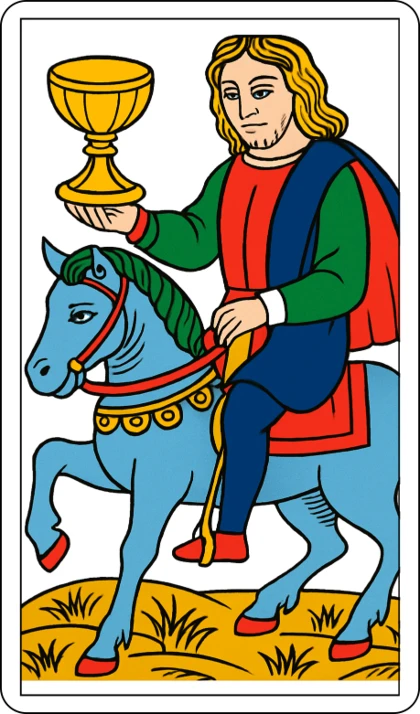
This minor honor from the Cups suit shows a rider on a blue horse, holding a cup raised flat on his hand. Upright, the card signifies communication, friendly contact, and a role as a mediator. Reversed, it does not invert that meaning; the card signifies a slower communication and an opposition to travel, leaving a settled, stay-in-place quality.
| Suit | What it covers | Cards | Symmetrical plates |
|---|---|---|---|
| Batons | feeling, mood and the quality of emotions | 14 | 9 |
| Cups | affective life and matters of the heart | 14 | 0 |
| Swords | working life and the field of activity | 14 | 2 |
| Coins | material life and money matters | 14 | 7 |
| Total | 56 | 18 |
This axis is not the Golden Dawn's elemental grid: this school places feeling on the batons and working life on the swords.
The Card Face
On the Marseille plate, the image shows a rider on a blue horse walking toward the left. The rider is bareheaded, with long hair. He holds a golden cup raised flat on his open hand. The ground beneath the horse is ochre. The card carries no printed legend, no number, and no other figure. That is all the image gives: a person, a horse, a cup, and the ground.
What the Card Says
Le Cavalier de Coupe is one of the sixteen honors in the Marseille Tarot, a figure card rather than a numeral. Unlike the forty numeral cards, which show only repeated suit symbols and ornament, this card carries a person. That person is not a king or a queen; he is a rider, a figure of movement and delivery. In the Cups suit, the cup is the object he carries, and the cup is not a weapon. It is a vessel, something held out, something offered.
This card signifies communication as a social act. The rider does not charge or attack; he moves forward with the cup held flat, as if presenting it. The image indicates a person who knows how to carry a message, how to bring people together, how to make an introduction. The cup is not hidden or clutched; it is visible, balanced on the hand. That visibility matters: the card signifies not private feeling but shared exchange.
Because the rider is bareheaded, there is no crown, no helmet, no rank. The card does not signify authority or command. It signifies approachability. The long hair and bare head give the figure a quality of openness. The blue horse, walking rather than rearing, reinforces a steady, unhurried pace. This is not a card of conquest; it is a card of carrying something to someone.
Upright
Upright, Le Cavalier de Coupe signifies first communication. The card signifies a role of speaking, introducing, explaining, or connecting people. The card signifies a good mediator, someone who can put ideas into words that others can receive. It signifies friendly encounters and the kind of contact that builds trust. The card signifies a social role, not as a performer but as a link between people.
As an accessory meaning, the card can signify travel for pleasure, especially travel to see friends or family. It can also signify a move to a region with existing emotional ties or relationships. These meanings are secondary; they do not replace the core of communication, but they extend it. The rider is in motion, and that motion can be literal.
Reversed
Reversed, the meaning of Le Cavalier de Coupe is slightly attenuated. Communication does not disappear; it is slowed. The card still signifies contact and exchange, but the pace is reduced, the openings are fewer, the words come more slowly. It does not signify silence or hostility. It signifies that the same current runs, but with less force.
The reversed card also signifies an opposition to all travel. Where the upright rider moves, the reversed rider stays. This is a card of sedentariness, of remaining in place. Reversed, the card does not signify a journey; it indicates an absence of movement. This is the one rule of rank for the minor cards, and it holds across all four suits: the reversed honor does not reverse its meaning, it attenuates it and signifies an opposition to displacement.
What Nuances This Reading
The upright and reversed orientations of Le Cavalier de Coupe are independent: the reversed does not negate the upright meaning but attenuates it and signifies an opposition to travel. The card’s core signification of communication remains constant, but the pace and direction change. The bareheaded rider and the walking blue horse reinforce a steady, open quality that distinguishes this card from other honors.
Frequently Asked Questions
Is Le Cavalier de Coupe a person or a situation?
It can be either. As a figure card, it often signifies a person with a mediating, communicative quality. It can also signify a situation of contact, introduction, or travel for pleasure.
Does reversed mean the opposite of upright?
No. The reversed Le Cavalier de Coupe does not signify failed communication or hostility. It signifies the same communication, but slower, and an opposition to travel. The meaning is attenuated, not inverted.
Can this card predict a move or a trip?
Upright, it can signify travel for pleasure or a move toward people one already knows. Reversed, it signifies an absence of travel and staying put. But no card sets a date or a duration.
How is this Knight different from the other Knights?
Each Knight carries a different object. Le Cavalier de Coupe carries a cup, a vessel for offering and receiving. That makes this card signify communication and social exchange, not conflict, work, or material gain. The bare head and the walking blue horse reinforce a steady, open, unhurried quality.