Six of Cups: The Marseille Tarot’s Card of Mutual Love and Its Frustrated Reverse
In brief
- Reciprocal love is the card’s core promise, guaranteeing a sincere and solid exchange where giving and receiving are perfectly balanced.
- The central tension is frustration versus reality, where a partner’s unavailability or your own excessive demands create the sense of a one-way love.
- This card holds the paradox of objective reality and subjective perception, so the same situation can be a solid bond or a painful void depending on the lens.
- It signifies the state of emotional exchange, it does not act, but it reveals whether the person is loved or merely longing.
Contents
- The Card’s Image
- What the Card Signifies
- Upright
- Reversed
- What Nuances This Reading
- Frequently Asked Questions
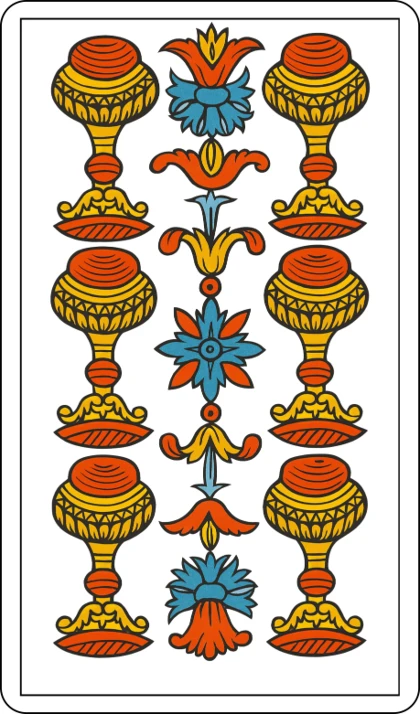
The Six of Cups is a minor numeral from the Cups suit of the Marseille Tarot. On the card, six stemmed cups stand in two columns of three among flowering rinceaux, with no person and no printed number. Upright, it signifies pure, shared, reciprocal love; reversed, it points to emotional frustration and one-sided affection.
| Suit | What it covers | Cards | Symmetrical plates |
|---|---|---|---|
| Batons | feeling, mood and the quality of emotions | 14 | 9 |
| Cups | affective life and matters of the heart | 14 | 0 |
| Swords | working life and the field of activity | 14 | 2 |
| Coins | material life and money matters | 14 | 7 |
| Total | 56 | 18 |
This axis is not the Golden Dawn's elemental grid: this school places feeling on the batons and working life on the swords.
The Card’s Image
On this Marseille numeral, six cups with a bowl at the top and a foot at the bottom are arranged in two vertical columns of three. Flowering rinceaux weave between and around the cups. No human figure, no narrative scene, and no printed numeral appear anywhere on the card. The rank is read by counting the cups themselves.
What the Card Signifies
The Six of Cups belongs to the forty minor numerals, cards that carry no illustration of a scene. Their meaning comes from the number and the suit. Six is a number of balance and exchange, and the Cups suit speaks of feelings, bonds, and emotional life. The symmetrical arrangement of two columns of three suggests a mirror: what one gives, one receives. The flowering rinceaux add a note of natural growth, an affection that unfolds without force.
Because no person appears, the card does not describe a specific individual or a dramatic event. It describes a quality of relation. The six cups are identical, evenly spaced, each with its foot firmly planted. This visual equality points to a bond where both sides hold the same weight. The card signifies an emotional state in which love is not a demand or a chase but a settled, mutual recognition.
The Six of Cups is not about the first spark of attraction or the pain of loss. It sits in the middle of the suit, after the turbulence of the lower numbers and before the complexity of the higher ones. It signifies a moment of emotional clarity, where the feeling is clean, sincere, and returned. The absence of any human face means the card does not indicate who loves whom; it tells you that the love itself is reciprocal.
Upright
The upright Six of Cups signifies the axis of reciprocity. In order of importance: first, it signifies pure, sincere, and shared love. The person involved loves and is loved in return, without hidden conditions. Second, it points to the fact of loving and being loved as a single experience, not two separate acts. Third, it indicates reciprocity of feelings: what one gives comes back in equal measure. This is one of the strongest cards in the Cups suit for matters of the heart, because it signifies solidity and sincerity in love. The bond is not fragile or one-sided; it rests on mutual recognition.
Reversed
The reversed Six of Cups signifies the axis of frustration, and it is not the simple negation of the upright. It signifies emotional frustration, a state where the exchange of feeling is uneven or absent. The person may love without being loved in return, or may wait for a partner who is emotionally unavailable or physically absent. The frustration can be real: the other person does not share the feeling. It can also be perceived: the person is loved, but their expectations are so high that they cannot feel the love that is actually present. The reversed card points to a one-sided bond, a love that flows in only one direction, or to a gap between what one wants and what one receives.
What Nuances This Reading
A single card never makes a reading. The Six of Cups has its full meaning determined by its position in a spread, the cards around it, and the question asked. In a position about the past, the upright meaning may point to a memory of mutual affection; in a position about an obstacle, the reversed meaning may dominate. Surrounding cards can specify whether the frustration is external, such as an absent partner, or internal, such as excessive demands. The question also matters: asked about work, the reciprocity may read as fair exchange or collegial support; asked about love, it reads as mutual feeling. But no card carries a fixed duration or a date; only the position in a spread can frame time, and this page describes no spread.
Frequently Asked Questions
Does the Six of Cups always mean romantic love?
No. The Cups suit covers all emotional bonds, so the card can point to friendship, family affection, or any relationship where feeling is given and received. Its core is reciprocity, not romance specifically.
Is the reversed Six of Cups just the opposite of the upright?
No. The reversed card carries its own meaning of frustration and one-sidedness. It does not simply mean the absence of love; it points to a specific experience of emotional imbalance, whether real or perceived.
Why does the card have no people on it?
Marseille minor numerals are ornamental, not narrative. They show only the suit symbol repeated as many times as the rank, surrounded by rinceaux and flowers. The absence of a human figure means the meaning comes from the number six and the Cups suit, not from a depicted scene.
Can the reversed card mean the person is imagining the lack of love?
Yes. The frustration may be real, but it can also come from the person’s own expectations. Someone who is too demanding may not feel the love that is actually present, so the reversed Six of Cups can point to a perception problem as much as a real one.