Le Roi de Coupe: The Veiled Offer of the Marseille Tarot
In brief
- The King of Cups is a seduction and charm card: it points to a period of encounters, a desire for novelty and change, where your emotional presence draws people toward you.
- The central tension is between this charm and emotional satisfaction: when you rely only on your charm, you may not find solutions that truly address your problems, and the situation can worsen.
- The card can designate a man of heart, a father, a lover, a beloved, whose charisma opens doors when upright, but when reversed becomes a source of weariness and difficulty for him.
- The line of direction is mastery of your own heart: the King of Cups is not a passive state, but an active skill to charm and to change, with the warning that this skill can become a trap of dissatisfaction if you avoid the deeper causes of your restlessness.
Contents
Le Roi de Coupe is a minor honor of the Cups suit in the Marseille Tarot, a figure card that bears a person rather than a number. Upright, it signifies seduction, charm, and the pull toward novelty. Reversed, it signifies a distinct axis: emotional dissatisfaction, the sense that no solution fits, and a weariness that deepens rather than resolves.
| Suit | What it covers | Cards | Symmetrical plates |
|---|---|---|---|
| Batons | feeling, mood and the quality of emotions | 14 | 9 |
| Cups | affective life and matters of the heart | 14 | 0 |
| Swords | working life and the field of activity | 14 | 2 |
| Coins | material life and money matters | 14 | 7 |
| Total | 56 | 18 |
This axis is not the Golden Dawn's elemental grid: this school places feeling on the batons and working life on the swords.
The card
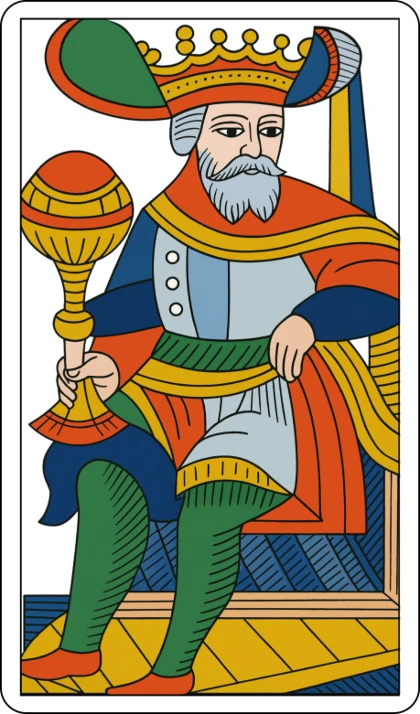
A bearded king sits, crowned beneath a wide hat, wrapped in a red cloak. In one hand he holds a covered cup raised high. The plate bears no legend, no number, no inscription. The cup is not open; it is veiled, its contents hidden. The king’s posture is seated, stable, but the raised cup suggests a vertical tension: something is offered, yet kept under cover. The red cloak is a field of warmth and presence. The crown sits under the hat, authority softened or partially concealed.
What the card says
Le Roi de Coupe shows an emotional authority that passes through veiling. The covered cup is the heart of the image: what is offered is not fully revealed. This is not deception, but a kind of reserve that makes the offer more potent. Seduction, in this card’s language, is not about exposure but about the tension between what is shown and what is withheld. The king’s charm lies in this gap. He does not pour the cup; he holds it aloft, covered, as if to say: there is something here, but you must come closer to know it.
The red cloak signifies warmth, vitality, presence. The seated posture signifies stability, of someone who does not need to move to attract. The crown under the hat suggests that authority here is not flaunted; it is worn lightly, almost privately. This card signifies emotional intelligence that holds back, that creates desire through restraint.
Upright
The upright Le Roi de Coupe signifies the axis of seduction. It signifies encounters, the pull of charm and the desire for novelty. The person who embodies this card knows how to attract without forcing, how to offer without emptying. There is a playfulness here, but it is a playfulness with depth: the covered cup means that what is offered is never fully given away. The desire for change, for something new, is not restless; it is a deliberate turning toward what is not yet known.
This card can also signify a man of heart: a father, a husband, a beloved. Not necessarily a romantic figure, but someone whose emotional presence is central, whose warmth is felt even when his full contents remain veiled.
Reversed
The reversed Le Roi de Coupe signifies the axis of dissatisfaction. This is not the negation of the upright; it is a different territory entirely. Here, the covered cup is a symbol of what cannot be accessed, of emotional resources that are present but unreachable. The person feels an emotional dissatisfaction, a sense that no solution fits the problem at hand. The charm that once attracted now feels like a performance that has worn thin. The desire for novelty, when reversed, is a weariness: the search for change has not led anywhere, and the situation has worsened rather than improved.
The king’s stability is rigidity; his reserve is withdrawal. This card can also signify a man of heart, a father or husband, who is going through difficulties, whose warmth is still there but whose cup remains stubbornly covered.
What nuances this reading
Le Roi de Coupe is a card of reserve and veiled offering. Its upright meaning is seduction through what is withheld; its reversed meaning is dissatisfaction through what cannot be accessed. The covered cup is the central image: it shows that emotional resources are present but not fully given. The red cloak and seated posture reinforce the same tension between warmth and restraint. There is no sequence or duration in this card; it signifies a state, not a process.
Frequently asked questions
Is Le Roi de Coupe always a man?
No. The figure on the card is a king, but the card can signify any person whose emotional authority is expressed through reserve and veiled offering. The man of heart is one possible meaning, not a rule.
What does the covered cup mean?
The covered cup is the central image of this card. It means that what is offered is not fully revealed, that emotional resources are held in reserve. Upright, this reserve is seductive; reversed, it is a source of frustration.
How is the reversed Le Roi de Coupe different from the upright?
They are two independent meanings, not opposites. The upright signifies the axis of seduction and the pull toward novelty. The reversed signifies the axis of dissatisfaction, the sense that no solution fits, and a deepening weariness. One is not the failure of the other; they are different territories.
Can this card signify a specific person?
Yes, it can signify a man of heart: a father, a husband, a beloved. Upright, this person is charming and warm; reversed, this person is going through difficulties, his warmth present but his cup covered.