Seven of Cups in the Marseille Tarot: The Blossoming of Desire and the Risk of Rupture
In brief
- Emotional fulfillment is the upright core: you feel happy and in harmony, whether single or in a couple, with communication flowing freely.
- The central tension of this card: the same cups that overflow when upright show, when reversed, conflict, failure, separation, or the thought of divorce.
- The card signifies your state, it doesn’t act: you are the one who exchanges, connects, or withdraws, and the card only mirrors that.
- A reversed Seven of Cups is not definitive: the rupture only becomes final if other cards in the spread confirm it, so you hold the outcome open.
Contents
- The Card Face
- What the Card Signifies
- Upright
- Reversed
- What Nuances This Reading
- Frequently Asked Questions
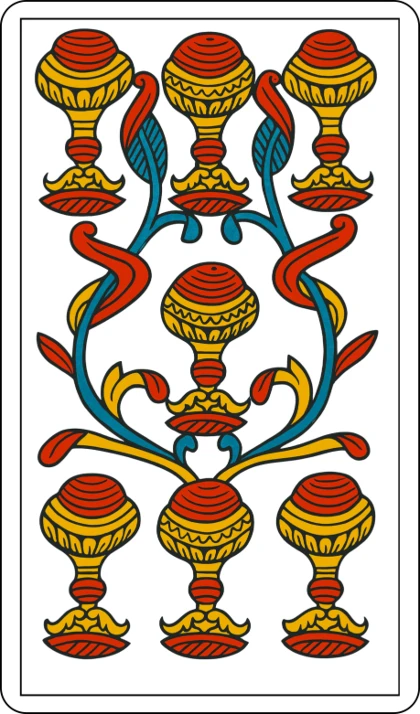
The Seven of Cups is a minor numeral of the Cups suit in the Marseille Tarot. Upright, it signifies emotional blossoming, the realization of desires, and harmony in affective life. Reversed, it carries an independent meaning of relational failure, conflict, and possible separation. The card face contains no scene, only seven cups among flowering scrollwork.
| Suit | What it covers | Cards | Symmetrical plates |
|---|---|---|---|
| Batons | feeling, mood and the quality of emotions | 14 | 9 |
| Cups | affective life and matters of the heart | 14 | 0 |
| Swords | working life and the field of activity | 14 | 2 |
| Coins | material life and money matters | 14 | 7 |
| Total | 56 | 18 |
This axis is not the Golden Dawn's elemental grid: this school places feeling on the batons and working life on the swords.
The Card Face
The card face contains seven stemmed cups, each with the bowl at the top and the foot at the bottom. They are arranged in a clear pattern: three cups in the upper register, one cup in the center, and three cups in the lower register, all woven among flowering scrollwork. There is no human figure, no narrative scene, and no printed numeral in the margin. The number seven is read directly from the cups themselves. This is the ornamental language of the Marseille minors: a numeral card repeats its suit sign as many times as its rank, surrounded by vegetal decoration, and nothing else.
What the Card Signifies
In the Marseille tradition, a numeral card does not depict a situation; it presents a pattern of receptacles. The image of the Seven of Cups is seven open cups, all upright, all evenly distributed among growing foliage. You read in this pattern a state where the emotional field is full without being overloaded. The cups are empty, which points to receptivity and capacity, not to lack. The flowering scrollwork around them indicates organic growth, a life that expands from within. This card is timeless; it describes a quality of being.
The symmetry of three, one, three matters. The central cup is a pivot between the upper and lower triads, giving the whole a sense of balance and integration. There is no conflict in the image, no broken stem, no overturned vessel. The Seven of Cups therefore signifies a condition in which desire, feeling, and communication are aligned. It is not a card of fantasy or illusion, as some other decks imagine; it is a card of lived satisfaction.
Upright
The upright Seven of Cups signifies emotional blossoming. The person is in a state where their desires find realization, not through strain but through alignment. This is a condition of feeling good in one’s affective life, whether single or in a couple. This state does not require a partner; it describes an inner harmony that radiates outward. The seven cups, all upright and evenly spaced, are a sign that the emotional receptacles are full and balanced.
Communication is favored. Exchanges with others feel nourishing rather than draining, and the person is at ease with themselves and with those around them. The upright meaning includes the realization of desires, a sense of being in the right place emotionally, and a natural flow of give and take. This is not a promise of future happiness; it is a sign of a present state of fulfillment.
Reversed
The reversed Seven of Cups has its own axis: relational failure. It does not mean the absence of the upright state; it describes a different condition altogether. The pattern of seven cups, read in reverse, is a sign of a disturbance in the emotional field. The vessels no longer hold together, the flowering scrollwork becomes tangled. You read here conflicts between partners, a relationship that fails to sustain itself, a growing distance.
The reversed meaning includes separation, rupture, and sometimes the thought of divorce. But a rupture is not definitive unless other cards in the spread confirm it. Alone, the reversed Seven of Cups describes strain and disarray, not a final outcome. It signifies communication breakdown and a loss of harmony, where exchanges become difficult and the emotional bond weakens. This is not a punishment; it is a sign that the emotional structure is under pressure.
What Nuances This Reading
The Seven of Cups is never read alone. Its meaning changes according to where it falls in a spread, which cards touch it, and what question is asked. In a position about the past, the upright sense may describe a period of emotional fulfillment already lived. In a position about obstacles, the reversed sense may point to a relational conflict that needs attention. The surrounding cards are read as confirming or softening the rupture indicated by the reversed position. A card of stability nearby is read as suggesting that a separation is temporary, while a card of ending is read as confirming it.
The question also matters. Asked about work, the Seven of Cups speaks less of romance and more of satisfaction in exchanges and creative flow. Asked about love, it speaks directly to the state of the bond. No single card carries a deadline or an outcome; only the position in a spread frames time.
Frequently Asked Questions
Does the Seven of Cups show a person choosing between seven options?
No. That is the image from another deck. The Marseille Seven of Cups contains only seven cups and flowering scrollwork, no person, no scene. The meaning comes from the pattern, not from a narrative.
Is the reversed Seven of Cups just the opposite of the upright?
No. In the Marseille tradition, each orientation carries an independent meaning. Upright it signifies emotional blossoming; reversed it signifies relational failure, conflict, and possible separation. They are two distinct axes, not one blocked energy.
Does the reversed Seven of Cups always mean divorce?
No. It can point to separation or the thought of divorce, but a rupture is only definitive if other cards in the spread confirm it. Alone, it describes strain and conflict, not a final outcome.
Can the Seven of Cups predict when something will happen?
No. A card is timeless. Only its position in a spread can frame a duration. This page describes the card’s meaning, not a timeline.