Ten of Cups: The Upright Vessels and the Cup Laid Down
In brief
- The Ten of Cups is the card of return and reunion, it signifies a reconnection with people from your past, family, friends, or a former partner, and the promise of resuming what was left unfinished.
- Its reversed form signifies the opposite: a slow, gentle withering, where desire fades and the relationship evolves naturally toward separation without anyone noticing.
- The card holds a paradoxical tension: you can either actively reach out to reconnect or passively let things fade, and the same situation can go either way.
- The reversed card is insidious and pernicious, its effect is quiet and gradual, but with vigilance, you can catch the fading early and arrange things before it is too late.
Contents
The Ten of Cups in the Marseille Tarot is a minor numeral from the suit of Cups. It shows ten cups arranged in a precise pattern, with one cup lying on its side. Upright it signifies return and reunion; reversed it signifies a quiet fading of connection.
| Suit | What it covers | Cards | Symmetrical plates |
|---|---|---|---|
| Batons | feeling, mood and the quality of emotions | 14 | 9 |
| Cups | affective life and matters of the heart | 14 | 0 |
| Swords | working life and the field of activity | 14 | 2 |
| Coins | material life and money matters | 14 | 7 |
| Total | 56 | 18 |
This axis is not the Golden Dawn's elemental grid: this school places feeling on the batons and working life on the swords.
The Card
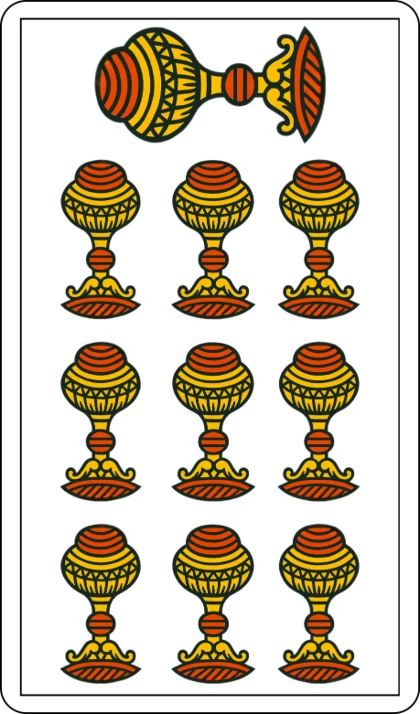
On the Marseille Ten of Cups, you see nine upright stemmed cups arranged in three rows of three. Above them, a tenth cup lies on its side, placed horizontally across the top of the card. There is no person, no scene, no printed numeral. The number is read by counting the cups themselves. The design is ornamental, with foliage and scrollwork around the repeated suit symbols. This is a numeral card, one of forty in the minor arcana, and it carries no narrative illustration.
What the Card Means
As a numeral of Cups, this card concerns the realm of feeling, attachment, and emotional bonds. The ten cups are not a story; they are a pattern. Nine cups stand upright, full and ordered. The tenth cup is set down horizontally, no longer held upright. This single detail shifts the whole reading. The upright cups suggest a gathered fullness, a circle of shared feeling. The cup laid across the top suggests a pause, a rest, or a deliberate setting aside.
The Ten of Cups carries a specific tension. It is not a card of generic happiness or family bliss. It points to what returns after absence, or to what quietly fades when no one tends it. The ten cups are many, but one is not standing. That one cup changes the meaning from simple abundance to a question: is this a return to fullness, or a slow letting go?
Upright
Upright, the Ten of Cups signifies return. This is the axis of reunion, reconciliation, and the rekindling of an old bond. A person may find themselves reconnecting with a friend, a family member, or a former partner. The link is not new; it is resumed. The nine upright cups show a structure of feeling that still holds. The tenth cup laid across the top shows a pause that ends, a cup set down and then picked up again.
This card can indicate the act of meeting again after time apart. It can point to the repair of a relationship that had cooled, or the return of someone who had been absent. The emphasis is on continuity rather than novelty. What comes back is known, familiar, and still meaningful. The Ten of Cups upright does not promise a perfect outcome; it shows the possibility of renewed connection when the conditions allow it.
Reversed
Reversed, the Ten of Cups carries its own meaning, not the opposite of upright. It signifies withering or quiet fading. This is the slow, gentle end of a relationship or a desire. Nothing dramatic happens. No door slams. Instead, a bond loses its warmth over time, like a plant not watered. The couple or the friendship drifts apart without either person noticing until the distance is already there.
The reversed Ten of Cups can be insidious. Because the fading is soft and natural, it is easy to miss. A person may think everything is fine while the connection quietly empties. The card does not signify a sudden break; it signifies a gradual loss of vitality. However, this meaning also carries a note of vigilance. If a person sees the signs early, they may still tend the bond and restore some warmth. The reversed card is not a verdict; it is a description of a process that can be interrupted by attention and care.
Nuances of the Card
The tenth cup laid across the top is the key nuance. Its horizontal position contrasts with the nine upright cups. This contrast is what gives the card its two axes: return when the cup is seen as set down temporarily, and fading when it is seen as set down and left. The image itself holds both possibilities, without needing any other card to clarify them.
Frequently Asked Questions
Does the Ten of Cups reversed mean a breakup is certain?
No. The reversed Ten of Cups describes a gradual fading, not a sudden or inevitable end. It points to a process that can be noticed and sometimes addressed. The card does not signify a fixed outcome.
Why is one cup lying on its side?
The tenth cup laid horizontally is the key visual detail. It shows a cup that is not standing with the others. Upright, this can mean a pause before return. Reversed, it can mean a cup set down and forgotten, a feeling no longer held upright.
Is the Ten of Cups a card of family happiness?
In the Marseille Tarot, no. The card shows only cups, no people. Its meaning is not a family scene. It concerns return and reunion upright, and quiet fading reversed.
Can the reversed Ten of Cups be a good card?
It can be useful. A quiet ending may be natural and even peaceful. Not every fading is a loss; sometimes a relationship completes its cycle. The reversed card can show a gentle release that frees both people, if accepted with awareness.