Four of Cups: The Marseille Tarot’s Card of Reciprocal Commitment and Waiting
In brief
- The card’s strength is the reciprocal emotional commitment it signifies, a shared life, marriage, or family, but the person holds this promise in tension with the possibility of waiting and rigidity.
- The central tension: love is never in question, yet the person can either regularize the relationship or face a partner who refuses to evolve, creating distances.
- The card signifies that the person’s own choice is between engaging in a secure shared home or remaining in an independent waiting, but the card does not judge which path is right.
- The specific angle: this card is not about the absence of feelings, but about the shape of the relationship, whether it becomes a stable commitment or a rigid independence in friendships and family.
Contents
The Four of Cups is a minor numeral of the Cups suit in the Marseille Tarot. Upright, it signifies mutual emotional engagement, shared life, and the security of a stable bond. Reversed, it carries an autonomous meaning of distance, waiting, and a refusal to move forward, without denying the underlying feelings.
| Suit | What it covers | Cards | Symmetrical plates |
|---|---|---|---|
| Batons | feeling, mood and the quality of emotions | 14 | 9 |
| Cups | affective life and matters of the heart | 14 | 0 |
| Swords | working life and the field of activity | 14 | 2 |
| Coins | material life and money matters | 14 | 7 |
| Total | 56 | 18 |
This axis is not the Golden Dawn's elemental grid: this school places feeling on the batons and working life on the swords.
La planche
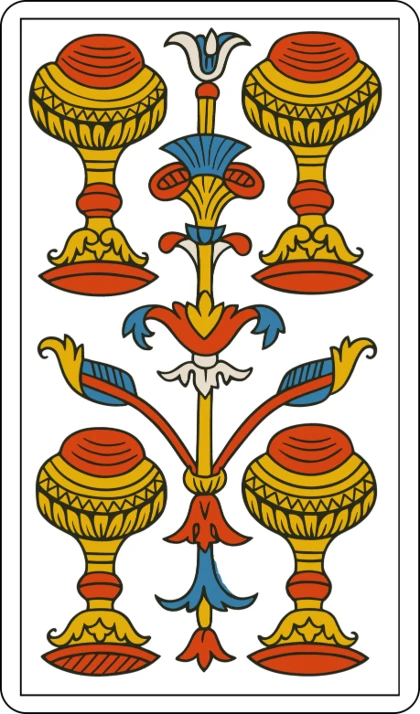
The card shows four cups with stems, each bowl at the top and foot at the bottom, placed at the four corners among flowering scrollwork. No person, no scene, and no printed numeral appears. The rank is read from the four cups themselves. Like all Marseille numerals, the design is ornamental: the suit symbol repeated four times, surrounded by curling foliage and flowers, and nothing else.
Ce que dit la lame
The Four of Cups points to a structure of feeling that holds. Four is the number of the square, of corners, of a frame that contains without crushing. The cups, as vessels of emotion, are not scattered or overflowing; they are placed at equal distance, each with its own foot and bowl. This arrangement signifies a relational container, a shared space where feeling can be received and kept.
The absence of any figure matters. This card does not describe one person’s mood or a single dramatic moment. It describes a field between people, a form that has been built or is being built. The flowering scrollwork around the cups indicates that this structure is alive, not sterile. The four cups do not spill into one another, yet they face the same center. That tension between separateness and union is the core of the card.
À l’endroit
Upright, the Four of Cups signifies reciprocal emotional engagement. The four cups at the corners form a shared container, a mutual holding of feeling. This is not a one-sided longing but a bond in which both parties pour into the same structure. The card points to a commitment that is recognized by both sides, not merely desired by one.
The card indicates shared life, whether marriage, cohabitation, or a partnership that is taking shape. It can point to a relationship being regularized, made official, or given a stable form. The fourfold arrangement suggests a household, a domestic unit, and sometimes the arrival of a child. Emotional security is the ground note: the feeling that one is held, recognized, and not alone.
À l’envers
Reversed, the Four of Cups carries its own axis: waiting. The same four cups no longer form a closed container; they mark a distance between positions. The person may be waiting for a commitment that does not come, or for a situation to evolve, while nothing moves. This is not the opposite of engagement; it is a different stance, one of suspension and held breath.
The card signifies rigidity, a holding pattern that has become fixed. A partner may refuse to commit, but this does not mean the feelings are absent. The emotional bond can remain real while the form stays unresolved. In friendships and family, the reversed Four of Cups points to independence. The person keeps a certain distance, not out of coldness, but because closeness without a clear frame feels unsafe. The waiting is not passive despair; it is a stance of not forcing what is not ready.
Ce qui nuance cette lecture
A single card never tells a whole story. The Four of Cups means one thing in a position about the past, another in a position about a relationship’s foundation, and still another when it appears as advice. The cards beside it can sharpen the axis: a major arcana nearby may show what larger force frames the engagement or the waiting. The question asked also matters. Asked about a job, the upright Four of Cups may point to a stable team or a regularized contract, not a marriage. Asked about a friendship, the reversed card may highlight independence rather than a partner’s refusal.
Questions fréquentes
Does the Four of Cups predict a marriage?
No single card predicts an event. Upright, it signifies the possibility of shared life and regularization, but only a full spread can show whether that is actual, desired, or feared.
Is the reversed Four of Cups a sign that love is gone?
No. The reversed axis is waiting and distance, not the absence of feeling. The card can point to a partner who refuses to commit while the emotional bond remains intact.
Why are there no people on this card?
Marseille numerals are ornamental. The Four of Cups shows only four cups among scrollwork and flowers. The meaning comes from the number, the suit, and the arrangement, not from a scene.
Does the Four of Cups always speak about romantic relationships?
No. Upright it often concerns mutual engagement, family, or emotional security in any close bond. Reversed it can describe independence in friendships or family ties, not only a romantic partner.