Ace of Cups: The Self-Standing Vessel of Autonomy and Abandonment
In brief
- The Ace of Cups signifies a central tension: your autonomy is the source of your emotional fullness, yet the same cup can turn into a void of abandonment.
- Upright, it signifies self-sufficiency as the true foundation for a romantic encounter, not the encounter itself.
- Upright, solitude is a well, lived state, while reversed, it becomes a suffered isolation.
- Reversed, it signifies an unsatisfied request and the feeling of being abandoned, a state of your being, not a timeline.
Contents
The Ace of Cups is a minor numeral from the suit of Cups in the Marseille Tarot. It shows a single monumental cup, and its meaning turns on two independent axes: upright, autonomy and the possible start of a relationship; reversed, abandonment and painful solitude. This guide reads the card face, then each orientation on its own terms.
| Suit | What it covers | Cards | Symmetrical plates |
|---|---|---|---|
| Batons | feeling, mood and the quality of emotions | 14 | 9 |
| Cups | affective life and matters of the heart | 14 | 0 |
| Swords | working life and the field of activity | 14 | 2 |
| Coins | material life and money matters | 14 | 7 |
| Total | 56 | 18 |
This axis is not the Golden Dawn's elemental grid: this school places feeling on the batons and working life on the swords.
The Card Face
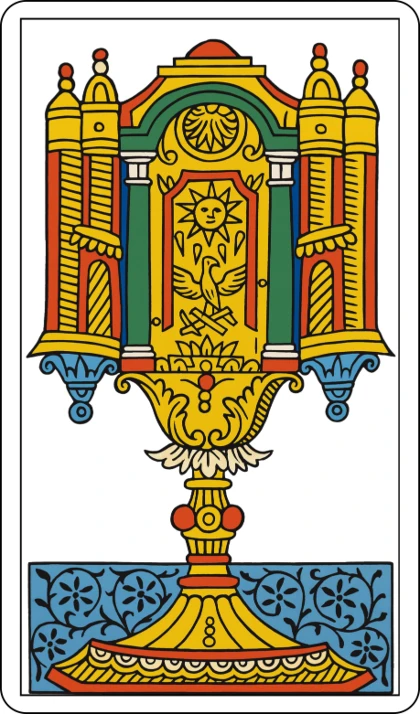
What you see on the Marseille Ace of Cups is entirely ornamental, as with all numeral cards in this deck. There is no person, no hand, no scene. The card shows one very large cup, built like an edifice. It has a wide, flared foot, a fluted bowl, and above the bowl a facade with turrets and arcades. On that facade appear a sun face and a bird. Around the cup, the usual scrollwork and floral motifs of the Marseille minors frame the image, but the cup itself is the only emblem. Its rank is not written on the side; the single cup is the number one.
What the Card Means
The Ace of Cups speaks of a vessel that stands on its own. The cup is not held by anyone, not offered, not received. Its architectural form, with a broad base and a decorated upper structure, gives it self-contained presence. You can read this as a sign of emotional independence: a person can hold their own feelings without needing another person to fill or steady them. The absence of any hand is not a lack here; it is the condition of the image. The cup is complete as it stands.
At the same time, a cup is a container made to receive. The sun face and the bird on the facade add a living, radiant quality to an otherwise static structure. This is why the Ace of Cups can also point to the possibility of a new emotional beginning, including a romantic encounter or the start of a relationship. But that possibility does not cancel the autonomy. The cup receives from a position of self-possession, not from need. The paradox is central: the more self-standing the vessel, the more it can welcome without losing its shape.
Upright
Upright, the Ace of Cups first indicates independence and autonomy. A person may be emotionally self-sufficient, able to name and contain their own feelings without leaning on someone else. This is not coldness. It is the capacity to stand alone without collapsing. The cup’s wide foot and solid structure mirror a person who knows their own ground.
From that base, the upright Ace can also point to the possibility of a romantic encounter or the start of a sentimental relationship. The key is that the encounter does not come from desperation. It comes from a place where the person is already whole. The cup is ready to receive, but it does not beg to be filled.
As an accessory meaning, the upright Ace can describe solitude that is well lived, or isolation that a person has chosen. This is not loneliness. It is the deliberate withdrawal into one’s own space, a period of self-containment that feels restorative rather than empty.
Reversed
Reversed, the Ace of Cups carries the axis of abandonment. This is not the upright meaning blocked or negated. It is a distinct state. The same cup that stood on its own now reads as a vessel no one reaches for, no one fills, no one notices. The absence of any hand becomes painful: no one pours, no one offers, no one stays.
Here the card points to solitude that is badly lived, isolation that hurts. A person may feel left behind, forgotten, or cut off from others. The feeling of abandonment can be real or felt, but the weight is the same. The cup’s architectural enclosure no longer reads as self-containment; it reads as being walled in or set aside.
The reversed Ace also indicates a period unfavorable to friendly or romantic encounters. Requests for connection may go unanswered. A person may reach out and find no response, or may feel unable to reach out at all. The card can point to an unsatisfied request, a longing that finds no object, a need that remains unmet.
What Nuances This Reading
A single card never makes a spread. The Ace of Cups takes its full meaning from its position, the cards around it, and the question asked. In a past position, upright, it may describe a period of chosen solitude. In a future position, it may point to a possible encounter, but only the spread can suggest when. The card itself is timeless; it sets no deadline and no duration.
Surrounding cards also modulate the reading. Other Cups can deepen the emotional tone. Swords may add mental distance or conflict. A Major card can shift the weight of the whole. The question matters too: in a question about work, the upright Ace may speak of professional autonomy; in a question about love, it may speak of a new beginning. The card does not change, but the context gives it a specific voice.
Frequently Asked Questions
Does the Ace of Cups always mean a new love?
No. Upright, it can point to the possibility of a romantic encounter or the start of a relationship, but its primary axis is autonomy. In a non-romantic question, it may simply describe emotional self-sufficiency or a well-lived solitude.
Is the reversed Ace of Cups just the upright meaning blocked?
No. In the Marseille Tarot, a reversed card carries an independent meaning. The reversed Ace of Cups speaks of abandonment, painful solitude, and an unsatisfied request. It is not a failed version of autonomy; it is its own state.
Why is there no person on the card?
Marseille numeral cards are ornamental, not scenic. The Ace of Cups shows only the cup and its architectural decoration. The absence of any hand or figure is central: no one gives, no one takes, the cup stands alone.
Does this card predict when I will meet someone?
No card does. A single card is timeless. Only its position in a spread, such as past, present, or future, can suggest when a meaning may apply. The Ace of Cups itself carries no date and no duration.