The Five of Cups: When the Heart Changes Course
In brief
- This card holds two opposite outcomes in tension: a positive emotional shift when upright, versus stagnation or worsening when reversed.
- Upright, it signals a concrete change in your affective life: a reunion, a better understanding, a new partner, or for a single person, an encounter that ends solitude.
- Reversed, it means no positive evolution occurs: relationship problems persist and intensify, with a real risk of definitive rupture or a continued isolation for the single person.
- The central tension is that the same situation can lead to either renewal or hardening, depending on how you handle the emotional loss it represents.
- Your action determines the outcome: the card only signifies the fork in the road, it never decides which path you take.
Contents
You are looking at a numeral card from the Cups suit, one of the forty rank cards that carry no scene and no figure. The Five of Cups speaks of emotional movement, either a turn toward something better or a deepening of what already hurts. Its two orientations do not oppose each other: one carries the axis of happy change, the other the axis of aggravation.
| Suit | What it covers | Cards | Symmetrical plates |
|---|---|---|---|
| Batons | feeling, mood and the quality of emotions | 14 | 9 |
| Cups | affective life and matters of the heart | 14 | 0 |
| Swords | working life and the field of activity | 14 | 2 |
| Coins | material life and money matters | 14 | 7 |
| Total | 56 | 18 |
This axis is not the Golden Dawn's elemental grid: this school places feeling on the batons and working life on the swords.
La planche
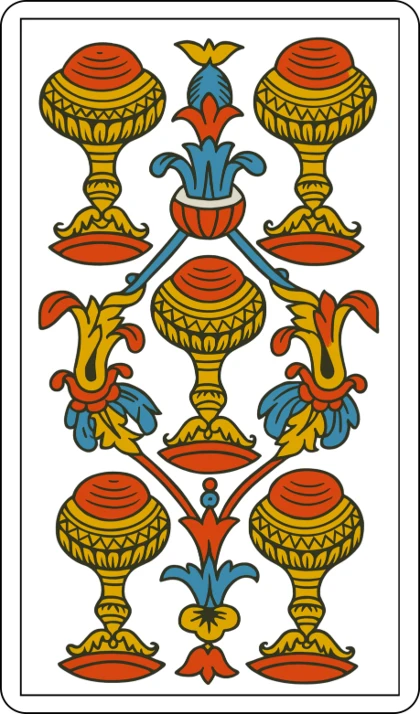
On the Marseille card, you see five cups with stems, each one drawn with its bowl at the top and its foot at the bottom. Two cups sit in the upper part of the card, one stands alone in the center, and two rest in the lower part among flowering scrollwork. The ornamental foliage curls around the cups without touching them. There is no person, no landscape, no printed numeral on the side. The number five is read directly from the five cups themselves, repeated as many times as the rank indicates. The whole composition is symmetrical and decorative, in keeping with the ornamental nature of the Marseille minors.
Ce que dit la lame
The Five of Cups carries a specific tension: it points to a turning point in emotional life, but the direction of that turn depends entirely on the orientation of the card. This is not a neutral card. It does not describe a stable state. It describes a movement, a shift in the quality of a bond or in the experience of solitude. The five cups, arranged in a balanced pattern, suggest that the emotional field is full, that something has reached a point of saturation where change becomes possible or necessary.
What matters here is the quality of the bond, not the number of people involved. The card does not count relationships. It weighs their texture, their warmth, their capacity to evolve. When this card appears, the question is never whether feelings exist, but whether they are moving toward renewal or toward collapse. The cups are upright, open, ready to receive or to spill. That openness is the core of the card: the emotional container is not sealed.
The Five of Cups also speaks to the experience of emotional fullness. Five is a number of the hand, of grasp, of holding. In the Cups suit, this suggests a moment when feelings have accumulated enough to demand attention. The card does not say what will happen. It says that the emotional material is present, abundant, and in motion.
À l’endroit
Upright, the Five of Cups carries the axis of happy change. The emotional situation shifts in a positive direction. This can take the form of a reunion, a renewed understanding between two people who had drifted apart. The bond does not necessarily end: it may simply become warmer, more honest, more alive. The change is felt in the texture of the relationship, not necessarily in its outward form.
For someone already in a relationship, the card can also point to a change of partner. The emotional movement is outward, away from what no longer nourishes and toward something new. This is not a card of betrayal or rupture in the upright position. It is a card of transition, where the heart moves from one attachment to another with a sense of relief or discovery.
For a person who is alone, the upright Five of Cups speaks of a meeting that ends solitude. The emotional fullness of the card finds an outlet, a recipient. The cups are no longer held in isolation. They are shared. This is the most direct expression of the card’s happy change: the end of emotional emptiness, the arrival of someone who receives what has been waiting to be given.
À l’envers
Reversed, the Five of Cups carries the axis of aggravation. This is not the absence of the upright meaning. It is a distinct movement in its own right. The emotional situation does not improve. It hardens. Problems that were already present become more entrenched, more difficult to ignore. The cups are still full, but the fullness now feels heavy, stagnant, without an outlet.
In a relationship, the reversed card points to a risk of rupture, of a definitive end. The bond does not evolve. It deteriorates. The emotional material that once connected two people now separates them. The card does not predict the rupture as a certainty, but it shows that the movement is toward closure, toward an ending that may be final.
For a person who is alone, the reversed Five of Cups speaks of maintained isolation. The solitude does not lift. It persists, and the emotional fullness of the card turns inward, becoming a weight rather than a resource. The cups are there, but no one drinks from them. The isolation is not chosen. It is endured, and it deepens over time.
Ce qui nuance cette lecture
A single card never tells the whole story. The Five of Cups takes its meaning from its position in a spread, from the cards that surround it, and from the question that was asked. The same card can point to a joyful reunion in one context and to a painful ending in another. The orientation matters, but so does the company the card keeps.
If the Five of Cups appears near cards that speak of stability or commitment, the happy change may be internal, a shift in feeling rather than a change of partner. If it appears near cards of rupture or departure, the aggravation may be more pronounced. The surrounding cards do not cancel the Five of Cups. They color it, they give it a specific weight and direction.
The question asked also shapes the reading. A question about a current relationship will draw out the card’s relational meaning. A question about solitude will draw out its meaning for the single person. The card itself remains the same. What changes is the angle from which it is read.
Questions fréquentes
Does the Five of Cups always mean a breakup when reversed?
No. The reversed card points to a risk of rupture, a movement toward closure, but it does not guarantee an ending. The surrounding cards and the position in the spread determine how that risk plays out. The card shows a direction, not a verdict.
Is the upright Five of Cups only about romantic relationships?
No. The Cups suit speaks of emotional bonds in general, including friendship, family, and the relationship one has with oneself. The happy change can occur in any emotional field, not only in romance.
Why does the card show no people if it speaks of relationships?
The Marseille minors are ornamental. They show their suit repeated as many times as their rank, surrounded by scrollwork and flowers. The absence of figures is not a lack. It is the tradition of this deck. The meaning comes from the number, the suit, and the arrangement, not from an illustrated scene.
Can the Five of Cups indicate a change that is both happy and painful?
Yes. A change of partner, for example, can bring relief and grief at the same time. The card does not flatten emotional experience into a single tone. It points to a movement, and movements often carry mixed feelings. The orientation indicates the dominant direction, not the absence of all other currents.