The Page of Cups (Valet de Coupe): The Young Heart and the Weight of Solitude
In brief
- This card signifies a romantic openness and the youthful thrill of being in love, where a new encounter or a fresh emotional development takes center stage.
- It can point to a sociable, communicative child or adolescent, but the card never acts, the person embodies this open-hearted state.
- Reversed, it signifies moral solitude, the feeling of being alone with your problems, and the belief that no one can truly support you.
- It can also describe a timid, inhibited young person, yet the card only reflects that inner withdrawal, it never causes it.
Contents
The Page of Cups is a minor honor in the Cups suit of the Marseille Tarot. It shows a young figure holding a two-basin cup, and it speaks of romantic feeling when upright, and of moral solitude when reversed. This guide reads the card from the actual plate, without inventing scenes that are not there.
| Suit | What it covers | Cards | Symmetrical plates |
|---|---|---|---|
| Batons | feeling, mood and the quality of emotions | 14 | 9 |
| Cups | affective life and matters of the heart | 14 | 0 |
| Swords | working life and the field of activity | 14 | 2 |
| Coins | material life and money matters | 14 | 7 |
| Total | 56 | 18 |
This axis is not the Golden Dawn's elemental grid: this school places feeling on the batons and working life on the swords.
La planche
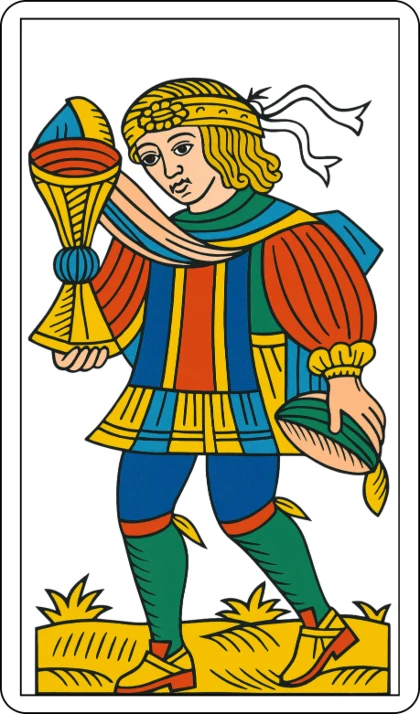
On the Marseille plate, a young man stands facing forward. A band circles his hair, and a scarf floats from his shoulder or neck. He holds a cup with two basins in front of him, using both hands. The ground beneath him is yellow, with small tufts of grass. The card carries no printed title and no numeral. That is all the plate shows. As one of the sixteen honors, it bears a person, unlike the forty ornamental numeral cards of the minor suits.
Ce que dit la lame
The Page of Cups belongs to the Cups suit, which concerns emotional life, bonds, and the movement of feeling. The young man’s two-handed grip on the cup shows a direct, unguarded relation to feeling. The cup has two basins, which suggests a feeling that can be offered and received, or a heart that holds more than one layer. The floating scarf and the band in the hair point to youth, openness, and lightness. The yellow ground gives the figure a warm, receptive footing.
This card does not describe a finished love story. It describes the moment when feeling is fresh, when a person is willing to hold something tender and show it. The Page of Cups is not a card of strategy or calculation. It is a card of sincere emotional presence, where the heart leads before the mind has time to weigh the risk.
À l’endroit
The upright Page of Cups carries the axis of romanticism. It points to being in love, to the early stage of feeling, and to a favorable encounter. The person is not calculating; they hold the cup with both hands, which means they are ready to receive and to give. The card favors the development of a union, but it does not promise a duration. It shows a quality of feeling: young, sincere, a little naive, and alive.
The figure can also designate a child or adolescent who is sociable, open, and communicative. In a reading, this card often marks a moment when emotional honesty is more useful than strategy. The two basins of the cup suggest that the feeling can be shared without losing its shape. The upright meaning is not about a grand passion already built; it is about the first clear movement of the heart.
À l’envers
The reversed Page of Cups carries the axis of moral solitude. It does not mean the opposite of love. It means a state where the person feels alone in facing their own problems, as if no one can truly help. The cup is still there, but the two-handed grip becomes a sign of holding something without a witness. The person may feel that they cannot count on anyone, not because others are absent, but because the inner weight is not shared.
This card can also designate a child or adolescent who is shy, uncomfortable, inhibited, or introverted. The reversed position does not cancel the emotional sensitivity of the Page; it turns that sensitivity inward, where it becomes a private burden. The yellow ground remains, but the warmth feels distant. The floating scarf, which upright suggests openness, here suggests a person who is easily unsettled. The meaning is autonomous: it speaks of a solitude that is moral, not physical, and of the effort to solve one’s own difficulties without leaning on others.
Ce qui nuance cette lecture
A single card never makes a reading. The Page of Cups takes its full meaning from its position in a spread, from the cards around it, and from the question asked. In a position about the past, it may point to a first love or an early emotional opening. In a position about obstacles, the reversed Page may show a solitude that the person is carrying. The surrounding honors can indicate whether the feeling is met by another person or left unshared. The Cups numerals around it can show whether the emotional current is simple or layered.
The question also matters. Asked about work, the upright Page may point to a young collaborator or a sincere approach; asked about a bond, it points to the freshness of feeling. No card fixes a date or a duration. Only the position in a spread can carry time, and this page describes no spread.
Questions fréquentes
Does the Page of Cups always mean a new romance?
No. It points to romantic feeling, but it can also describe a sincere emotional attitude, a young person, or a favorable opening in any area where feeling matters.
Is the reversed Page of Cups just a blocked version of the upright?
No. In the Marseille tradition, the reversed card has its own meaning: moral solitude, the sense of having to solve one’s problems alone. It is not the upright meaning turned negative.
Why does the card show a cup with two basins?
The two basins are part of the actual Marseille plate. They suggest a feeling that can be offered and received, or an emotional life with more than one layer. The card does not explain the symbol; it shows it.
Can this card tell me when something will happen?
No. A card is timeless. Only a position in a spread can frame time, and this page describes no spread.