The Eight of Cups: When Discord Settles Into the Vessel
In brief
- This card points to a relational deadlock, where the bond survives but the harmony is gone, and you keep talking without ever really saying anything.
- The central tension is a stubborn attachment to a situation that drains you, you stay out of habit or pride, not out of love.
- You face a breakdown of dialogue, every exchange turns into a dispute or a cold silence, and the simplest subject becomes a battlefield.
- When reversed, the discordance hardens into entrenched positions, you refuse to bend or to walk away, and the conflict becomes a permanent backdrop.
- The card signifies a state of unresolved discord, it does not push you to leave or to stay, it simply shows you the cost of a bond that no longer works.
Contents
The Eight of Cups is a minor numeral of the Marseille Tarot, one of the forty rank cards that carry no figure and no scene. It speaks of relational friction, of a bond where words no longer land, and of the particular weight that accumulates when two people keep drinking from the same cup while tasting different things. This page describes what the card means on its own, upright and reversed, without any spread around it.
| Suit | What it covers | Cards | Symmetrical plates |
|---|---|---|---|
| Batons | feeling, mood and the quality of emotions | 14 | 9 |
| Cups | affective life and matters of the heart | 14 | 0 |
| Swords | working life and the field of activity | 14 | 2 |
| Coins | material life and money matters | 14 | 7 |
| Total | 56 | 18 |
This axis is not the Golden Dawn's elemental grid: this school places feeling on the batons and working life on the swords.
The plate
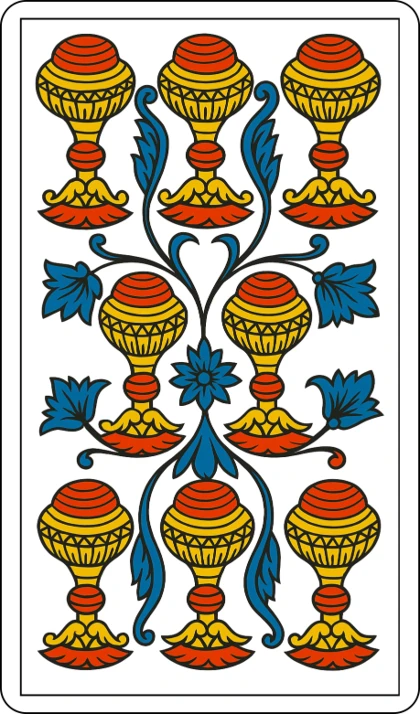
What you see on the Marseille plate is simple and entirely ornamental. Eight stemmed cups are arranged in three rows: three at the top, two in the middle, three at the bottom. Each cup has its bowl turned upward and its foot pointing down. Around them, flowering scrollwork fills the spaces, the same vegetal ornament that runs through all the numeral cards of this suit. There is no person, no landscape, no printed number in the margin. The rank is read directly from the count of the cups themselves.
What the card says
The Eight of Cups points to a state of discord that has become familiar. It does not describe a sudden rupture or a single violent clash. It describes a texture of relationship where disagreement has settled in, where the same arguments return, and where the space between two people has filled with unspoken reproaches. The cups are all upright, all open, all apparently ready to receive. Yet their arrangement, three, two, three, suggests an uneven rhythm, a conversation that never quite finds its balance.
This card speaks of communication that misses its mark. The words are there, the cups are full, but what one person pours does not reach the other. There is talk without dialogue, exchange without meeting. The flowering scrollwork around the cups can be read as the politeness, the decorum, the social forms that keep the discord from becoming open war. But the ornament also shows how much energy goes into maintaining appearances while the core of the bond goes unaddressed.
The Eight of Cups carries a specific tension: the cups are not broken, not spilled, not overturned. Nothing has been destroyed. And yet the relationship they signify is not working. This is the paradox of the card: a vessel that holds, but does not nourish. The form remains, the function has faded.
Upright
Upright, the Eight of Cups signifies mésentente, a French word that names a state of being out of tune with another person. It points first to relational difficulty: a couple that functions poorly, a partnership where the basic rhythm has been lost. The card does not say who is at fault. It says that the space between two people has become a place of friction rather than flow.
Next comes the failure of communication. Problems to communicate are central here. The card shows cups that are all present, all upright, all seemingly available, yet the arrangement suggests that what is said does not reach the other. There are words, but no true exchange. There are attempts, but no landing.
Then come frequent disagreements. The card points to a pattern of disputes and conflicts that recur, not as isolated incidents but as the background noise of the relationship. These are not necessarily explosive fights. They can be small, repeated, wearing. The absence of true dialogue is the ground from which these disagreements grow.
Reversed
Reversed, the Eight of Cups does not become its opposite. It becomes a harder version of the same discord. The relational difficulty does not disappear; it thickens. What was friction becomes entrenchment. The card points to stubbornness, to a refusal to yield, to a posture where each person holds their position not because they believe in it but because letting go would feel like losing.
There is also attachment despite the conflicts. The cups are still there, still upright, still counted. No one has walked away. The bond persists, but it persists as a site of repeated injury. The reversed Eight of Cups speaks of people who stay in a relationship that hurts, not out of love alone but out of habit, fear, or the inability to imagine a different arrangement.
Finally, the card points to a lack of constructive reaction. The discord is met with rigidity, with repetition, with the same responses that have already failed. Nothing new enters the exchange. The cups remain full of the same undrinkable liquid.
What nuances this reading
A single card never tells the whole story. The Eight of Cups gains precision from its position in a spread. In a place that speaks of the past, it may point to a history of discord that still shapes the present. In a place that speaks of an obstacle, it may name the relational friction that blocks movement. In a place that speaks of an outcome, it may indicate that the current pattern of communication will continue unless something shifts.
The cards around it also matter. A major arcana placed beside the Eight of Cups can indicate whether the discord is structural or circumstantial, whether it touches the foundations of a bond or only its surface. The other cups numerals, especially the Six or the Ten, can show whether the relationship has known better times or whether the discord has been present from the start.
The question asked also shapes the reading. Asked about a romantic bond, the card points to the couple itself. Asked about work, it points to a team, a partnership, a collaboration where communication has broken down. Asked about family, it points to the unspoken tensions that run through a household. The card does not change its meaning; the context tells you where to look.
Frequent questions
Does the Eight of Cups mean a breakup is coming?
No. The card shows cups that are intact and upright. It points to discord, not to separation. Whether a breakup occurs depends on the people involved, on the surrounding cards, and on the question asked. The card itself only says that the relationship is not working well.
Is the reversed Eight of Cups worse than the upright?
It is not worse in the sense of more catastrophic. It is harder in the sense of more rigid. The upright card points to friction that may still be fluid. The reversed card points to friction that has hardened into stubbornness and repetition.
Does this card always refer to a romantic couple?
No. The cups suit speaks of emotional bonds, but those bonds can be romantic, familial, friendly, or professional. The Eight of Cups points to any relationship where communication has broken down and discord has become the norm.
Can the Eight of Cups indicate a problem within myself rather than with another person?
Yes. The discord can be internal. A person can be at odds with their own feelings, their own desires, their own history. The cups that do not communicate with each other can represent parts of the self that have stopped listening to one another.