Queen of Cups: The Steady Heart of the Marseille Tarot
In brief
- The queen’s core strength is a deep emotional commitment and the continuity she brings, choosing to settle into the duration of a bond.
- The central tension is that her emotional constancy can flip into rejection and hostility, where the same intensity that nurtures can turn to destroy the very person she loves.
- When reversed, she risks losing the beloved through her own aggressive behavior, a self-inflicted wound born from her emotional turmoil.
- She embodies the woman of the heart (mother, spouse, beloved), but her power is not passive, she actively chooses to maintain or to break the tie, and the card signifies that choice, not fate.
Contents
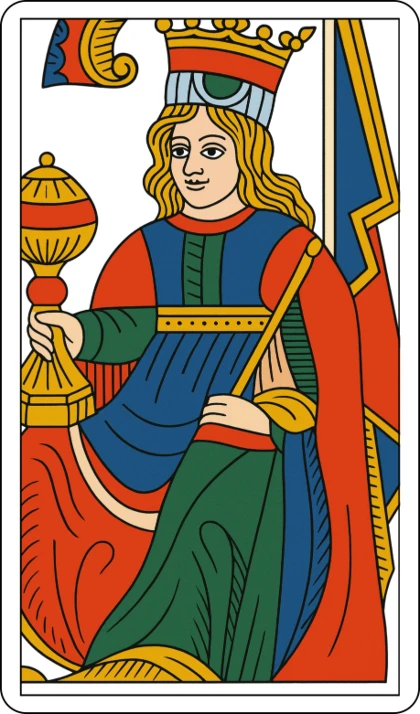
The Queen of Cups is a court card from the suit of Cups. She shows a crowned queen holding a covered cup and a scepter. Upright, she signifies constancy and emotional commitment. Reversed, she carries an independent meaning of rejection and animosity.
| Suit | What it covers | Cards | Symmetrical plates |
|---|---|---|---|
| Batons | feeling, mood and the quality of emotions | 14 | 9 |
| Cups | affective life and matters of the heart | 14 | 0 |
| Swords | working life and the field of activity | 14 | 2 |
| Coins | material life and money matters | 14 | 7 |
| Total | 56 | 18 |
This axis is not the Golden Dawn's elemental grid: this school places feeling on the batons and working life on the swords.
The card
On the Marseille card, a queen sits facing you. She wears a crown. Her robe is green and blue, and a red mantle covers her shoulders. In one hand she raises a covered cup. In the other she holds a scepter. The card has no printed legend and no numeral. As one of the sixteen honors, she is a person, not an ornamental arrangement of cups.
What the card says
The Queen of Cups signifies emotional authority that does not spill. The covered cup is the key: what she carries is protected, held, not displayed. Her scepter shows a command that comes from continuity, not from force. This card points to a way of loving and caring that lasts because it is contained.
She does not promise excitement. She indicates the quiet work of keeping an attachment alive over time. The green and blue under the red mantle suggest a living sensitivity wrapped in a steady outer presence. The face-on posture gives her a directness: she sees what she holds, and she does not turn away.
Upright
Upright, the Queen of Cups carries the axis of constancy. The first meaning is affective engagement: a bond that is chosen and maintained. Then comes continuity: the person keeps returning to the same care, the same loyalty, the same emotional presence. This is not a card of sudden passion but of conservation, of keeping what has been built.
She can also point to a woman of heart: a mother, a wife, a beloved. But the card does not require a specific person. It can describe a way of being: someone who installs themselves in duration, who does not abandon what they love when the first heat fades.
Reversed
Reversed, the Queen of Cups does not mean the absence of constancy. It carries its own axis: rejection. The covered cup now suggests something held back with coldness, not care. The person may push others away, show animosity, or act with malevolence. This is not a blocked version of the upright card; it is a distinct posture where the emotional authority turns sharp.
The reversed card can also point to aggressiveness coming from the person themselves. There is a risk of losing the loved one by one’s own fault: the rejection is not suffered from outside but produced from within. A woman of heart, a mother or a wife, may be crossing difficulties, but the card does not say she is a victim. It says the rejection is active.
What nuances this reading
A single card never makes a reading. The Queen of Cups takes its color from the question asked and from the cards around it. Next to a Cups numeral, the constancy may concern a specific emotional bond. Next to a Sword, the same upright card may show a loyalty that must defend itself. Reversed, surrounded by warm cards, the rejection may be a passing stance rather than a settled character.
Its position in a spread also matters. In a place that speaks of the past, the card can point to a long-held attachment. In a place that speaks of a present obstacle, the reversed card can show a current refusal. But this page describes no spread, so no duration is fixed here.
Frequently asked questions
Does the Queen of Cups always represent a woman?
No. She can point to a woman of heart, but she also describes a way of being: steady, protective, emotionally constant. Anyone can embody that.
Is the reversed Queen of Cups just the upright card blocked?
No. In the Marseille Tarot, the two orientations carry two independent meanings. Upright is constancy; reversed is rejection. They are not opposites of each other.
What does the covered cup mean?
The cup is covered, not open. That detail is central: what the queen holds is protected and contained. Upright, that means care that lasts. Reversed, that same containment can become cold distance.
Can this card predict a breakup?
The reversed card can point to a risk of losing a loved one by one’s own fault, but a single card does not predict an event. It describes a posture of rejection or animosity. The surrounding cards and the question determine whether that risk is active.