Le Trois de Deniers: The Ornamental Gain and Loss of the Marseille Minor
In brief
- Sudden financial shift: the Three of Coins signifies an abrupt change in your money flow, either a windfall or a loss, never a gradual trend.
- Gain and loss are two sides of the same coin: the same raw energy that brings a brutal increase in income can also produce unexpected expenses or bad investments when reversed.
- Upright, it points to strong vitality and income, but that excess energy can tip into overindulgence and health problems if you don’t pace yourself.
- Reversed, it warns of sudden financial problems and illness after excess, reminding you that your resources and your body are both volatile under this card.
Contents
- The Card Face
- What the Card Signifies
- Upright
- Reversed
- What Nuances This Reading
- Frequently Asked Questions
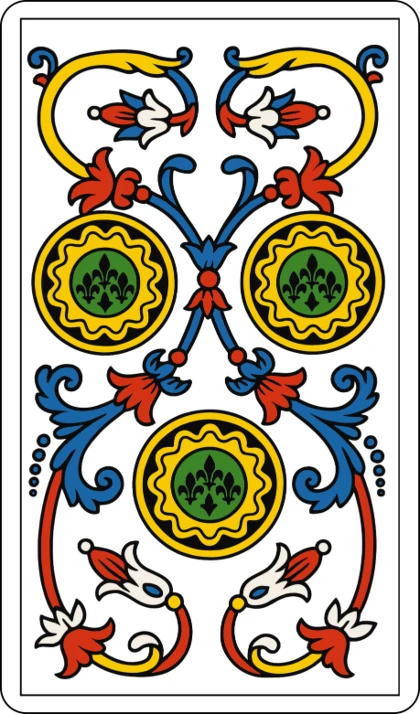
Le Trois de Deniers is a minor numeral from the suit of Coins in the Marseille Tarot. Its face carries only three coins arranged around a floral axis, with no figure and no printed number. Upright it signifies sudden financial gain and strong vitality; reversed it signifies sudden loss and the cost of excess.
| Suit | What it covers | Cards | Symmetrical plates |
|---|---|---|---|
| Batons | feeling, mood and the quality of emotions | 14 | 9 |
| Cups | affective life and matters of the heart | 14 | 0 |
| Swords | working life and the field of activity | 14 | 2 |
| Coins | material life and money matters | 14 | 7 |
| Total | 56 | 18 |
This axis is not the Golden Dawn's elemental grid: this school places feeling on the batons and working life on the swords.
The Card Face
On the Marseille plate, three round disks appear. Each disk has a wavy yellow border and a black fleur-de-lis on a green field. Two coins sit at the top and one at the bottom, arranged around a central axis of interlaced floral stems. There is no person, no scene, no landscape, and no printed numeral in the margin. The number is read directly from the three coins themselves. Like all Marseille numeral cards, this one is ornamental: it repeats its suit sign and adds only vegetal decoration.
What the Card Signifies
Le Trois de Deniers signifies a condensation of the suit of Coins into a pure numerical rhythm. Three is the first number that breaks the pair, introducing a third term, a circulation, a result that exceeds simple exchange. In the suit of Coins, which concerns material resources, work, and the body, this third term often appears as a sudden increase. The card does not signify a slow accumulation. It signifies a moment when resources arrive all at once, without a visible preparatory phase.
The arrangement on the card matters. Two coins above and one below create an imbalance that is not resolved. The two upper coins form a pair, a stable base in the visual field, while the lower coin hangs alone, as if received or detached. This visual tension gives the card its double edge: the same configuration can mean a gain that lands in a person’s hands or a loss that drops away. The floral axis between them does not connect the coins into a story. It only ornaments the space, reminding you that the number is the message.
Because this is a numeral card, no person appears on it. The repetition of the sign is the whole content. Three coins are enough to signal a threshold: enough to be counted, enough to be noticed, but not enough to build a fortune. The card therefore signifies a discrete sum or a discrete event, not a lifelong condition.
Upright
Upright, Le Trois de Deniers signifies gain. The primary meaning is an increase in material resources, often sudden. This is not a modest trickle but a sharp rise in income, an inflow of money that arrives without long preparation. The card does not indicate where it comes from, only that the movement is toward the person and that it is abrupt.
Separate from this financial axis, the upright card also carries a note of strong vitality. On the level of the body, it can signify a surplus of energy, a period of physical force, a capacity to act without immediate fatigue. This is not a medical statement but a qualitative indication: the same threefold pulse that marks material increase can mark bodily vigor.
Reversed
Reversed, Le Trois de Deniers does not mean the absence of gain. It means loss. The primary sense is a loss of money, often sudden and unforeseen. The card signifies a movement of resources away from the person, abrupt and without visible preparation.
On a separate level, the reversed card can signify a state of physical depletion that follows excess. This is not a diagnosis and not a prediction of any specific illness. It is a qualitative note: the body has been pushed too hard, and the cost of that excess now appears. The same suddenness that upright marks as vitality can reverse into a sharp drop in energy.
What Nuances This Reading
A single card is never a whole reading. The temporal and contextual color of Le Trois de Deniers comes from its position in a spread. In a position that speaks of the past, the gain or loss may already be in motion. In a position that speaks of a project, the card may signify the material core of that project rather than a final outcome. The surrounding cards specify the field: next to a card of work, Le Trois de Deniers may signify income from labor; next to a card of relationship, it may signify a material exchange between people. The question asked also matters. A question about love will not read the same as a question about money, even if the card retains its core of sudden gain or sudden loss.
Frequently Asked Questions
Does Le Trois de Deniers always mean money?
Le Trois de Deniers is a coin card, so its core is material. But in a spread, surrounding cards can shift the field toward work, body, or exchange. The card retains its sudden quality, but the domain is specified by context.
Why is there no person on the card?
The Marseille numeral cards are ornamental. They repeat the suit sign and add vegetal decoration. No person appears because the number itself is the message. Le Trois de Deniers does not need a scene to signify gain or loss.
Is the reversed card just the opposite of the upright?
No. Reversed is not the negation of upright. Upright carries the axis of gain; reversed carries the axis of loss. They are two independent meanings, each with its own texture and its own accessory note.
Can Le Trois de Deniers predict a specific amount or date?
No. A single card does not give a date or an amount. Only the position in a spread can suggest time, and even then the card itself remains qualitative. It signifies a sudden movement, not a measurable figure.