Page of Coins: The Promise Held in a Raised Hand
In brief
- The core strength of this card is that you possess little now, but you can acquire much, and any action you take will be rewarded.
- The central tension is a paradox between a promising future and an extreme passivity, where the desire exists but the means and the action are missing.
- This card is about the seed, not the harvest, so the focus is on the first step you take, not the final result.
- In the reversed orientation, the card shows a sterile inertia, a total blockage where you do nothing, and the promise is frozen.
- The card can point to a young person, but its core meaning is the capacity to act, not the age or the health of the person.
Contents
This minor honor from the Marseille Tarot shows a young figure lifting a single coin while another rests at his feet. Upright, the card speaks of a promising future, small beginnings that can grow, and action that finds its reward. Reversed, it carries a different axis entirely: obstruction, inertia, and desire without the means to move.
| Suit | What it covers | Cards | Symmetrical plates |
|---|---|---|---|
| Batons | feeling, mood and the quality of emotions | 14 | 9 |
| Cups | affective life and matters of the heart | 14 | 0 |
| Swords | working life and the field of activity | 14 | 2 |
| Coins | material life and money matters | 14 | 7 |
| Total | 56 | 18 |
This axis is not the Golden Dawn's elemental grid: this school places feeling on the batons and working life on the swords.
La planche
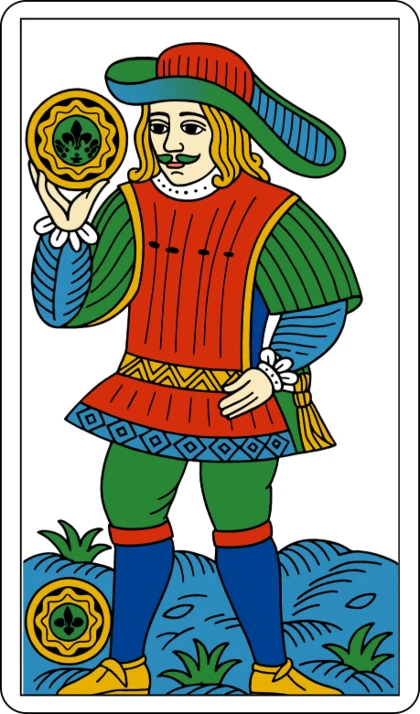
On the Marseille plate, a young man stands in three-quarter view. He wears a wide bonnet with a long fall that drops behind his head, marking him as a figure still in apprenticeship rather than mastery. One hand holds a denier raised in the air, clearly visible and deliberately lifted. The other hand rests on his hip, a posture of readiness that is not yet movement. A second denier lies on the ground at his feet, already placed in the material world. The ground beneath him is blue, with small tufts of grass. The card carries no printed legend and no numeral, as is true of all sixteen honors in the Marseille Tarot.
Ce que dit la lame
The Page of Coins is not a scene of action but a study in material intention. The raised coin is the key: it is not spent, not buried, not exchanged. It is shown, offered to view, held up as a possibility. The coin at the feet is the small existing resource, the first result or the starting capital. Together they describe a person who has little but who stands in relation to what could be acquired.
The hand on the hip gives the figure a certain firmness, but the feet are still. This is not a card of rushing forward. It is a card of positioning oneself before the material world. The blue ground and the grass suggest fertile but uncultivated terrain, a field that has not yet been worked. The bonnet with its long fall reinforces the idea of youth, of a role not yet fully assumed, of someone learning how to handle resources.
When this card appears, the person is often in a place of modest means but real potential. The question is not whether there is enough, but whether the raised coin will be put to use. The Page of Coins signifies a moment where small actions can build something larger, provided the person does not simply stand and admire the coin.
À l’endroit
Upright, the Page of Coins carries the axis of promise. It points to a future that can be built through concrete, patient work. The person may possess very little right now, but the card indicates a capacity to acquire much more. This is not a sudden windfall; it is the slow accumulation that comes from placing one coin after another into the world.
The upright orientation says that any action will be rewarded, as long as it is real and material. A small effort, a first step, a modest investment: these are not insignificant. They are the beginning of a process. The card is especially favorable to the creation of a business, a craft, a trade, or any project that requires building something from the ground up.
In some readings, the Page of Coins can designate a child or an adolescent in good health. But more often it describes an attitude: the willingness to learn, to start small, to handle money or resources with care and curiosity. The raised coin is not a boast; it is a visible commitment to the material plane.
À l’envers
Reversed, the Page of Coins does not simply negate the upright meaning. It carries its own axis: obstruction. Here the raised coin stays raised, never placed, never used. The coin at the feet is ignored or treated as irrelevant. The hand on the hip becomes a posture of waiting without engagement, a stillness that produces nothing.
This orientation speaks of extreme passivity. The person may want something, may even feel a strong desire for change, but the means and the action are missing. There is a gap between what is wished and what is done. The inertia is total, sterile, and negative. It is not rest or patience; it is a refusal or an inability to convert desire into gesture.
The reversed Page of Coins can also point to a child or adolescent with fragile health, but its deeper meaning is not about illness. It is about a state where nothing moves. The person does nothing, not because there is nothing to do, but because the connection between intention and act has been severed. The coin remains in the air, and the ground remains empty.
Ce qui nuance cette lecture
A single card never makes a reading. The Page of Coins takes its full meaning from its position in a spread, the cards around it, and the question asked. In a past position, the promise may already be realized or missed. In a future position, it indicates a direction, not a date. No card carries a fixed duration.
Surrounded by active cards, the reversed Page of Coins may describe a temporary blockage rather than a permanent state. Surrounded by passive cards, the obstruction deepens. The question also matters: asked about work, the card points to a material beginning or a stalled project; asked about a relationship, it may describe someone who is present but not engaged. The same card can indicate a young person, an attitude, or a material situation, depending on the context of the spread.
Questions fréquentes
Does the Page of Coins always mean a young person?
No. It can designate a child or adolescent, but more often it describes an attitude of apprenticeship, a material beginning, or a way of handling resources. The figure is young, but the meaning is not limited to literal age.
Is the reversed Page of Coins just laziness?
No. Laziness implies a lack of desire. The reversed Page of Coins often shows the opposite: the desire exists, but the means or the action are missing. It is a specific form of obstruction, not simple unwillingness.
What is the difference between the raised coin and the coin on the ground?
The raised coin is a visible intention, a promise not yet placed. The coin on the ground is the small existing resource or first result. Upright, the person builds from the ground coin using the raised one. Reversed, both remain unused.
Can this card predict financial success?
No card predicts a fixed outcome. The Page of Coins signifies a favorable climate for material growth if the person acts. It does not guarantee money, and it does not set a timeline. The result depends on what the person does with the coin in hand.