Ten of Coins: The Turning Point in the Marseille Tarot
In brief
- This card signals a decisive material turning, a financial change that closes one period and opens another.
- The meaning of that turn comes from your past: a comfortable past leads to a stricter phase, a difficult past leads to ease.
- Reversed, the turn is taken at the wrong time, the stage ends without the next opening, and the material change is not seized.
- You are the one who acts on this threshold, the card only signifies the turning, never the outcome.
Contents
- The card face
- What the card signifies
- Upright
- Reversed
- What nuances this reading
- Frequently asked questions
The Ten of Coins is a minor numeral card in the Marseille Tarot. It shows ten coins arranged symmetrically around a floral axis, with no person and no scene. Upright it signifies a decisive material turning point; reversed it signifies a missed or mistimed turn.
| Suit | What it covers | Cards | Symmetrical plates |
|---|---|---|---|
| Batons | feeling, mood and the quality of emotions | 14 | 9 |
| Cups | affective life and matters of the heart | 14 | 0 |
| Swords | working life and the field of activity | 14 | 2 |
| Coins | material life and money matters | 14 | 7 |
| Total | 56 | 18 |
This axis is not the Golden Dawn's elemental grid: this school places feeling on the batons and working life on the swords.
The card face
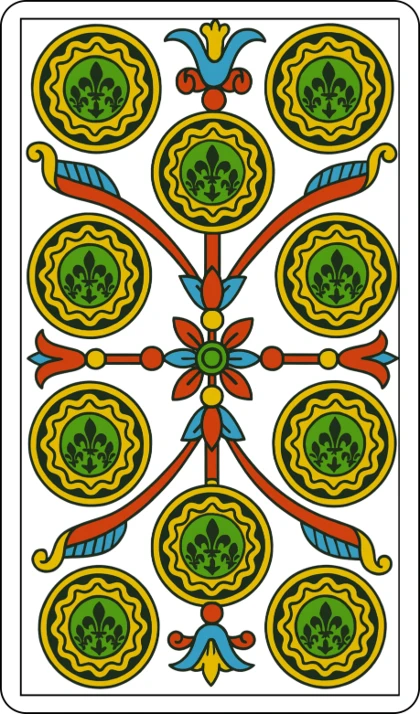
On the Marseille Ten of Coins, you see exactly ten coins. Each coin is a round disk with a yellow wavy border, and each bears a black lily on a green field. The coins are arranged from top to bottom in a pattern of one, two, two, two, two, one, all around a central axis of floral interlacing. There is no person, no scene, no building, and no printed numeral on the side. The number ten is read directly from the coins themselves.
The card is perfectly symmetrical. If you place it on the table, nothing on the drawing tells you which side is up. This is a fact of the image, not a flaw. The card carries its two orientations like every other card, but its symmetry means the direction of the turn is never given by the card alone.
What the card signifies
The Ten of Coins is the last numeral of the Coins suit before the court cards. It signifies the full count of material order. Ten is not a beginning or a middle; it is the point where a decimal cycle completes itself. The coins are not scattered or random. They are placed in a strict, ornamental pattern around a central stem, which gives the card a sense of accumulated structure.
Because the card shows only its sign repeated, it does not narrate a situation. It signifies a pure threshold. The floral interlacing around the coins suggests an organic order, something grown and now complete. The Ten of Coins therefore signifies a hinge in material life: the end of one economic stage and the threshold of another. It is not a card of daily fluctuation. It signifies a capital change in the material situation.
The symmetry of the card reinforces this. The card does not show whether the turn is favorable or difficult. It signifies only that a turn is present. The direction of that turn must be read from the cards that surround it in a spread.
Upright
Upright, the Ten of Coins signifies a decisive turning point. It signifies the end of a stage and the beginning of a new period in economic life. This is not a small adjustment or a passing fluctuation. It is a financial shift, a term and a commencement. The person at the center of the reading stands at a hinge between two material conditions.
The card does not show the direction of the turn. A favorable material past opens a more rigorous phase; a difficult past opens ease. The upright Ten of Coins signifies that the turn is here, and the person is in a position to recognize it. The change is structural, not superficial. It touches the foundation of how resources are held, spent, or built.
Reversed
Reversed, the Ten of Coins signifies a turn taken at the wrong time. The stage ends, but the next one does not open. The material change is present, yet it is not seized. This is not the opposite of the upright; it is a distinct condition of being out of phase with the turning point.
The reversed card signifies a suspended interval. The old order has closed, and the new order has not been entered. The person may see the end clearly but cannot step into the beginning. The ten coins still show the full count, but the inverted axis suggests a loss of orientation. The turn is missed, or it is taken too late, or it is taken without the necessary footing. The material change does not disappear; it remains available but ungrasped.
What nuances this reading
A single card never makes a spread. The temporal and contextual meaning of the Ten of Coins depends on its position. In a past position, it signifies a turn already taken; in a future position, it signifies a turn to come, but the card itself carries no duration. The surrounding cards specify the nature of the material change. With other Coins, the turn is economic; with Swords, it involves decisions or cuts; with Cups, it touches emotional or relational resources; with Wands, it concerns initiative or work.
The question asked also shapes the reading. A question about career reads the turn as professional; a question about home reads it as domestic. The card does not signify a single outcome. It signifies a structural change that must be placed in a larger pattern. No card acts on its own, and no card predicts a fixed event.
Frequently asked questions
Does the Ten of Coins show a family or a scene?
No. It is a numeral card. It shows only ten coins and floral ornament, with no people and no narrative.
Is the reversed Ten of Coins just the opposite of the upright?
No. The reversed card signifies a missed or mistimed turning point, not the absence of change. It is an independent sense.
How do I know which direction the turn will take?
The card itself does not show. The direction is read from the cards that precede it in the spread. A favorable past opens a more rigorous phase; a difficult past opens ease.
Does the Ten of Coins predict a specific amount of money or a date?
No. It signifies a structural change in material affairs, not a sum or a deadline. Only a position in a spread can frame time.