Le Six de Deniers: What the Marseille Tarot’s Quietest Card Signifies About Effort
In brief
- Effort is the price of the Six of Coins: you reap only what you have sown, and no wish or hope replaces the act itself.
- Financial progress appears when you actually do the work, the coin comes to the hand that has already given it.
- Collaboration is the key: you need competent people around you, and seeking them out is part of the effort, not an extra.
- When the card is reversed, the effort is skipped: you wait for the harvest without planting, and the result stays out of reach.
- A sense of unease or low mood marks the effort taken but not directed, a hard work that goes nowhere because the aim is missing.
Contents
Le Six de Deniers is a numeral card from the suit of Deniers in the Marseille Tarot. It carries no scene, no figure, no story: just six coins arranged around a flowering axis. What it signifies, however, is far from empty. This card signifies effort, the need to sow before reaping, and the difference between work that builds and work that merely exhausts.
| Suit | What it covers | Cards | Symmetrical plates |
|---|---|---|---|
| Batons | feeling, mood and the quality of emotions | 14 | 9 |
| Cups | affective life and matters of the heart | 14 | 0 |
| Swords | working life and the field of activity | 14 | 2 |
| Coins | material life and money matters | 14 | 7 |
| Total | 56 | 18 |
This axis is not the Golden Dawn's elemental grid: this school places feeling on the batons and working life on the swords.
The card
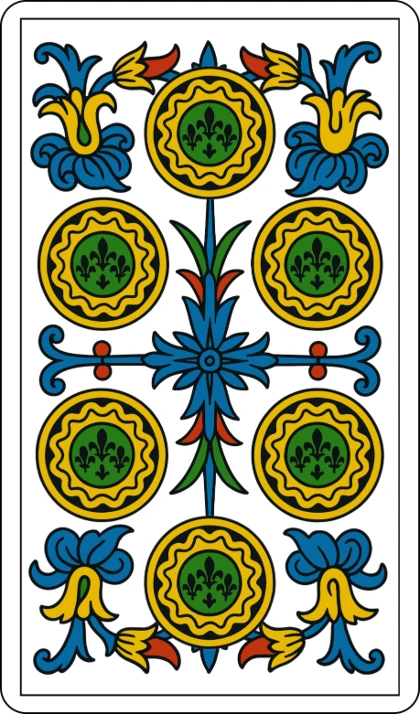
Look at the card and you see six coins, nothing more. Each coin is a round disk with a wavy yellow border, and inside each one sits a black fleur-de-lis on a green field. They are arranged in a vertical pattern: one at the top, then two, then two, then one at the bottom. Between them runs a central axis of interlaced flowering stems, the kind of ornamental rinceau that fills the Marseille minors. There is no person, no landscape, no building, no printed numeral in the margin. The number is read directly from the coins themselves. The card is perfectly symmetrical: laid on the table, nothing on its face tells you which way is up. That symmetry is not a flaw. It is the card’s nature, and it signifies both its meanings without preference.
What the card signifies
Le Six de Deniers belongs to the ornamental tradition of Marseille numerals. It does not depict a situation; it repeats its sign. Six is the number of structured effort: not the first spark of an idea, not the final harvest, but the middle passage where work must be sustained. The coins are arranged in a stable, balanced pattern, and that arrangement itself is the message. Nothing here is accidental. The fleur-de-lis inside each coin indicates a kind of order that is both material and deliberate. This card signifies that results do not appear by themselves. They are built, coin by coin, through repeated and directed action.
There is also something quietly social in this card. Six coins arranged around a shared axis suggest cooperation, the need to work alongside others rather than alone. The interlaced stems between the coins reinforce this: separate elements held together by a common structure. Le Six de Deniers does not signify wealth. It indicates the conditions under which material progress becomes possible, and those conditions are effort, association, and the willingness to sow before expecting to reap.
Upright
Upright, Le Six de Deniers signifies the axis of effort. The first thing it indicates is that results require work. There is no shortcut here, no windfall, no passive waiting. If you want the coins to line up, you must place them there yourself. This is a card of necessary labor, the kind that is not glamorous but is indispensable. It does not signify that the work will be easy; it indicates that the work is the path.
In material matters, the card indicates a positive financial evolution, but only if the required effort is actually provided. The coins are there, arranged and visible, but they are not handed over. They are shown as the result of a process. This is not a card of sudden gain. It is a card of earned progress, the slow accumulation that comes from consistent, directed action.
Le Six de Deniers also signifies association. It indicates seeking out collaborators, surrounding yourself with competent people, and not trying to carry the whole structure alone. The interlaced axis between the coins is a reminder that individual effort, however strong, benefits from being connected to the efforts of others. This is not dependence; it is the recognition that certain results require more than one pair of hands.
In all cases, the card signifies: act, sow, begin. The coins do not arrange themselves. The pattern does not emerge from waiting. Le Six de Deniers is a call to movement, to the concrete gesture that starts the process. It is a card of initiative, not of patience.
There is also an accessory meaning, separate from the main axis. Le Six de Deniers can sometimes indicate a sensation of malaise, a low mood, a quiet depression. This is not the card’s central message, but it appears often enough to be noted. The effort required may feel heavy, the work may seem thankless, and the person may feel the weight of it before seeing any result. This is not a contradiction of the card’s main sense; it is a shadow that sometimes accompanies it.
Reversed
Reversed, Le Six de Deniers signifies the axis of effort avoided. This is not the opposite of the upright meaning; it is a distinct sense in its own right. Here, the work is not done. The coins are still there, still arranged, but the person is not placing them. There is a waiting for results without having sown, an expectation that the harvest will come without the planting. The card reversed signifies: the effort is missing, and the results are therefore not forthcoming.
This is not laziness in the simple sense. It is a specific kind of avoidance, a hope that things will work out without the necessary labor. The person may look at the coins and want them, but does not reach for them. The reversed Le Six de Deniers indicates a gap between desire and action, between the wish for progress and the willingness to build it.
The card also indicates that association is lacking or not being sought. The person may be trying to do everything alone, or may be avoiding the collaboration that the upright card indicates. The interlaced axis is there, but it is not being used. The structure exists, but no one is connecting to it. This is isolation by default, not by choice.
Finally, the reversed Le Six de Deniers can indicate effort taken without direction. The person may be working hard, but the work is scattered, unfocused, not aimed at any particular result. The coins are being moved, but not arranged. Energy is spent, but it does not build. This is the frustration of busyness without progress, of motion without movement.
What nuances this reading
Le Six de Deniers, with its symmetrical arrangement and absence of any figure, takes its full meaning from its position in a spread, from the cards that surround it, and from the question that was asked. In a position that indicates the past, it may indicate work already done or avoided. In a position that indicates the present, it may describe the current state of effort. In a position that indicates what is to come, it may indicate what will be required. The card itself signifies no time; only the spread gives it a temporal frame.
The surrounding cards also matter. Next to a card of stability, Le Six de Deniers may indicate that the effort is well placed. Next to a card of rupture, it may indicate that the work is being undermined or that the association is fragile. The question asked shapes the reading too: asked about work, the card signifies professional effort and collaboration; asked about a relationship, it signifies the work that any bond requires; asked about money, it signifies earned progress rather than sudden gain. The card is not a fixed answer. It is a sign whose meaning is shaped by the context in which it appears.
Frequently asked questions
Does Le Six de Deniers signify money?
No. It indicates the conditions under which material progress becomes possible: effort, association, and the willingness to sow before reaping. The coins are shown, not given. The card signifies that results require work, not that they are guaranteed.
Is the reversed Le Six de Deniers just the upright meaning blocked?
No. In the Marseille tradition, the two orientations signify two independent meanings. Upright, the card signifies effort provided. Reversed, it signifies effort avoided, of waiting without sowing, of work without direction. It is not a negation; it is its own sense.
Why does the card have no scene or figure?
Because it is a Marseille numeral. The minor cards of this tradition are ornamental: they repeat their sign as many times as their rank, surrounded by interlaced stems and flowers. Only the sixteen court cards have figures. Le Six de Deniers shows six coins and nothing else, and that repetition is itself the message.
Can Le Six de Deniers indicate depression?
It can signify a secondary sense of malaise or low mood, but this is accessory to its main meaning. The card is not a diagnostic tool. If you are concerned about your mental health, speak to a qualified professional. The card’s primary axis remains effort, whether provided or avoided.