The Sept de Deniers: Reading the Marseille Tarot’s Card of Opulence and Debt
In brief
- Financial success is the card’s upright core: wealth, expansion, and a high standard of living, but the card never acts, you achieve it.
- Reversed, debt and serious money problems dominate, with losses and regression, yet the situation stays not insurmountable.
- The central tension is a paradox: the same material axis holds opulence or ruin, depending on your position, never a comfortable middle.
- Health appears only as a secondary echo: healing upright, illness reversed, always tied to your material state.
- This card measures concrete results, not intentions: what you have or lose, in money and comfort, not what you hope for.
Contents
The Sept de Deniers is a minor numeral card that signifies material accumulation and its shadow. Upright, it signifies opulence, financial expansion, and a level of comfort that has been earned or built. Reversed, it presents an autonomous meaning of indebtedness, regression, and economic strain, a situation that is difficult but not insurmountable.
| Suit | What it covers | Cards | Symmetrical plates |
|---|---|---|---|
| Batons | feeling, mood and the quality of emotions | 14 | 9 |
| Cups | affective life and matters of the heart | 14 | 0 |
| Swords | working life and the field of activity | 14 | 2 |
| Coins | material life and money matters | 14 | 7 |
| Total | 56 | 18 |
This axis is not the Golden Dawn's elemental grid: this school places feeling on the batons and working life on the swords.
The Card
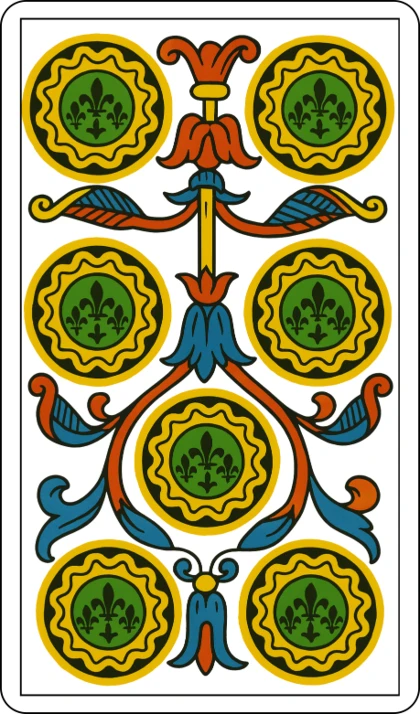
What you see on the Marseille Sept de Deniers is exactly what the card is: seven coins, nothing more, nothing less. Each coin is a round disk with a wavy yellow border, and at the center of each disk sits a black fleur-de-lis on a green field. The coins are arranged in a vertical pattern of two, two, one, two, stacked from top to bottom around a central axis of interlaced floral stems and leaves. There is no person, no scene, no landscape, and no printed numeral in the margin. The card is ornamental. The sign is repeated seven times, and that repetition is the entire message.
The floral interlacing in the center is ornamental, not narrative. The coins are held in place visually by it, creating a sense of order and symmetry. The coins themselves are identical, each one a small emblem of value, and their arrangement indicates accumulation, a pile that has been counted and arranged with care. The absence of any human figure means the card signifies a state, not an action. It signifies a condition of having, not a moment of doing.
What the Card Signifies
The Sept de Deniers is at a threshold in the suit of Coins. It is the card of material fullness, the point where accumulation has reached a level that can be seen, counted, and enjoyed. The number seven, expressed through the repetition of the coin, signifies a completeness that is tangible. This is not the beginning of a venture, nor the end of one. It is the moment when the fruits of effort have become visible and can be held in the hand.
But the card also presents a tension. The coins are manufactured objects, stamped with a fleur-de-lis, a sign of authority and legitimacy. They are not natural growths, even though they are surrounded by floral ornament. This tension between the organic and the artificial is present throughout the card. Wealth, as the card signifies, is something that is made, not something that simply grows. It requires structure, repetition, and a system of value that is agreed upon. The Sept de Deniers shows that system at its most concentrated.
The central axis of interlaced flowers is the only element that is not a coin. It is the spine of the card, the organizing principle by which the seven disks are held in place. Without it, the coins would scatter. With it, they form a column, a stack, a reserve. The card thus signifies order as the foundation of wealth. Accumulation without structure is chaos. Structure without accumulation is empty. The Sept de Deniers signifies both order and accumulation.
Upright
Upright, the Sept de Deniers signifies opulence. It signifies financial success and realization, to gains that have been made and can be counted. This is the card of expansion, of a level of material comfort that has been reached and can be enjoyed. It signifies wealth that is not merely hoped for but present, tangible, and stable. The person who draws this card upright is in a position of having, not wanting.
The card also presents the sense of accession to a very good standard of living. This is not sudden windfall, but a state that has been built, step by step, coin by coin. The arrangement of the seven disks, two by two, one by two, indicates a deliberate stacking, a careful accumulation. The comfort the card signifies is earned comfort, the kind that comes from sustained effort and good order.
As an accessory meaning, dissociated from the main axis, the Sept de Deniers upright can also signify good health and healing. In a reading concerned with the body, it signifies recovery, a return to strength, a state of well-being that has been restored. This is not the primary meaning of the card, but it is a legitimate secondary reading, one that follows from the card’s general sense of fullness and restoration.
Reversed
Reversed, the Sept de Deniers presents the axis of indebtedness. This is not the negation of opulence. It is a distinct state, with its own logic and its own weight. The card reversed signifies significant financial problems, to a situation where the coins have been spent, lost, or owed. It signifies a diminution of the standard of living, a regression from a level of comfort that was once held.
The reversed card signifies a situation that is difficult but not insurmountable. The debts are real, the losses are real, but the structure is not entirely gone. The central axis of the card, the organizing principle, remains. What has been lost is the accumulation, not the order that made it possible. The person who draws this card reversed is in a position of strain, but not of collapse. The situation can be worked through, though it will require effort and time.
The reversed Sept de Deniers also signifies losses of money and a negative evolution of the economic situation. This is not a sudden catastrophe, but a gradual erosion, a slow diminution of resources. The card signifies a period when the coins are fewer than they were, when the pile has shrunk and the comfort has thinned. As an accessory meaning, the reversed card can also indicate health problems or illness, a state of bodily strain that mirrors the financial strain of the main axis.
What Nuances This Reading
The meaning of the Sept de Deniers, with its seven coins arranged around a floral axis, depends on its position in a spread, the cards that surround it, and the question that has been asked. In a position that indicates the past, the card may signify a period of accumulation that has shaped the present. In a position that indicates the future, it may signify a state that is still to be reached, or a strain that is still to be faced. The card itself is timeless. It is the position that gives it time.
The presence of a major arcana next to the Sept de Deniers may modify the reading from the material to the existential. A court card may evoke a person, a specific agent whose actions bear on the state of having or owing. Another coin card may accentuate the material axis, while a card from another suit may evoke a different register entirely, love, work, conflict, or rest.
A question about work will orient the reading toward professional income and its fluctuations. A question about a relationship will orient the reading toward shared resources, the material foundation of a life together. A question about health will orient the reading toward the accessory meanings, recovery or strain.
Frequently Asked Questions
Does the Sept de Deniers indicate a specific amount of money?
No. The card signifies a state of opulence or indebtedness, not a sum. It signifies a level, a condition, a direction. The specific amounts, if they matter, come from the context of the reading, not from the card itself.
Is the reversed Sept de Deniers always about debt?
The reversed card presents the axis of indebtedness as its primary meaning, but it can also signify losses, regression, or a diminution of the standard of living. Debt is the central image, but the card signifies a broader state of economic strain.
Can the Sept de Deniers indicate health matters?
Yes, as an accessory meaning. Upright, it can signify good health and healing. Reversed, it can signify health problems or illness. These are secondary readings, dissociated from the main material axis, and they become relevant only when the question or the surrounding cards call for them.
Does the Sept de Deniers show a person or a scene?
No. The Marseille Sept de Deniers shows only seven coins arranged around a central floral axis. There is no person, no scene, no landscape. The card is a numeral, and like all Marseille numerals, the sign is repeated and nothing else is shown.