King of Coins: The Marseille Tarot’s Sovereign of Detachment and Reversal
In brief
- This card shows a person whose material situation is solid and satisfying, yet their defining trait is a deep detachment from possessions.
- The central tension: they hold wealth without being defined by it, investing in values that go beyond money.
- Reversed, the same card points to economic hardship and debt, a reversal of fortune that tests that very detachment.
- The card never acts; it describes a state where material security and inner freedom coexist, and the person chooses what truly matters.
Contents
In the Marseille Tarot, the King of Coins is a minor honor from the suit of Coins, one of the sixteen figured cards that carry a person rather than an ornamental numeral. Upright, it points to detachment built on a sound material base. Reversed, it carries its own axis: reversal of fortune and economic strain.
| Suit | What it covers | Cards | Symmetrical plates |
|---|---|---|---|
| Batons | feeling, mood and the quality of emotions | 14 | 9 |
| Cups | affective life and matters of the heart | 14 | 0 |
| Swords | working life and the field of activity | 14 | 2 |
| Coins | material life and money matters | 14 | 7 |
| Total | 56 | 18 |
This axis is not the Golden Dawn's elemental grid: this school places feeling on the batons and working life on the swords.
The Card
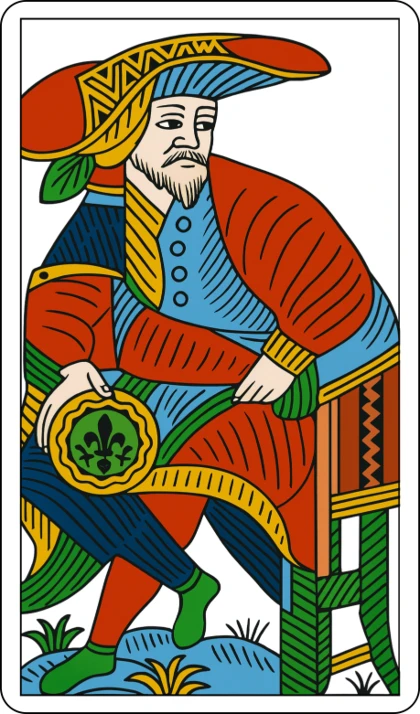
On the plate, a bearded king sits on a seat. He wears a wide hat with a turned-down brim, a red cloak over a blue doublet. He holds a single coin resting on his knee, and his other hand is raised near his beard. The plate carries no printed legend and no numeral, as is true for all sixteen honors in the Marseille Tarot.
What the Card Means
The King of Coins is the fourth honor of the Coins suit, after the Page, the Knight, and the Queen. Unlike the numbered Coins cards, which are purely ornamental, this card shows a person. That person is not acting on the coin, not counting it, not raising it for display. The coin rests on the knee, and the other hand sits near the beard, a gesture of thought or restraint. The image suggests a relation to material reality that is settled, watchful, and unhurried.
This is not a card about acquiring wealth. It is a card about what happens when wealth no longer needs to be chased. The seated posture and the wide hat give the figure an air of quiet authority, but the coin’s passive placement is the key: the person can let material things sit without constant handling. The King of Coins therefore signifies a mature, non-grasping relation to money, property, and resources.
Upright
Upright, the King of Coins points first to detachment. The person is not indifferent to material life; they simply do not need to cling to it. Their material situation is sound and satisfying, which allows them to invest energy in other values: relationships, craft, knowledge, service, or inner work. The coin on the knee is a sign that money works in the background, not as a constant preoccupation.
This card can designate a businessperson or financier, but the profession matters less than the attitude. The upright King of Coins is someone who has built or inherited a stable base and now turns toward what money cannot buy. They are little materialistic, not because they lack resources, but because resources no longer define them.
Reversed
Reversed, the King of Coins carries a distinct meaning: reversal of fortune. The coin that once rested easily now seems to slip or demand constant attention. The person may face economic difficulty, a loss of income, a failed venture, or mounting debt. This is not the upright card blocked; it is a separate state where material stability has been overturned.
The reversed King can designate a businessperson going through a hard passage, but again the card points to the condition, not the label. The hand near the beard, upright a gesture of thought, here suggests worry, second-guessing, or the pressure of obligations. The person may feel that the material layer has become heavy, urgent, and unstable, and that their usual detachment is no longer possible.
What Nuances This Reading
A single card never makes a spread. The King of Coins takes its full meaning from its position, the surrounding cards, and the question asked. In a past position, it may point to a previous period of ease or a past reversal. In a future position, it indicates a tendency, not a date. The cards around it specify the field: next to a Coins numeral, the material theme sharpens; next to a Cups honor, the detachment may concern emotional or relational wealth.
The question also matters. Asked about work, the upright King often points to a stable professional base and a non-possessive manager. Asked about love, it may point to a partner who is reliable but emotionally reserved, or to a relationship where money is not the main bond. Reversed, the same question shifts toward financial strain or a loss of footing, but the surrounding cards show whether that strain is external, internal, or structural.
Frequently Asked Questions
Does the King of Coins always represent a man?
As an honor, it often points to a person, usually a mature masculine figure, but it can also describe an attitude or a situation. The gender is not fixed; the card’s core is the relation to material reality.
Is the reversed King of Coins just the upright card blocked?
No. In the Marseille Tarot, a reversed card carries its own axis. Here it is reversal of fortune, not a blocked detachment. It describes economic difficulty and material pressure as a distinct state.
What is the difference between the King of Coins and the other Coins honors?
The Page begins, the Knight moves, the Queen holds and distributes, the King sits with the coin resting on his knee. The King is the most settled, the least grasping, the one whose authority over matter is quiet rather than active.
Does this card predict financial ruin?
A card does not predict; it signifies. The reversed King of Coins indicates a risk or a present strain, but a spread’s position and surrounding cards show the context. It is a sign to examine material obligations, not a sentence.