Nine of Coins: The Marseille Tarot’s Card of Practical Formation
In brief
- The Nine of Coins is built on practical formation: you need to study and train to grow, and this learning is the true engine for expansion in your affairs.
- The central tension is the shortcut to evolve: you want to move forward without the effort of learning, but the card insists that skipping the training leaves you stuck.
- Disinterestedness is a force here: you act out of love for the work, not for the material result, yet this can slide into indifference if you stop caring about the craft.
- The reversed side shows a postponed formation, a refusal to learn, and the disinterest turns into a cold distance from knowledge, while the secondary note of fertility and birth stays as a background echo.
Contents
The Nine of Coins is a minor card of the Coins suit in the Marseille Tarot. It is a numeral card, one of the forty rank cards from one to ten, and it carries no printed lateral number: its rank is read from the nine coins themselves. Upright, it points to formation, practical study, and disinterested work; reversed, it points to formation avoided and knowledge kept at a distance.
| Suit | What it covers | Cards | Symmetrical plates |
|---|---|---|---|
| Batons | feeling, mood and the quality of emotions | 14 | 9 |
| Cups | affective life and matters of the heart | 14 | 0 |
| Swords | working life and the field of activity | 14 | 2 |
| Coins | material life and money matters | 14 | 7 |
| Total | 56 | 18 |
This axis is not the Golden Dawn's elemental grid: this school places feeling on the batons and working life on the swords.
La planche
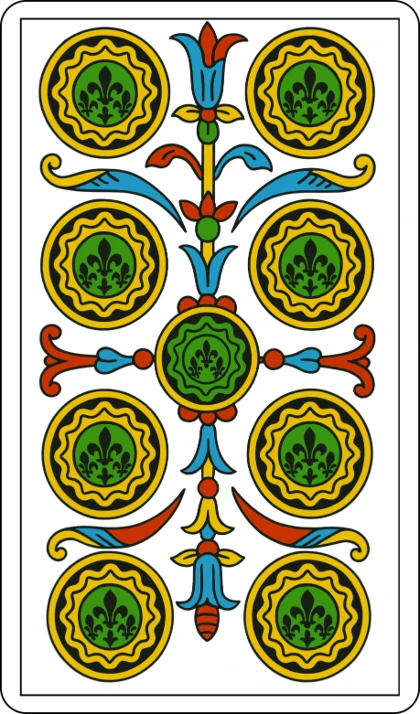
The card bears nine round coins. Each coin has a yellow wavy border and a black lily on a green field. The coins are arranged in two columns of four, with a ninth coin at the center, around an axis of interlaced flowers. No person, no scene, no printed numeral appears anywhere on the card. The design is symmetrical: placed on the table, nothing on the card indicates which way it rests. This is a numeral card of the Marseille pattern, ornamental by nature. The forty numeral cards repeat their suit sign as many times as their rank, surrounded by foliage scrolls and flowers, and nothing else. The sixteen court cards are the only minor cards that show a human figure.
Ce que dit la lame
The Nine of Coins does not tell a story. It repeats a single sign nine times, and that repetition is the whole message. The card signifies a process of accumulation, not a sudden event. Nine coins arranged in two columns of four with a central ninth coin create a structure: the four on each side support the one in the middle. This is the image of a person building competence step by step, where each learned skill becomes a support for the next. The central coin is not separate from the others; it is held by them.
The interlaced flowers around the axis add an organic quality. The card does not show a rigid grid; it shows growth that follows a pattern. A person who draws this card upright is often in a phase where learning feels alive, not forced. The black lily on each coin works as a repeated emblem of refinement. The green field behind each lily suggests something cultivated, not wild. The Nine of Coins therefore points to formation that is both structured and alive.
Because the card is symmetrical, it carries no visual bias toward one orientation. This does not weaken the card; it means the two meanings stand side by side, each complete. The upright meaning and the reversed meaning are not opposites. They are two distinct axes: one of formation, one of formation avoided. The card itself remains the same nine coins; the person who reads it chooses which axis the position and the question activate.
À l’endroit
The upright Nine of Coins first signifies a period favorable to formation. A person in this phase benefits from studies, practical training, and hands-on stages. The card points to the necessity of learning before evolving: one does not move upward without acquiring the skill that supports the move. In work and affairs, the upright Nine of Coins indicates creation, expansion, and development. These are not sudden windfalls; they grow from the competence the person has built. The card also carries a note of disinterestedness: the person does things more for love of the work than for a material result. This is not naivety; it is a form of freedom from calculation. As an accessory meaning, the upright Nine of Coins can point to fecundity or a birth, but only when the surrounding cards and the question support that reading.
À l’envers
The reversed Nine of Coins signifies formation avoided. Here the person does not simply lack the upright meaning; they actively push learning away. The desire to evolve remains, but the willingness to acquire skill is absent. The person wants the result without the apprenticeship. Disinterestedness, which upright meant doing something for love rather than gain, now turns into flat disinterest: a withdrawal of care, a shrug where there was once engagement. Knowledge stays at a distance, not because it is unavailable, but because the person refuses to approach it. The reversed Nine of Coins does not describe a temporary block. It describes a stance: the person has decided, consciously or not, that learning is not worth the effort. The nine coins are still there, but the central one no longer holds the structure together; the person sees the coins and walks past them.
Ce qui nuance cette lecture
A single card never makes a spread. The Nine of Coins takes its full meaning from its position, the cards around it, and the question asked. In a position about the past, the upright card may point to a completed training; in a position about an obstacle, the reversed card may describe a refusal to learn that blocks the way. The neighboring cards matter just as much. Next to a court card, the upright Nine of Coins can describe a mentor, a student, or a colleague whose skill is central. Next to a major arcana, the scale of the formation changes: what is learned becomes a life lesson rather than a technical skill. The question also frames the reading. Asked about work, the card speaks of professional development; asked about a creative project, it speaks of craft and practice. None of these variations is fixed. The card offers an axis; the spread gives it a direction.
Questions fréquentes
Does the Nine of Coins predict a birth?
As an accessory meaning, the upright Nine of Coins can point to fecundity or a birth, but only when the surrounding cards and the question support that reading. It is not a standalone prediction, and it never overrides the main axis of formation.
Is the reversed Nine of Coins just the upright meaning blocked?
No. In the Marseille pattern, the reversed card has its own axis: formation avoided, not formation delayed. It describes a person who wants to evolve without learning, not someone who is temporarily stuck. The two orientations are independent, not a positive and its negation.
Why does the card have no printed number?
The Marseille numeral cards show their rank through the repeated suit signs, not through a lateral numeral. The Nine of Coins displays nine coins, so the number is read from the image itself. This is true of all forty numeral cards.
Does the symmetry of the card mean it has no reversed meaning?
The drawing is symmetrical, but the two orientations still carry two independent meanings. The symmetry is a fact of the design, not a cancellation of the reversed sense. A reader who knows the card can read it either way without relying on a visual cue.