Quatre de Deniers: The Marseille Tarot’s Quiet Architecture of Stability and Blockage
In brief
- You have a stable base, a protective grip on your own resources, and the means to face any negative development without fear.
- The central tension is the grip itself: the same hold that secures you also locks everything in place, so safety becomes inertia.
- When you hold too tight, nothing moves, obstacles and delays pile up, and the situation stays blocked because you refuse to let go.
- As a secondary, dissociated signal, the reversed card points to physical difficulty, especially health or fertility, but this is not the main axis.
Contents
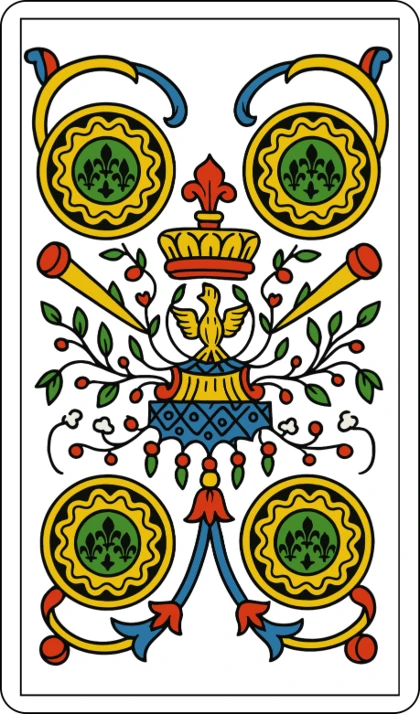
This minor card from the Coins suit carries two independent meanings: upright, it signifies material stability and protection; reversed, it points to blockage and inertia. The card shows only four coins arranged at the corners, with no person, no scene, and no printed numeral.
| Suit | What it covers | Cards | Symmetrical plates |
|---|---|---|---|
| Batons | feeling, mood and the quality of emotions | 14 | 9 |
| Cups | affective life and matters of the heart | 14 | 0 |
| Swords | working life and the field of activity | 14 | 2 |
| Coins | material life and money matters | 14 | 7 |
| Total | 56 | 18 |
This axis is not the Golden Dawn's elemental grid: this school places feeling on the batons and working life on the swords.
The card
The card displays four round disks, each with a yellow wavy border and a black fleur-de-lis on a green field. They sit at the four angles around a central axis of interlaced flowers. There is no human figure, no narrative scene, and no lateral numeral: the rank is read directly from the four coins themselves. This is one of the forty numeral cards of the Marseille Tarot, and like all Marseille minors, it is ornamental. The suit sign is repeated as many times as the rank, surrounded by floral scrolls and flowers, and nothing else.
What the card signifies
The Quatre de Deniers signifies a configuration of four equal signs placed at the corners of a square. That geometry points to a frame, a support, a perimeter that holds. When you draw this card, you are looking at a structure of containment: resources are not scattered, they are gathered and kept within a defined space. The number four in the Marseille minors often carries this sense of a stable base, a foundation with four points of contact.
Because the suit is Coins, the holding usually concerns material resources, money, possessions, or the practical means to face a situation. But the card does not describe a story; it shows a pattern. The pattern is one of secured position and defended perimeter. Nothing in the image suggests movement, loss, or sudden change. The four coins are identical and evenly placed, which reinforces the idea of balance and repetition rather than progression.
Upright
Upright, the Quatre de Deniers signifies financial stability and material protection. The person who draws this card has, or is building, the means to face what comes. There is no aggravation to fear, no negative evolution indicated by the card itself. The situation holds its shape. This is a card of security: the resources are present, the ground does not shift, and the person can rely on what has been accumulated.
The emphasis falls first on stability, then on protection. The four corners suggest a closed circuit, a reserve that is not easily drained. In a reading about money, work, or practical matters, this card points to a solid position. In a reading about emotional or relational holding, it can indicate a person who keeps their boundaries firm and their commitments steady. The upright Quatre de Deniers signifies no collapse.
Reversed
Reversed, the Quatre de Deniers carries its own axis: blockage and inertia. This is not the opposite of stability, nor the same energy simply blocked. It is a distinct meaning in which nothing evolves, no progression intervenes, and the situation remains stuck. The four coins, instead of forming a protective frame, become a closed box with no door. The person may feel that every effort meets the same wall, that time passes without movement, and that obstacles, delays, and slowdowns accumulate.
The reversed card points to a state where nothing advances. It can describe a project that does not start, a negotiation that does not conclude, a routine that repeats without change. The resources may still be present, but they are frozen. The person is not necessarily losing anything; they are simply not moving. This is a card of stagnation, not of ruin.
What nuances this reading
A single card never makes a reading. The Quatre de Deniers is timeless: it does not set a duration, a date, or a deadline. Only its position in a spread can indicate past, present, or future, and this page describes no spread. The question asked also changes the emphasis. In a question about work, the upright card points to job security; in a question about a relationship, it may point to emotional containment or a need for boundaries.
The cards around the Quatre de Deniers modulate its tone. Next to other Coins, the material dimension grows stronger. Next to Swords, the holding may become tense or defensive. Next to a major arcana, the structural pattern of the four corners may be placed inside a larger arc of change. None of these combinations is fixed; they are ways of reading the same card in context.
Frequent questions
Does the Quatre de Deniers always mean money?
No. Because it belongs to the Coins suit, it often concerns material resources, but the pattern of four stable corners can also describe emotional containment, practical security, or a defended position in any area of life.
Is the reversed Quatre de Deniers just the opposite of the upright?
No. In the Marseille Tarot, the two orientations carry two independent meanings. Upright, the card signifies stability; reversed, it signifies blockage and inertia. The reversed is not instability, but a frozen state where nothing moves.
Why does the card have no person or scene?
Marseille numeral cards are ornamental. They repeat the suit sign as many times as the rank, surrounded by floral scrolls and flowers, and nothing else. The meaning comes from the number, the suit, and the arrangement, not from a narrative illustration.