Eight of Coins: The Marseille Tarot’s Card of Unrewarded Labor and Heavy Toil
In brief
- The Eight of Coins is the card of sustained labor: you sow for a long time before any harvest, and no stroke of luck or outside help will shorten the process.
- The central tension is that the result is not guaranteed: your sacrifices may prove useless, and the value of this card is only judged on the whole spread, never on this card alone.
- When reversed, the labor turns into a burden: you exhaust yourself carrying what gives nothing back, and the effort loses its horizon, becoming pure weariness.
- This card also signifies the end of negotiations or a refusal of a loan: it marks a period of investment, not a promise of reward, and the outcome depends entirely on the context around it.
Contents
The Eight of Coins is a minor numeral card from the Coins suit. It carries two independent meanings: upright, it points to sustained labor without luck or help; reversed, it points to labor that has become a burden. This guide reads the card face, the upright sense, the reversed sense, and what modulates them.
| Suit | What it covers | Cards | Symmetrical plates |
|---|---|---|---|
| Batons | feeling, mood and the quality of emotions | 14 | 9 |
| Cups | affective life and matters of the heart | 14 | 0 |
| Swords | working life and the field of activity | 14 | 2 |
| Coins | material life and money matters | 14 | 7 |
| Total | 56 | 18 |
This axis is not the Golden Dawn's elemental grid: this school places feeling on the batons and working life on the swords.
The Card Face
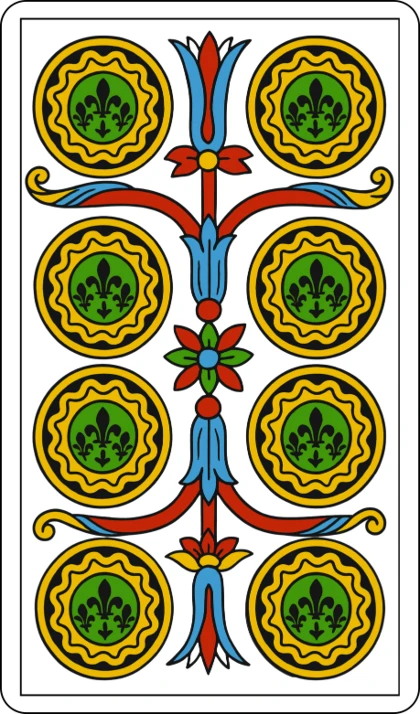
The card shows eight round coins, each with a wavy yellow border and a black stylized lily on a green center. They are arranged in two columns of four around a central axis of flowering interlaced stems. There is no person, no scene, no printed number: the card repeats its sign eight times and tells no story. The design is perfectly symmetrical, so when the card lies on the table, nothing on its face indicates which way is up.
What the Card Means
The Eight of Coins is the card of labor. It does not show a reward, a harvest, or a finished work. It shows eight identical coins arranged in a pattern, and that repetition is the key: the person must repeat the same effort many times before anything can be gathered. There is no figure to help, no tool, no open hand. The card points to a situation where the person is alone with the task.
This card carries a specific tension. The work is real and necessary, but the outcome is not guaranteed. A person may sow and still see no harvest. The card signifies that effort is not guaranteed. It only shows that effort is required. Whether the sacrifice proves useful depends on the whole spread, never on this card alone.
In practical readings, this card often signifies sustained effort without outside assistance. The person must not count on luck. The card’s symmetry reinforces this: there is no direction, no progress, only the steady repetition of the same sign.
Upright
Upright, the Eight of Coins means first of all labor. The person must sow before any harvest. There is no luck factor and no help from others. Effort, work, energy, and time are indispensable. The result is not guaranteed: sacrifices may turn out to be useless, and that judgment belongs to the whole spread.
Reversed
Reversed, the Eight of Coins carries its own meaning: labor that has become heavy. The effort continues, but without any horizon. The person exhausts themselves carrying something that yields nothing. The toil turns into wear, and the repetition of the eight coins becomes a grind rather than a discipline. This is not the absence of work; it is work that has lost its purpose and now weighs on the person. The card shows the same eight coins, but read this way, their symmetry can be read as a closed loop: no exit, no variation, only the same burden again and again.
What Nuances This Reading
A single card never makes a spread. The position, the surrounding cards, and the question change the card’s meaning. In a position about the past, it may describe work already done; in a position about obstacles, it may point to the weight of that work. Neighboring cards can show whether the labor leads somewhere or simply repeats. The question also matters: the card’s meaning varies according to the question asked. None of that can be known from the card alone.
Frequently Asked Questions
Does the Eight of Coins signify success?
No. It shows labor and repetition, but the outcome is not guaranteed. Only the surrounding cards and the position can indicate whether the effort will pay.
Is the reversed Eight of Coins just the opposite of the upright?
No. The reversed card has its own meaning: labor that has become heavy and purposeless. It is not the absence of work, but work that wears a person down.
Why is there no person on the card?
Marseille numeral cards are ornamental. They repeat the suit sign as many times as the rank, with interlaced stems and flowers, and nothing else. The Eight of Coins shows eight coins, no figure, no scene.
Does this card indicate a time frame?
No card carries a duration by itself. Only a position in a spread can frame time. The Eight of Coins is timeless: it describes a quality of labor, not a deadline.