Le Cinq de Deniers: When Progress Becomes Visible in the Marseille Tarot
In brief
- Steady, concrete progress is the card’s core: a financial project or a raise that actually lands, not a sudden windfall but a slow, certain improvement you can count on.
- The central tension is that the solution is already in view, yet you must still reach for it: the card shows you find the answer to your problem, but the result only comes after patient, continuous effort.
- When reversed, the same progression is slowed down: the improvement is delayed, the project stays in the workshop, and the solution remains visible but not yet taken, so you wait without losing the direction.
- As an accessory, the card also points to a positive health trend, but on the same gentle curve: a slow return to balance, never a separate miracle.
Contents
Le Cinq de Deniers is a minor numeral card from the suit of Coins in the Marseille Tarot. It signifies a message of progression made tangible, of financial or material matters moving forward with quiet certainty. Where the Four stabilizes, the Five shows what happens when that stability begins to grow, not through sudden windfalls but through steady, verifiable advancement.
| Suit | What it covers | Cards | Symmetrical plates |
|---|---|---|---|
| Batons | feeling, mood and the quality of emotions | 14 | 9 |
| Cups | affective life and matters of the heart | 14 | 0 |
| Swords | working life and the field of activity | 14 | 2 |
| Coins | material life and money matters | 14 | 7 |
| Total | 56 | 18 |
This axis is not the Golden Dawn's elemental grid: this school places feeling on the batons and working life on the swords.
The Card
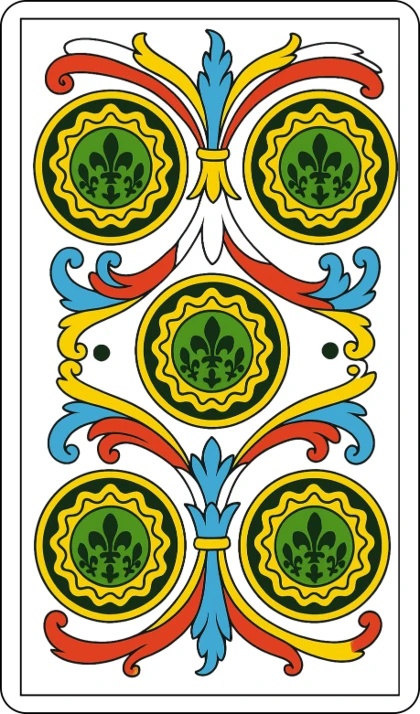
What you see on this card is exactly what the name promises: five coins, nothing more, nothing less. Each coin is a round disk with a wavy yellow border, and at the center of each sits a black fleur-de-lis on a green field. They are arranged in a pattern of two, one, two, stacked vertically around a central axis of flowering interlacing stems. There is no person, no scene, no landscape, no printed numeral in the margin. The card does not depict a story. It shows its sign five times over, and the number speaks through ornament alone.
This card is perfectly symmetrical. Lay it on the table and nothing on its face tells you which end is up. That is a fact of the drawing, and it matters: the card has both of its orientations with equal weight, and neither one is a mere shadow of the other.
What the Card Signifies
Le Cinq de Deniers belongs to the family of numeral cards, the forty cards ranked from one to ten across the four suits. These cards are ornamental by design. They show their suit repeated as many times as their rank, surrounded by foliage and flowers, and nothing else. Le Cinq de Deniers is therefore not a picture of poverty or exclusion, not a scene of two figures walking through snow. Those images belong to another deck entirely. Here, the meaning lives in the number and the suit, in the repetition of the coin and the structure of the arrangement.
Five is the number that follows the solidity of four. Four coins form a square, a stable base. Five coins introduce movement within structure. The central coin sits between the pairs above and below, creating a vertical axis, a line of growth. The interlacing stems reinforce this: they climb, they weave, they connect the coins to one another. The card signifies a process that has already begun and is now becoming visible, a progression that is not explosive but cumulative.
The suit of Coins grounds this in the material world: money, work, resources, the body, the tangible results of effort. Le Cinq de Deniers therefore points to a phase where material progress is no longer theoretical. What was being built is now showing its shape. The solutions exist, the path forward is clear, and the movement is steady.
Upright
Upright, Le Cinq de Deniers signifies the axis of progression. It signifies evolution in material matters, a financial project that is taking concrete form, an increase in income, a raise, a durable promotion. The card does not signify a sudden stroke of luck. It signifies something that grows, step by step, and that growth is reliable. The person facing this card is someone whose material situation is advancing step by step, whose efforts are producing visible results, not by force but by persistence. Things work themselves out, gradually and with certainty.
This is a card of accrual. What was planted earlier now begins to yield. The coins are not scattered; they are arranged, ordered, connected by the flowering stems. There is a logic to the progression, a sense that each step builds on the one before. Le Cinq de Deniers upright signifies: the direction is right, the work is paying off, and the improvement is real.
As a secondary meaning, dissociated from the main axis, the card can also point to a positive evolution in health, a recovery that advances without drama, a body that regains its balance through consistent care. This is not the primary reading, but it is present in the card’s quiet momentum.
Reversed
Reversed, Le Cinq de Deniers signifies its own axis: progression slowed. This is not the opposite of the upright meaning. It is not failure, not loss, not regression. It is the experience of waiting for something that is already in motion but has not yet arrived. The improvement is real, but it is held back. What was supposed to come together remains unfinished, a project still in progress, a solution that is visible on the horizon but not yet within reach.
The card reversed signifies a delay that has a shape. The coins are still there, still arranged, still connected. Nothing has fallen apart. But the movement has stalled, or it moves so slowly that it feels like standing still. The person facing this card is not facing ruin. They are facing the frustration of a door that is open but blocked, a path that is clear but long.
This is the card of the almost. The solution is in view. The promotion is being discussed. The money is coming. But it has not come yet, and the waiting itself becomes the test. Le Cinq de Deniers reversed does not signify "give up." It signifies: the progression is real, but it is not yours to force. The pace is not yours to set.
What Nuances This Reading
A single card never makes a reading. Le Cinq de Deniers takes its full meaning from where it sits in a spread, from the cards that surround it, and from the question that was asked. In a position that speaks of the past, it may signify a foundation that was laid and is now bearing fruit. In a position that speaks of obstacles, it may point to the very thing that is slowing the progression down. The same card, in the same orientation, has a different weight depending on what it is being asked to illuminate.
The surrounding cards matter just as much. Next to a major arcana that speaks of structure, Le Cinq de Deniers may signify a promotion within an institution. Next to a card of rupture, it may signify a financial matter that survives the break. The card does not exist in isolation, and its message is always filtered through the company it keeps.
The question asked also shapes the reading. Asked about love, Le Cinq de Deniers signifies less of money and more of a relationship that is growing, or one that is waiting to grow. Asked about work, it signifies income, position, recognition. Asked about a creative project, it signifies the moment when the work begins to take visible form. The card is not a fixed answer. It is a lens, and the question determines what it brings into focus.
Frequently Asked Questions
Does Le Cinq de Deniers mean poverty or financial loss?
No. That association comes from another tarot tradition that illustrates its minor cards with scenes. In the Marseille Tarot, Le Cinq de Deniers is a numeral card showing five coins arranged in an ornamental pattern. Its meaning is progression, not lack. Upright, it points to financial growth. Reversed, it points to growth that is delayed, not to loss.
Is the reversed Le Cinq de Deniers the opposite of the upright card?
No. In the Marseille tradition, the two orientations have two independent meanings. Upright, the card signifies progression that is happening. Reversed, it signifies progression that is slowed, held back, or still in progress. The reversed card is not failure. It is the experience of waiting for something that is already on its way.
Why does the card have no number printed on it?
Because the Marseille numeral cards do not have a printed numeral in the margin. The number is read directly from the coins themselves. You count them: five. The card does not need a label. Its meaning is in its sign, repeated five times, arranged around a central axis.
Can Le Cinq de Deniers indicate a specific timeframe?
No. A card is timeless. It does not have a duration, a date, or a deadline. Only the position of the card within a spread can suggest a relationship to time, and that depends entirely on the structure of the reading. Le Cinq de Deniers signifies a quality of movement, not a schedule.