La Reine de Deniers: Material Ease and the Independent Shadow of Greed in the Marseille Tarot
In brief
- Material ease is the core of this card: you can have a comfortable, secure situation and a better standard of life, but the card only signifies this state, it does not act for you.
- The central tension: the same opulence that brings comfort and security can turn into greed and luxury, a love of money that makes you act only for more goods.
- This card can designate a woman, a businesswoman, an accountant, but only as a figure: the person is the subject, the card is a mirror of a relationship with the material.
- When reversed, the card signifies a difficult passage for that businesswoman, or a person who is interested only in gain, but the card does not cause it, it only points to a state of excess or scarcity.
- Hold the paradox: ease and opulence are not a problem, but the card warns you to keep the material as a tool, not as a master.
Contents
La Reine de Deniers is a minor honor from the suit of Deniers in the Marseille Tarot. Upright, it signifies material ease, a secure standard of living, and the confidence that comes from well managed resources. Reversed, it carries its own distinct meaning: greed, love of money, and a calculating relationship to possessions. No single card sets a timeline; only its position in a spread can do that.
| Suit | What it covers | Cards | Symmetrical plates |
|---|---|---|---|
| Batons | feeling, mood and the quality of emotions | 14 | 9 |
| Cups | affective life and matters of the heart | 14 | 0 |
| Swords | working life and the field of activity | 14 | 2 |
| Coins | material life and money matters | 14 | 7 |
| Total | 56 | 18 |
This axis is not the Golden Dawn's elemental grid: this school places feeling on the batons and working life on the swords.
The Plate
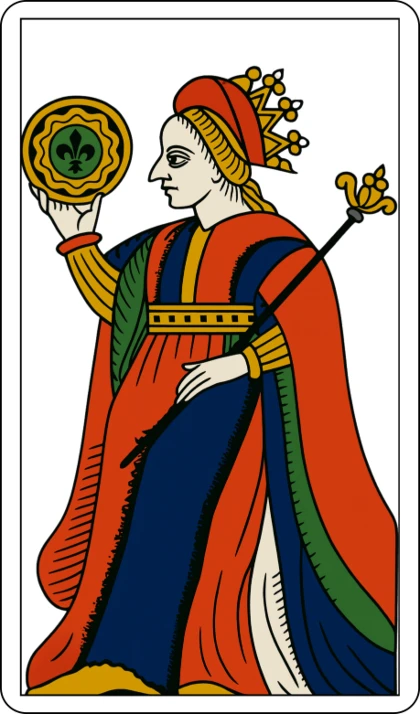
On the Marseille plate, La Reine de Deniers shows a crowned queen in profile, facing left. She wears a red mantle over a blue robe. One hand holds a raised coin, the other holds a scepter. The card carries no printed title and no number. As one of the sixteen court figures, it is a minor card that actually depicts a person, unlike the forty numbered pip cards of this deck, which show only repeated suit symbols and ornament.
What the Card Signifies
This card points to a person’s relationship with the tangible world: money, comfort, goods, and the management of resources. The raised coin is not hidden or clutched; it is displayed with authority. The scepter reinforces that authority, but it is a personal authority, rooted in daily competence rather than institutional power. La Reine de Deniers does not describe sudden events. It describes a quality of presence in material life, whether that quality is ease or greed.
Upright
Upright, La Reine de Deniers signifies material ease. This is not a vague comfort but a secure material situation, the kind that lets a person plan without constant fear of lack. The card points to an accession to a better standard of living, a step upward in how one lives, eats, dresses, and saves. At its fullest, it can indicate opulence, but even in modest form it speaks of a life where resources are sufficient and well managed.
The raised coin and scepter reinforce this reading: the person holds wealth visibly but without desperation. The card can designate a businesswoman, a shopkeeper, or an accountant, someone whose daily work is the competent handling of money and goods. The emphasis falls on lived ease, not on accumulation for its own sake.
Reversed
Reversed, La Reine de Deniers does not mean the absence of ease. It means the presence of a different drive: greed. The person’s relationship to money becomes possessive and calculating. Materialism, love of luxury, and love of money take the place of simple comfort. The raised coin now reads as a display of wealth for its own sake, and the scepter as a tool of control over resources and people.
This orientation can point to a businesswoman going through a difficult patch, where financial pressure sharpens an already interested streak. It can also describe someone who acts only for more money and goods, measuring every relationship by what it brings. The greed here is not a lack of ease; it is an active, hungry posture toward the material world.
What Nuances This Reading
A single card never makes a reading. La Reine de Deniers signifies differently according to its position in a spread. If it appears in a position that describes a person, it points to someone with a particular relationship to material life. If it appears in a position that describes an obstacle or a resource, the same card reads differently. Surrounding cards matter: next to other Deniers, the focus tightens on money and tangible assets; next to major arcana, the material theme may be framed by a larger life passage. The question asked also shapes the reading. In a question about work, upright ease may mean professional stability; in a question about inheritance, reversed greed may mean a conflict over assets. None of this is fixed by the card alone.
Frequently Asked Questions
Does La Reine de Deniers always represent a woman?
Not necessarily. As a court figure, it often points to a person, frequently a woman or someone in a traditionally feminine role, but it can also describe an attitude toward material life regardless of gender. The card’s core is the relationship to money and comfort, not biological sex.
Is the reversed La Reine de Deniers just the upright meaning blocked?
No. In the Marseille Tarot, reversed cards carry independent meanings. The reversed La Reine de Deniers signifies greed and materialism, not a lack of ease. It is a distinct axis, not a negation of the upright.
Does this card predict wealth or poverty?
No single card predicts a financial outcome. La Reine de Deniers describes a quality of relationship to material resources: ease and security upright, greed and possessiveness reversed. Only the position in a spread and the surrounding cards can indicate whether that quality is present, growing, or challenged.
What is the difference between La Reine de Deniers and other court figures in the same suit?
La Reine de Deniers focuses on material ease and the personal management of resources. Other court figures in the suit carry different nuances of authority, service, and action. The queen’s raised coin and scepter show command, but her profile and robe emphasize embodied ease rather than institutional rule.