Why Birth Chart Readings Feel so Accurate to You
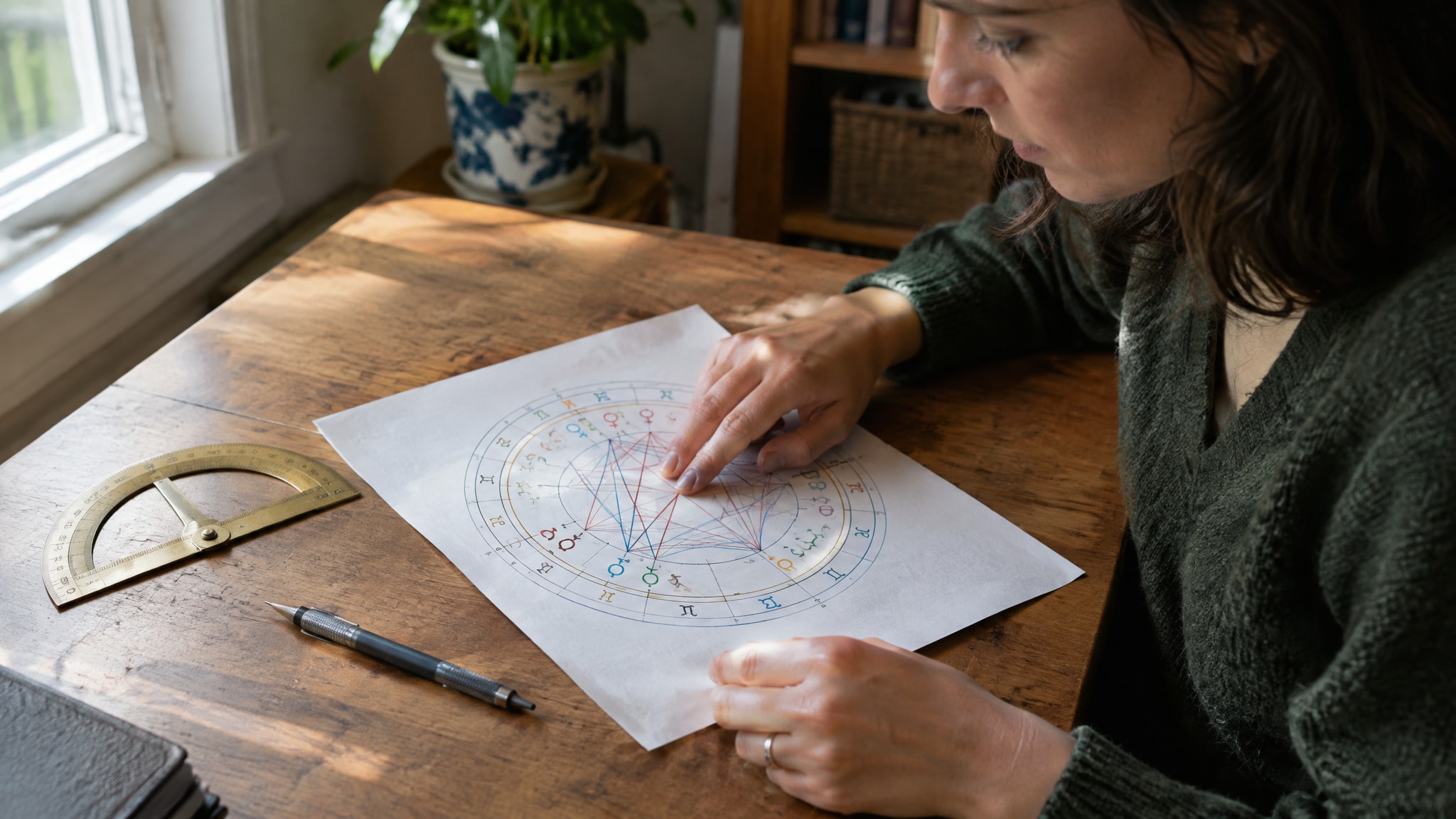
Some readings land with a small shock. A line about how you hold back in love, or how you work best alone, and you think: yes, that is me.
Why birth chart readings feel so accurate has two answers, and both are worth knowing. One is technical: a well-computed chart is built from exact inputs and read as a whole. The other is psychological: the mind is very good at recognising itself in a description.
This piece walks through both, plainly, so you can enjoy a reading without being fooled by it.
What Birth Chart Readings Are
A natal chart is a map of the sky at the moment and place you were born. It records where the Sun, Moon and planets stood, which sign was rising on the eastern horizon, and how those positions divide into twelve houses.
A reading is an interpretation of that map. It is not a forecast. It describes themes, tensions and strengths that astrological tradition associates with those positions, and it leaves you to decide what fits.
When people say a reading "feels like it knows you," they are describing an experience. The chart does not know anything about you. What happens is recognition, and recognition is a fact about the reader as much as the reading.
Why Specific Statements Feel More Accurate
A specific sentence gives you something to test. A vague one gives you nothing to push against, so it quietly passes.
Specificity Versus Vague Horoscope Statements
Set two lines side by side. The first: "This week, a Virgo may feel pressure to be perfect." The second: "Your Moon in Virgo in the sixth house suggests you settle your nerves through routine, and that daily work is where you feel most exposed to your own standards."
The first fits almost anyone, and it is never really tested, because nearly every reader can find a moment of perfectionism somewhere. The second names a placement, a house and a life area. You can hold it up against your own habits and keep it or reject it.
That openness to rejection is what makes it feel earned. A statement that could be wrong, and isn't, carries more weight than one that could never be wrong at all. If you want the structural comparison in more detail, here is how a personal reading differs from a generic horoscope app.
Personalization in Astrology, Explained
Personalization in astrology does not mean flattery. It means the calculation starts from your exact birth date, time and place, and changes when any of them changes.
Birth time matters most. The Ascendant moves through all twelve signs in a single day, roughly one sign every two hours, and the house cusps shift with it. Birth place matters too, because the horizon you were born under depends on your latitude and longitude. Two people born on the same day in different cities can have different Ascendants and different houses.
Your Astral Life computes charts with an in-house calculation engine built on NASA/JPL ephemerides, so a reading begins from those exact coordinates. Personal detail comes from the inputs, not from guessing at your mood. You can read more on why the Ascendant anchors the rest of the chart.
Precision of this kind makes a reading specific. It does not, on its own, make it true.
The Psychology of Personalized Readings
Specificity explains part of the pull. The rest happens inside you, and it is a well-studied part of how people recognise themselves.
Why General Statements Start to Feel Personal
In a classic psychology demonstration, people were given the same generic personality sketch and told it was written for them. They rated it as strikingly accurate. The psychologist Bertram Forer ran it, and the result is now called the Forer, or Barnum, effect.
The sketches work because of how they are built. They flatter a little ("you have a great deal of unused potential"). They hedge ("at times you are outgoing, at other times reserved"). They describe inner states nobody can easily check from outside.
Cold readers use the same tools: flattering generalities, hedged guesses, and statements that bend to whatever the sitter says. This is the core of why astrology feels true to many people, and it applies to any broad personality language, not only to astrology.
None of this makes you gullible. Seeing yourself in a description is how people make sense of themselves.
How Memory Completes the Match
Confirmation bias does the next piece of work. Once a line seems right, you notice the evidence for it and forget the evidence against.
Selective recall adds to it. You remember the sentence that hit and let the three that missed fade. You also supply the context yourself: "restless in friendships" becomes the move you made in 2019, the friend you drifted from, the dinner you cancelled.
In effect, you become a co-author of the match. The reading offers a frame, and your memory fills in the picture. Knowing this does not spoil a reading. It helps you decide which lines deserve to stay.
How Birth Chart Interpretation Works
Chart interpretation is a craft of relationships. An astrologer rarely reads a placement alone; the meaning comes from how placements speak to each other.
The Sun describes where you direct your vitality. The Moon describes how you respond and what steadies you. The Ascendant describes how you meet the world. The houses place each of these in a life area, and the aspects, the angles between planets, show where they cooperate or pull against each other.
When a reading works, one theme surfaces again and again across these layers. A Moon that needs privacy, an Ascendant that observes before it speaks, and a tense aspect to Mercury may all point at the same quality: a person who thinks carefully before sharing. For a worked example, see how the Sun, Moon, and Rising sign work together.
Why Connections Matter More Than Single Placements
A single placement is a fragment. Several placements pointing the same way become a portrait.
Disconnected template text cannot do this. Paste together one paragraph per planet and the result contradicts itself: bold in one line, timid in the next, with nothing to reconcile them. The platform's interpretations are built to cohere across a whole chart, so the pieces explain one another instead of competing.
Compare that with cold reading. A live cold reader adjusts in the moment to a sitter's face and replies, dropping what fails and pressing on what works. A written reading cannot do that, because it cannot see you. So its resonance has to come from specificity and internal consistency on the page.
That is a demanding standard, and it is one you can check for yourself.
What the Feeling of Accuracy Can and Cannot Prove
The feeling is real. It is worth understanding, and it is not something to be embarrassed about.
It is also not evidence on its own. Controlled, double-blind tests have generally found that astrologers cannot match natal charts to the people they belong to better than chance. The scientific assessment of astrology is broadly sceptical about its power to predict or measure personality.
So a strong sense of recognition tells you that a reading was well made, or that you are good at finding yourself in words, or both. It does not show that planetary positions cause personality traits. If you need proof of that kind, a reading is not the place to find it.
What a reading can do is give you a structured set of questions about yourself. That is a modest claim, and it holds up.
Insight Is Not Prediction
Insight describes tendencies, patterns and questions worth asking. Prediction promises a specific event at a specific time. A good reading offers the first and stays honest about the second.
"You tend to take on more than you admit, especially in work that feels like service" is insight. You can notice it, argue with it, and change what you do. "You will leave your job in March" is a prediction, and it leaves you nothing to do but wait.
A Tendency Is Not a Timetable
A tendency describes how you are inclined to move, not where you will end up. Think of it as the grain in a piece of wood: it shows which way the wood splits easily, but you can still cut across it.
Readings that treat the sky as a fixed script do you a disservice. Readings that treat it as a lens give you room to choose. You might learn that you decide best after a night's sleep, or that you ignore your own limits when you are praised. Neither is a verdict. Both are useful when a decision is on the table.
From Curiosity to Self-Understanding
Two simple checks help you notice the difference between a good reading and a pleasant one. They do not prove a reading, but they help you read it well.
- Specificity: does a statement name a placement, a house and a life area, so you can test it against your own experience?
- Coherence: do the placements point toward the same themes, or does each paragraph stand alone?
Hold a reading to both, and keep only what survives. Reject the rest without guilt.
A sensible first move is a free birth chart reading as a first step. Enter your exact birth date, time and place, then read it slowly and mark what fits and what doesn't. If a few lines stay true after a week, you have learned something about how you describe yourself.
If you want the full synthesis, with Sun, Moon, Ascendant, houses and aspects woven into one connected portrait, a one-time report is the natural next step. It gives you one deep reading to keep, with no ongoing commitment. Those who prefer recurring access can look at how to choose an astrology membership, and if cost is your question, here is what a professional reading costs.
Start with the free reading, test it against your own life, and let that decide whether you go deeper.
Frequently asked questions
What is the fakest zodiac sign?
No sign is fake. Every sign marks a real division of the sky, and your chart is computed from it. The joke usually reflects sun-sign stereotypes, which are broad by design. A full chart combines your Sun, Moon, Ascendant and more, so one sign alone says little about you.
Which are the kindest zodiac signs?
No sign owns kindness. Popular rankings rest on sun-sign stereotypes, and controlled tests have not shown that a sun sign predicts how kind someone is. In a chart, traditions look at the Moon, Venus and the aspects between them, and even then they describe tendencies, not guarantees.
What did Einstein say about astrology?
Be careful with quotes online. Many lines attributed to Einstein about astrology are hard to trace to a reliable source. He was a physicist, not an authority on whether astrology helps people reflect, so judge the practice by how well a reading holds up against your own life.
What if I don't know my exact birth time?
The Sun and most planets can still be placed from your birth date. The Ascendant and house cusps cannot be fixed without a birth time, because they shift through all twelve signs in a day. Check your birth certificate or ask a family member, since an exact time gives the most precise chart.