Vedic Vs Western Astrology: Which Is More Accurate for You?
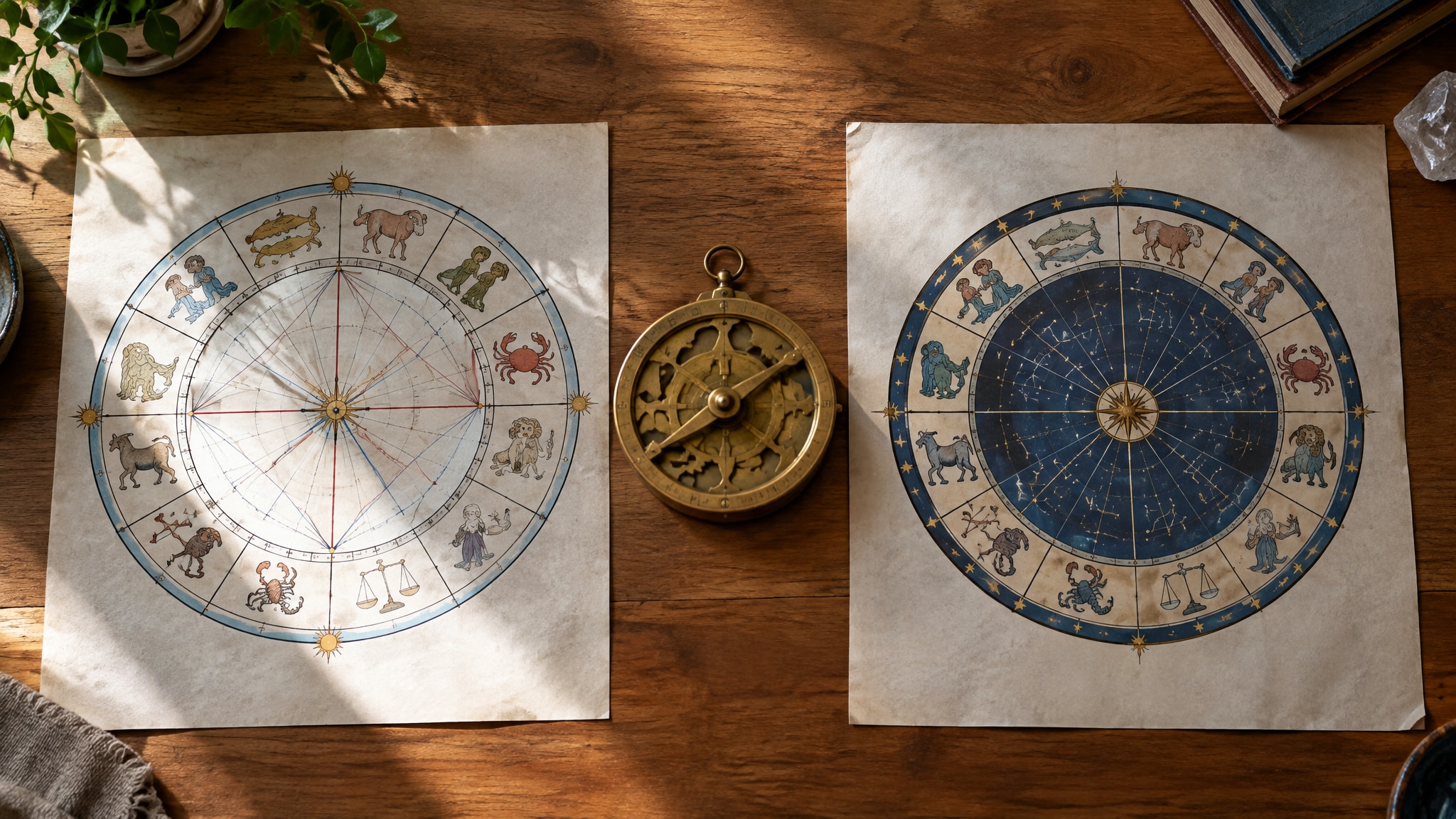
Neither system is more "true" than the other. Vedic and Western astrology start from the same sky and ask it different questions, so the better lens depends on what you want to understand.
Most comparisons stop at theory. This one goes a step further: you can have both charts computed from the same birth details and read them side by side. That is where the difference stops being an argument and becomes something you can see for yourself.
Two Zodiacs, One Sky: Sidereal vs Tropical Explained
Every astrology chart divides the sky into twelve signs of thirty degrees each. The disagreement is about where the first sign begins, and that one decision shifts every placement that follows.
The Tropical Zodiac Follows the Seasons
Western astrology mostly uses the tropical zodiac. Its starting point is the March equinox, the moment day and night are equal in length. Aries begins there, and the other signs follow in order.
This makes the tropical zodiac a calendar of light and season. Aries marks spring's opening, Cancer the summer solstice, Libra the autumn equinox. You read the signs as rhythms of the year, which is why tropical charts so often speak the language of temperament and growth.
The Sidereal Zodiac Follows the Fixed Stars
Vedic astrology uses the sidereal zodiac, measured against the fixed stars behind the planets. Its starting point is a star-based marker, not an equinox.
The two zodiacs once lined up closely. They no longer do, because Earth's axis wobbles slowly, a movement called axial precession. The equinox drifts backward against the stars by about one degree every 72 years. The gap between the two zodiacs is called the ayanamsa, and it has widened over the centuries to a little more than 24 degrees today, depending on which ayanamsa a tradition adopts.
Here is the effect in plain terms. A reader born in early April is an Aries in the tropical zodiac and a Pisces in the sidereal zodiac that Vedic astrology uses. The sky is the same; only the starting point differs.
That is why one birth date can carry two Sun signs. For most people the sidereal Sun sits one sign earlier than the tropical one. If you were born in the last few days of a tropical sign, the two may agree.
Much of the Chart Is Shared
Strip away the zodiac and the two traditions are reading the same architecture. Both look at the Sun, the Moon, the rising sign, the twelve houses and the angles the planets make to one another. Both read these through signs and houses, and both treat the chart as one connected picture rather than a list of parts.
If you want to see how those three main placements interact, here is how the Sun, Moon and rising sign work together in a single chart.
So the real disagreement sits in two places. The first is the zodiac anchor, which moves each planet by about a sign. The second is the technique layer: which bodies are used, how houses are drawn and how time is read. Those are the contrasts that matter in practice, and we come to them below.
A shared foundation also means you are not choosing between two unrelated sciences. You are choosing between two ways of tracing the same sky.
Is Vedic Astrology More Accurate Than Western?
Neither tradition has been shown to predict life events better than the other. "More accurate" only means something once you say what you are measuring, and there are three honest candidates: calculation precision, internal coherence, and usefulness for the question you are asking.
Calculation Precision Is Shared Ground
On the maths, the two systems stand level. Planetary positions come from an ephemeris, a table of where each body sits at a given moment, and both traditions can draw on the same one. The sidereal chart simply subtracts the ayanamsa from the tropical longitude.
At Your Astral Life, charts come from an in-house calculation engine built on NASA/JPL ephemerides, for both the Western and the Vedic reading. A careful computation is the floor for either tradition, and it is what separates a computed reading compared with a generic horoscope that only knows your Sun sign.
Precision, though, is not prediction. A chart can be flawlessly computed and still be a tool for reflection rather than a forecast.
What Controlled Testing Has and Has Not Shown
Controlled scientific tests have not shown either tradition to predict life events reliably. That is the prevailing assessment, and it applies equally to Vedic and Western methods.
So when a practitioner tells you their system is the more accurate one, read it as that tradition's own position, not a measured result. Jyotish holds that its timing methods are sharper. Western practitioners often hold that tropical symbolism is more psychologically exact. Each view is coherent inside its own framework. Neither has been separated from the other by a test.
This is not a reading that will tell you what will happen to you. If you want guaranteed predictions, no honest astrologer of either tradition can supply them.
What you can test is fit. Does the chart describe a pattern you recognise? Do its themes hold together, or does each paragraph contradict the last? Your own experience is the most useful instrument you have. If you also wonder how numerology and astrology compare on accuracy, the same questions apply.
How the Two Charts Differ in Practice
Once the zodiac is set, the techniques diverge. This table sets the main contrasts side by side.
| Vedic (sidereal) | Western (tropical) | |
|---|---|---|
| Zodiac anchor | Fixed stars | The seasons (March equinox) |
| Bodies used | Visible planets plus the lunar nodes | Most charts add Uranus, Neptune and Pluto |
| Houses | Whole-sign houses common | Quadrant systems such as Placidus common |
| Lunar layer | Nakshatras, the lunar mansions | Not a central feature |
| What leads | Moon sign (rashi) often leads | Popular writing leads with the Sun |
| Timing | Dasha periods | Transits and progressions |
Whole-sign houses give each sign one house, so the rising sign fills the first house entirely. Quadrant systems divide the houses by time or space from the angles of the chart, which makes houses of unequal size. The two methods can put the same planet in different houses.
The nakshatras divide the zodiac into 27 lunar mansions, each tied to the Moon's position. They add a fine-grained lunar layer that Western charts do not have in the same form.
Timing: Dasha Periods Versus Transits
Western timing watches the planets in motion. A transit asks where Saturn or Jupiter is now, and how that touches your natal chart.
Vedic timing works from a calendar built into the birth moment. In Vimshottari dasha, the Moon's nakshatra at birth determines the opening planetary period. The sequence then unfolds across a lifetime, so the birth moment sets the timing map itself.
Many readers find this clearer. You can see which planetary chapter you are in and when the next one begins, and that gives the reading a narrative shape. Still, it is a claim of the method and not a measured result. Treat a dasha as a way to frame a season of life, and you will use it well.
Which Astrology System Is Right for You?
The question is better asked by what you want from the chart. Neither system ranks above the other; each is tuned to a different kind of curiosity, and you can pick up whichever suits the one you are carrying now.
Either reading is a tool for personal choice. It gives you language and structure for thinking, and the decisions stay yours.
Questions That Lean Toward Each Lens
Questions that often start with a Vedic lens:
- When might a period of change or consolidation begin?
- What life stage am I in, and what does a traditional framework say about it?
- How does my Moon, and the nakshatra it sits in, shape my inner life?
Questions that often start with a tropical Western lens:
- What is my temperament, and how do I respond under pressure?
- How do the seasons and my own rhythms line up?
- What am I trying to understand about myself right now?
Relationships raise both kinds of question at once. If you are reading a partnership, the same two lenses applied to compatibility show how each tradition weighs two charts together.
Many people end up reading both. One lens tends to clarify the other, and the places where they disagree are often the most interesting part of the conversation.
Getting Both Readings From the Same Birth Data
Reading both has been awkward in the past. You needed two astrologers, two sets of assumptions and, often, two slightly different versions of your birth details.
One Set of Birth Details, Two Computed Charts
Your Astral Life computes charts with an in-house engine built on NASA/JPL ephemerides and offers both Western and Vedic readings. One set of details, your date, time and place of birth, yields both charts. Any difference you then see comes from the lens, not from the data.
That also means the birth time matters. The rising sign and the Moon travel through the zodiac within hours, so a small error in birth time can shift the rising sign and the house cusps. Near a boundary, it can change the Moon's nakshatra, which in turn alters the Vedic dasha sequence. Why your ascendant sign anchors the chart explains why that placement is the most sensitive of all.
If your birth certificate gives a time, use it. If you only remember it roughly, treat the rising sign, houses and dashas with extra care.
Comparing the Two Readings Firsthand
A simple method works better than deciding in one sitting.
- Read the Western and the Vedic reading in full, without skipping to the parts you like.
- Mark where they converge, such as a theme that appears in both, and where they diverge.
- Test each against a past event or a recurring pattern in your own life.
- Come back over several weeks, and note what still rings true.
Treat step three as reflection, not proof. A reading that fits a past event shows that it is a useful mirror. It does not show that the system predicts anything.
Patience is the point. Your first impression of a chart often changes after a week of living with it, and the comparison grows richer each time you return.
Choosing an Online Vedic Reading You Can Trust
A Vedic astrology reading online can look polished and still tell you nothing about how it was made. Before you trust any platform's accuracy claims, check for these:
- A named ayanamsa. The offset has several versions, and the reading should say which one it uses.
- A stated ephemeris source. You should be able to see where the planetary positions come from.
- A labelled house system. Whole-sign or quadrant, it should be named.
- Transparent timing periods. The dasha dates and the logic behind them should be visible.
- One coherent chart. The interpretation should read as a single portrait, not as template paragraphs stitched together.
For a closer look at these tests, here is how to judge an astrology website's accuracy claims.
Your Astral Life builds its interpretations around your own chart rather than generic sun-sign text, and states its ephemeris foundation as NASA/JPL.
The simplest way to learn the difference between the two lenses is to see it in your own chart. Generate a Western and a Vedic reading from one set of birth details, hold both up against a question you are living with, and start with a free birth chart reading.
Frequently asked questions
Will my Sun sign change if I switch to Vedic astrology?
For most people, yes. The sidereal Sun usually sits one sign earlier than the tropical Sun because the two zodiacs are offset by a little more than 24 degrees. If you were born in the last few days of a tropical sign, your sign may stay the same.
Which astrology site is the most accurate?
No site can honestly claim to predict life events, because controlled tests have not shown that for any astrology tradition. What you can judge is calculation and transparency: a stated ephemeris source, a named ayanamsa, a labelled house system and visible timing periods. Also check whether the interpretation reads as one coherent chart.
What is the main difference between tropical and sidereal astrology?
The tropical zodiac begins at the March equinox and follows the seasons. The sidereal zodiac is measured against the fixed stars. Both read the same sky, but the starting point moves every planet by roughly one sign.
Do I need an exact birth time for a Vedic reading?
The closer, the better. A small error can shift your rising sign and house cusps, and near a boundary it can change the Moon's nakshatra, which sets your dasha sequence. If your time is uncertain, treat those parts of the reading with caution.
Is it contradictory to read both Vedic and Western charts?
No. The two traditions work from the same planetary positions and ask different questions of them. Many people use Vedic methods for timing and life stages, and tropical Western ones for temperament and self-reflection.