Vedic Birth Chart Reading: The Sky Through Another Lens
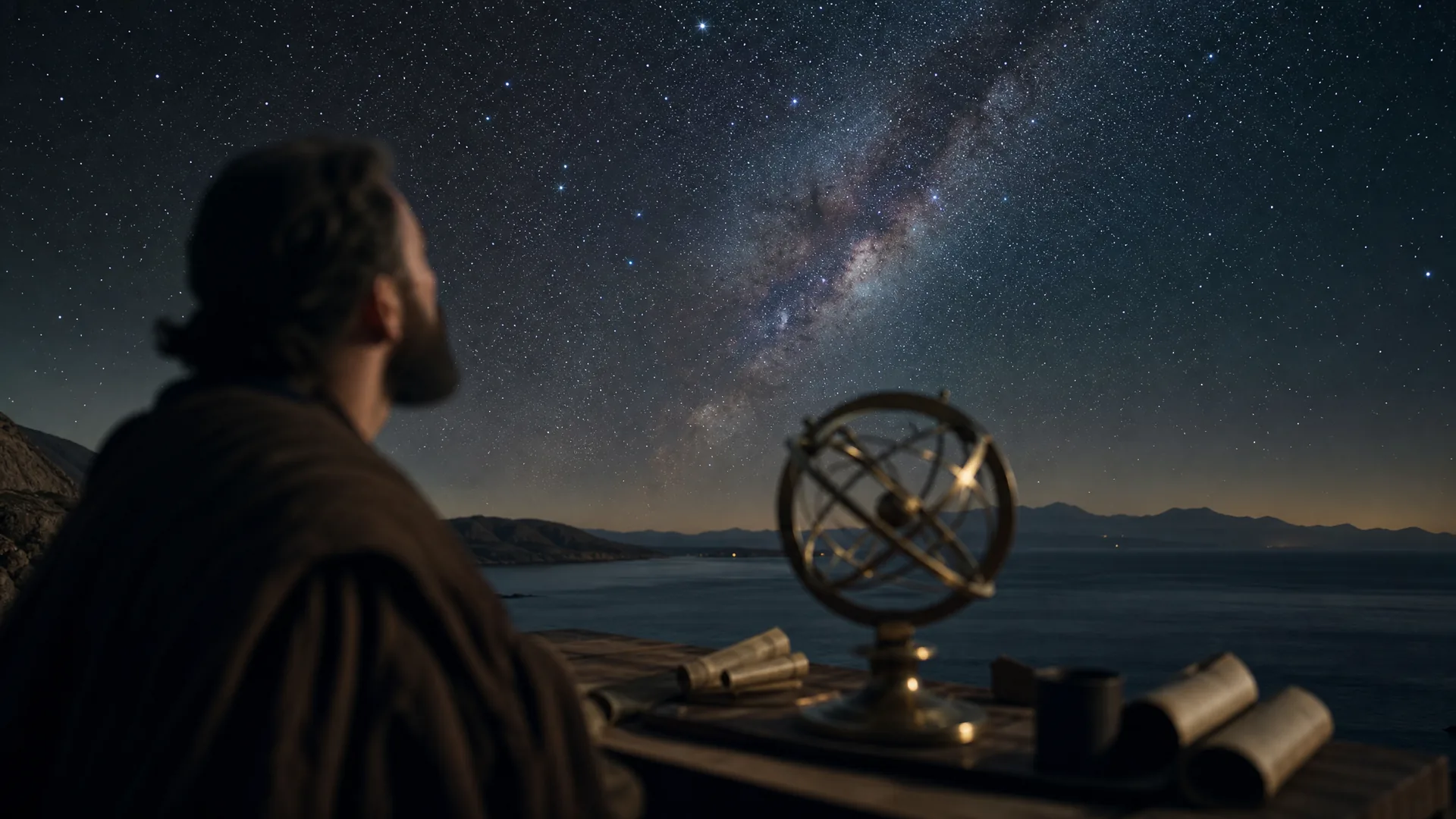
The moment you were born, the sky held still just long enough to be measured twice. One measurement starts from the seasons, the sun's return to the point of spring. The other starts from the stars themselves, fixed against the slow wheel of the galaxy. Both are honest readings of the same instant. They just answer different questions.
This is the quiet distinction at the heart of a vedic astrology birth chart reading online. It's not about which system is correct. It's about which lens you want to look through, and why the two can agree without arguing.
Two Skies, One Moment of Birth
Western astrology, the kind most people grow up with, uses the tropical zodiac. It anchors Aries to the spring equinox every year, regardless of where the actual constellations sit. It's a calendar of light and season, built around Earth's relationship to the sun.
Vedic astrology, called Jyotish in Sanskrit, uses the sidereal zodiac instead. It anchors its signs to the visible constellations as they actually appear in the sky tonight. Earth's axis wobbles slowly over thousands of years. Astronomers call this motion precession, and it's why the tropical and sidereal zodiacs have drifted apart over the centuries. They started aligned. They no longer are.
Neither approach is more true than the other. They're two coherent coordinate systems, each internally consistent, each with its own long tradition of interpretation.
Sidereal vs Tropical Astrology: What Actually Changes
In practice, the difference between sidereal vs tropical astrology shows up as a shift in your placements. Your sun sign, moon sign, and rising sign can all move once you switch from tropical to sidereal calculation, often into the adjacent sign.
This is the difference between Vedic and Western astrology in its simplest form. Western astrology reads the seasonal sky. Vedic astrology reads the starry one. Both get calculated with the same rigor. They just start from a different zero point.
What Is a Vedic Birth Chart, Exactly?
A Vedic birth chart, or Jyotish chart, plots the same planets, houses, and aspects as a Western natal chart. What changes is the backdrop. Instead of the tropical zodiac, it places every planet against the sidereal positions of the constellations, then builds its houses and yogas from there.
The word Jyotish means "the science of light." That name isn't decorative. Vedic astrology has always treated the sky as something to measure with precision, not simply intuit. Its charts start with calculation, then move to interpretation.
So what is a Vedic birth chart, and how does it differ from a natal chart in the Western sense? Structurally, they're close cousins. Both use your exact birth time, date, and location. Both divide the sky into twelve houses. The difference is the coordinate system underneath, sidereal instead of tropical, and the layers Vedic astrology adds on top. Nakshatras and dasha periods, in particular, have no direct Western equivalent.
The Ayanamsa: Precision Behind the Shift
The gap between the tropical and sidereal zero points has a name: the ayanamsa. It isn't a mystical adjustment. It's a measured astronomical offset that tracks the precession of the equinoxes, a motion that moves at a slow, calculable rate.
The ayanamsa has drifted to roughly 24 degrees today. That's the accumulated result of a precession Vedic astronomers have tracked and refined for centuries. Get this number wrong, or use an outdated version of it, and every planet in a Vedic chart lands in the wrong sign. Get it right, and the chart is exactly as precise as its tropical counterpart. It's just shifted to a different starting line.
Nakshatras: The 27 Lunar Mansions
Western astrology stops at twelve signs. Vedic astrology adds a finer grid on top: the 27 nakshatras, or lunar mansions, each spanning roughly 13 degrees and 20 minutes of the sidereal zodiac.
Each nakshatra carries its own character, ruling planet, and mythology, layered onto the sidereal moon's position at your birth. Two people with the same Vedic moon sign can land in different nakshatras, and read quite differently as a result.
Nakshatra Meaning in Your Birth Chart
The nakshatra meaning in a birth chart is best understood as texture, not replacement. Your moon sign tells you the broad emotional weather. Your nakshatra tells you the specific terrain: the finer instincts, the sensitivities, the particular flavor of how you process feeling and memory.
This is one of the clearest ways Vedic astrology out-resolves a purely sun-sign or moon-sign reading. It doesn't contradict the broader placement. It sharpens it.
Dasha Periods: Reading Time, Not Just Character
Western astrology tends to describe who you are. Vedic astrology spends just as much energy describing when. That emphasis on timing is one of its most distinctive contributions, and it comes from the dasha system.
Jyotish has historically placed as much weight on timing, through dashas, as on character description. That's why Vedic astrologers tend to speak in terms of life phases rather than fixed, unchanging traits.
How the Vimshottari Dasha System Works
The most widely used version, the Vimshottari Dasha, divides your life into sequential planetary periods, each ruled by one of nine planets for a fixed number of years. Your nakshatra at birth determines the sequence and lengths, so no two charts run through them in quite the same order.
Where Western astrology looks to transits, the current sky moving against your fixed chart, Vedic astrology layers dasha periods as an internal clock, unique to your birth moment. It's less a forecast, more a map of seasons within a single life.
Rahu and Ketu: The Lunar Nodes as Karmic Axis
Every Vedic chart also tracks Rahu and Ketu, the north and south lunar nodes: the points where the moon's orbit crosses the sun's apparent path. They aren't physical planets. They're mathematical points, and Vedic astrology treats them with the same seriousness it gives Mars or Jupiter.
Rahu and Ketu in a birth chart describe an axis of pull and release. Rahu points toward growth, appetite, and the unfamiliar. Ketu points toward release, detachment, and what's already been mastered. Together they form a throughline of direction across a life, distinct from anything in a standard Western chart.
Vedic or Western, Or Both?
None of this requires you to abandon a system you already trust. The tropical and sidereal zodiacs are both accurate descriptions of the sky. They simply describe it from different reference points, the way two mapmakers might use different meridians and still draw the same coastline correctly.
Someone who identifies as a Western Leo may discover their Vedic moon sits in Cancer, with a nakshatra of Ashlesha. That's not a contradiction. It's a second lens on the same birth moment, reframing emotional temperament without erasing the tropical reading underneath it.
Read side by side, the two systems tend to deepen each other. The Western chart speaks to personality and season. The Vedic chart adds timing, lunar texture, and the long arc suggested by Rahu and Ketu.
How Your Astral Life Calculates Both Systems From the Same Data
Your Astral Life computes every chart, Western and Vedic, from the same NASA/JPL ephemerides used across professional astronomy. It then applies the correct ayanamsa offset for the sidereal calculation, so both readings share identical positional accuracy.
Nothing gets approximated on one side and refined on the other. The difference between your Western and Vedic charts is the coordinate system, not the precision behind it.
Getting Your Vedic Chart Read Online
An accurate reading starts with accurate input. For jyotish reading online to mean anything, it needs your exact birth date, time, and location. That's the same data a Western chart requires, since both build from the identical planetary positions underneath.
Birth time matters more here than almost anywhere else in the chart. Nakshatras and dasha periods depend on the moon's precise position, so a birth time that's off by even twenty or thirty minutes can shift you into the wrong lunar mansion, or misalign your entire dasha sequence.
What to Expect From an Accurate Vedic Chart Calculation
A properly built Vedic report should give you:
- Your sidereal sun, moon, and rising placements
- Your birth nakshatra and its ruling planet
- Your current and upcoming Vimshottari dasha periods
- The placement of Rahu and Ketu across your houses
- Context on how these compare to your tropical, Western placements
You can generate your free personalized chart on Your Astral Life today, and see both your Western and Vedic placements calculated from the same precise data. From there, a full Vedic report or an annual membership adds the dasha timeline and deeper interpretive layers, the part of the chart concerned less with who you are, and more with when.
The sky doesn't change depending on which zodiac you read it through. What changes is how clearly certain patterns come into focus. Vedic astrology, read with the same rigor as any other system, offers one more way to see what was already there the moment you arrived.