Synastry Report Vs Compatibility Calculator: Which Fits?
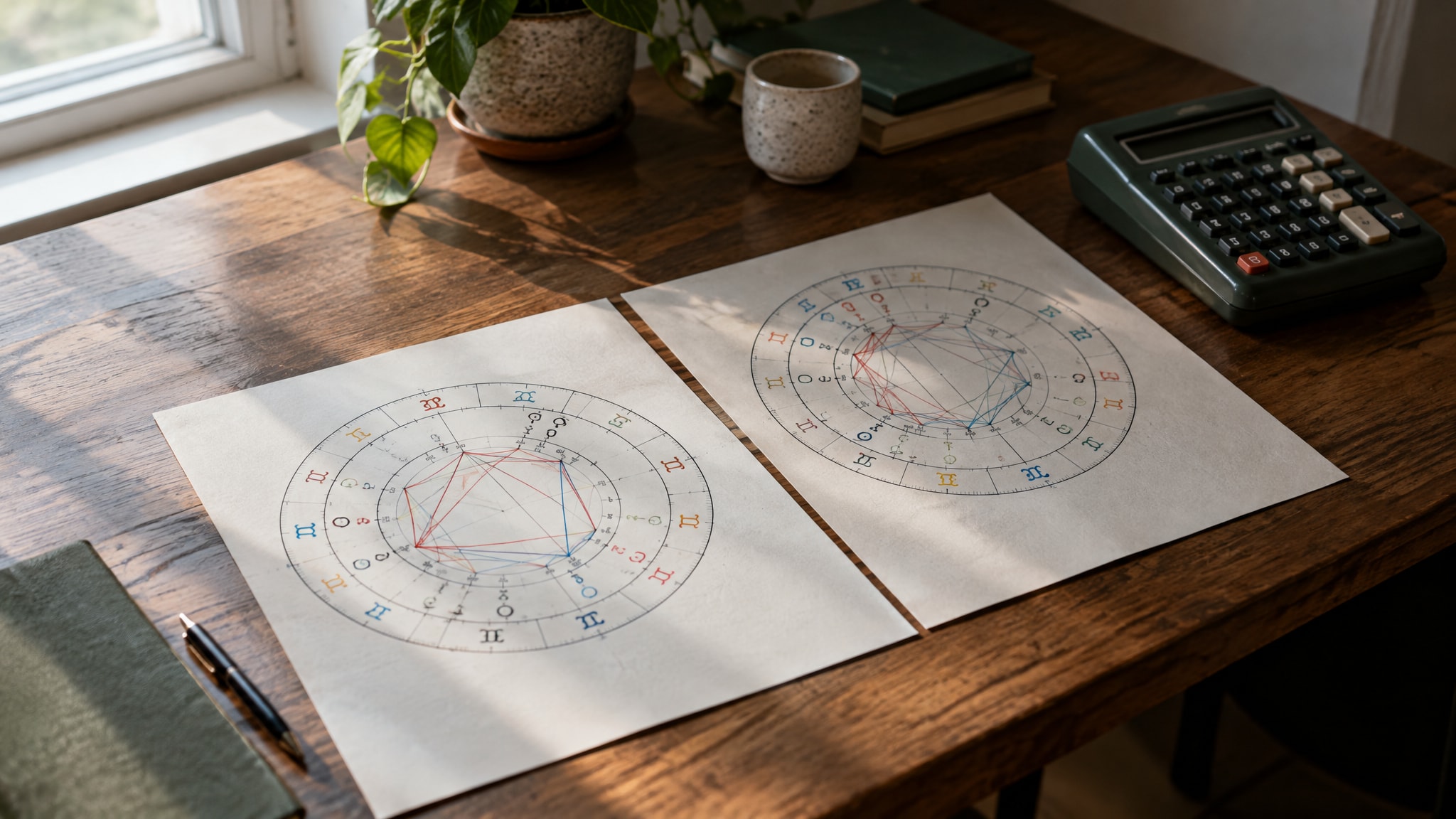
Two people, two birth charts, one question: how do we fit? The sky offers more than one way to answer it, and the right way depends on how deep the question runs.
This guide sets the quick compatibility test beside the full synastry report, so you can see what each one delivers before you choose.
A Quick Glance and a Full Reading
A quick compatibility test is a fast first look. A full synastry report interprets how both charts interact. The difference is depth and deliverables, not accuracy, and neither one predicts your future or decides your relationship.
Think of it as a ladder with three rungs, from lightest to fullest:
- A quick compatibility calculator. You enter two sets of birth details and receive a headline result in moments.
- The free personalized reading. This is the accessible starting point on Your Astral Life, and it begins with your own chart.
- The one-time synastry report. Both charts are set side by side and read together, with a written interpretation for the pair.
Each rung answers a different question. The calculator asks whether there is a pull. The report asks how two whole charts meet, and what that might mean for the two of you.
What a Compatibility Calculator Can and Can't Tell You
A quick check has real strengths. It is fast, it asks little of you, and it often works with less birth information than a full chart needs. If you have just met someone and only know their birthday, it gives you a light, low-commitment read on whether the two charts show an initial pull.
That is a fair use of a small tool, and there is no shame in it.
The limits are just as plain. A calculator usually compresses a pair into one number or one verdict, and a number cannot tell you why it landed where it did. You cannot see which placements drive the score, and you often cannot tell whether the result was written for your pair or pulled from a template line attached to a pair of signs.
It is also a sign-level read, which is only the first layer of a chart. If you want to see why, how Sun, Moon and Rising signs work together shows how much sits beneath a single sign.
Where a Headline Score Stops
Partners can share a Sun sign and still carry different Moon and Venus placements. A headline match cannot show that gap, because it never looks at the Moon or Venus at all. A full synastry report can set both charts side by side and show where those placements meet.
So a high score may hide friction, and a modest score may hide real warmth. The score is a doorway, not a room.
For a closer look at the gap between a headline and a true interpretation, read how a personalized reading differs from a generic app.
What a Full Synastry Report Adds
Synastry is the old craft of laying one chart over another and reading the contacts between them. Where a calculator gives you a verdict, a synastry report gives you the working: which planets touch, how, and what that means for two particular people.
It is built from two parts. One is the mechanics of the comparison. The other is the writing that turns those mechanics into something you can discuss over dinner.
How the Two Charts Meet, Planet by Planet
The report begins with positions. Planetary positions are computed in-house with NASA/JPL ephemerides, the same JPL data that astronomers use, so both charts come from one calculation engine. Nothing is stitched together from separate sources.
Then the two charts are set side by side. The report traces how each partner's personal planets meet the other's chart:
- Sun: the core of identity, and where each of you feels most like yourself.
- Moon: emotional needs and the texture of daily comfort.
- Venus: how each of you gives and receives affection.
- Mars: drive, desire and the way you each handle conflict.
Each contact is read in both directions, because your Venus touching their Moon is not the same story as their Venus touching yours. For a taste of this depth with one planet alone, see how a single Mars placement shapes drive and conflict.
This is also why the report needs accurate birth time and place for both partners. Those details set the angles and houses that are being compared, and a guessed birth time can shift them. If either of you does not know your birth time, find it first, perhaps on a birth certificate, before you buy.
A Written Reading Built for This Pair
Positions alone are a table of numbers. The second half of the report is the writing, an interpretation made for this pair rather than assembled from disconnected template text.
Interpretations are personalized and coherent, which is the brand's central distinction from generic sun-sign horoscopes. Each contact becomes context: where you naturally align, where you may pull against each other, and what each of you might notice.
The tone is that of a conversation tool. Nothing in it is a fixed prediction. A difficult contact describes a tendency you can work with, and a harmonious one is not a guarantee.
The Synastry Report and the Compatibility Calculator, Side by Side
Astrology compatibility tools differ most in how deep they go. Here is the grid, with the quick calculator described as a category, since many exist and they vary.
| Quick compatibility calculator | Full synastry report | |
|---|---|---|
| Scope | A headline result for the pair | Both full charts, compared contact by contact |
| Depth of interpretation | Often a score or a short template line | A written reading built for this pair |
| Birth details needed | Often just birth dates | Accurate birth time and place for both partners |
| Speed | Moments | A considered read, to be taken in at your own pace |
| Best suited to | Early curiosity, a first look | Serious commitment and shared decisions |
The free personalized reading sits between the two as your own starting point. It is where you meet your chart before you bring a partner into it.
The report is a one-time purchase, and its page lists its current price and contents. If cost is the sticking point, what a couples reading costs and what it is worth lays out the trade-off. And if you are weighing several products, what to look for in an astrology app for couples gives you a checklist to hold beside this grid.
One limit is worth stating. The report is not for anyone hoping to be told whether to stay or leave. It describes how two charts interact. It does not make the decision for you.
Which Compatibility Report Fits Your Relationship Stage
The best tool matches the question you are really asking. Early on, the question is light. Later, it carries weight, and the answer needs more than a headline.
Early Attraction: Start with a Quick Read
When you are newly drawn to someone, a quick read is usually enough. You are asking whether there is a spark worth following, and you probably do not yet know their birth time anyway.
A quick check answers that without asking much of either of you. Treat the result as a pleasant first look, and let the person in front of you do most of the telling.
Serious Commitment: When the Full Report Earns Its Place
The picture changes once real life is shared. Moving in together, merging finances, or planning the year ahead all depend on how two charts interact over time, not on a first impression.
In traditional astrology the Moon is linked with daily comfort and Saturn with long-term commitment. If you are weighing a move in together, the full report lets you see how those placements meet across both charts. A quick check cannot show that in the same depth.
That is the switch point. Choose depth when the question depends on how the charts work together over months and years. If you are among couples deciding whether to move in together, this is where the report repays the effort.
How to Read the Results Together
A result is most useful when you read it together, with curiosity rather than defence. Here is a sequence that works:
- Take the headline as a question. A score is a prompt, not a ruling.
- Use the full report to find the placements behind it. Look for the Moon, Venus, Mars or Saturn contacts that explain the pull or the friction.
- Test both against daily life. Notice together whether the words match what you actually live.
Because the report describes tendencies, you stay in charge of what to do with them. When a passage does not ring true, set it aside. The chart is a map you can check against the ground.
Turning the Headline into a Question
Suppose a quick check gives you a middling score. Do not read it as a warning. Ask what is behind it: is it a gap in how you each seek comfort, or in how you each handle disagreement?
The full report then lets you look for the answer in the actual contacts. Perhaps one partner's Moon sits far from the other's Venus. That is not a fault. It is a place where the two of you may need to say aloud what you each need.
Begin Free, Then Choose Your Depth
Create an account and begin with your free personalized reading. It is the accessible starting point, and it shows you how your own chart is read before any report or membership enters the picture. You can also start with a free birth chart reading to see the approach first.
When the question becomes about the two of you, the one-time synastry report is the step up. Here is what it delivers:
- Both birth charts set side by side
- A trace of how your personal planets meet
- A written interpretation built for your pair
- Positions computed in-house with NASA/JPL ephemerides
Have accurate birth time and place for both of you ready, and check the report page for its current price.
Frequently asked questions
Is a quick compatibility calculator less accurate than a synastry report?
Not in the sense of being right or wrong. The two differ in depth and deliverables. A calculator gives a headline read on a pair, while a synastry report traces how both charts interact and explains it in writing.
Do I need my partner's birth time for a synastry report?
Yes, accurate birth time and place for both partners are needed. Those details shape the angles and houses being compared, so a guessed time can change the reading. A quick calculator often works with less, sometimes just birth dates.
Can a synastry report tell us whether we should stay together?
No. It describes how two charts interact and where you may align or pull apart. It does not predict the future or decide the relationship, and it works best as a way to start conversations.
When is the quick read enough?
In early attraction, when you want a light first look and may not know your partner's birth time. Once you are moving in together, making shared decisions or planning the year ahead, the full report is the better fit.
Where should I start if I have never had a reading?
Create an account and begin with the free personalized reading. It is the accessible starting point before any one-time report or membership. When your question turns to the two of you, the synastry report is the step up.