How to Choose an Astrology Membership: What Matters
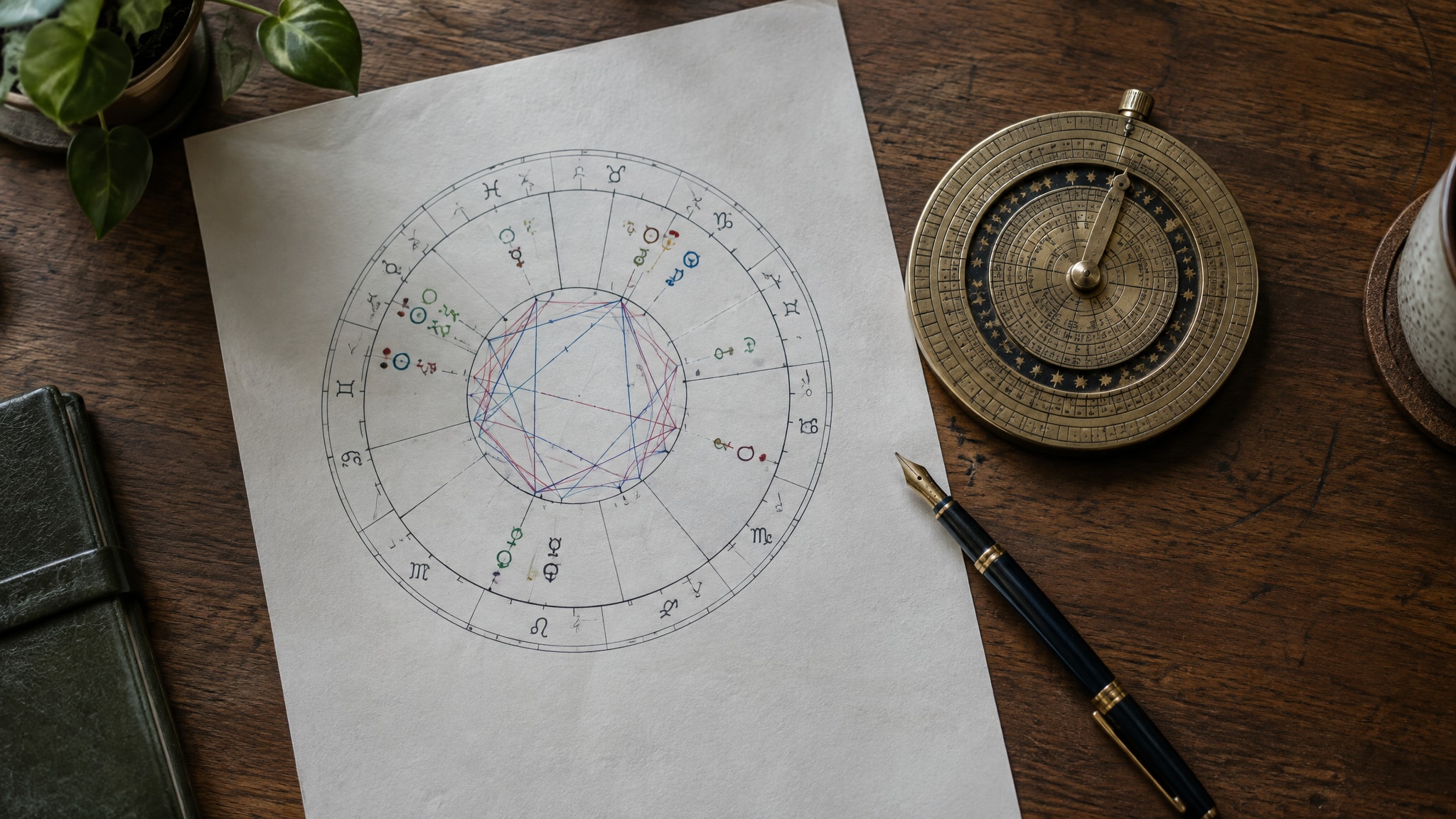
A birth chart is a map of the sky at the moment you arrived. A membership is a promise to keep reading that map with you, month after month.
Before you pay for that promise, it helps to know what it should contain. Most advice on how to choose an astrology membership lists apps and features. This guide does something quieter: it gives you three criteria you can test yourself, on your own chart, with no insider knowledge.
Choosing an astrology membership starts with the question you bring
No provider is best for everyone, because people arrive with different questions. Someone weighing a job change in the spring needs something other than someone who wants a steady companion through ordinary weeks, and a universal ranking cannot serve both.
Three formats answer three different needs:
- A free reading is a first look. It shows you how a provider interprets a chart, at no commitment.
- A one-time report is a single, deep reading. It suits one decision, one relationship or one yearly outlook.
- A recurring astrology reading service follows the sky as it moves and connects each change to your chart, so it suits steady tracking over months.
The membership is the right tool only when your question keeps changing with the calendar. If your question is fixed, a report usually does the work.
What to look for in an astrology subscription
Three criteria matter more than any feature list: personalization depth, update frequency and methodology transparency. A long menu of tools tells you little about whether a reading will feel true to your life.
You can test each criterion without knowing any astrology. The sections below show how.
Personalization depth: a reading built from your chart
The first test is whether the reading could only have been written for you. Many subscriptions skip this test, and the shortfall is easy to miss because the prose is pleasant.
Why sun-sign text falls short of a personal reading
A sun-sign paragraph reads the same for everyone who shares that Sun sign. Millions of people are told the same thing on the same morning, regardless of where they were born or what the rest of their sky looked like.
A chart-based reading works differently. It names your Moon sign and your rising sign, then explains how they shape the way your Sun shows up in one particular life. If you want to see how this plays out, read about how the Sun, Moon, and rising sign work together, and about how a personal reading differs from a generic horoscope app.
That difference matters more than any feature list. A provider can offer widgets, reminders and audio, but if the interpretation underneath is the same text for every Sun sign, those extras only decorate it.
Signs a personalized horoscope subscription reads your chart
Start with what the provider asks of you. A real chart reading needs your birth date, an accurate birth time and your birth place, because the rising sign and the house placements depend on the last two. A service that never asks for them cannot be calculating either.
Then read the first reading closely. These signs suggest your chart is actually in use:
- It mentions your Moon sign and rising sign, not only your Sun.
- It refers to houses, the twelve areas of life a chart divides into, and says which of them are emphasized for you.
- It connects separate placements into one account instead of listing them one by one.
- It would read differently for a friend born the same day in another city.
If you want to understand why the rising sign carries so much weight, why the ascendant anchors the rest of a chart explains it plainly. A provider that skips it gives you a thinner reading, however polished.
Update frequency: matching the rhythm to your questions
Updates are the heartbeat of a membership, and the right pace depends on what you ask of it.
Daily or weekly astrology forecasts: which pace suits your subscription
The Moon changes sign within a matter of days, while outer planets can take years to pass through a single sign. A daily feed and a long-range outlook therefore answer different questions, and a clear provider says which one each update gives you.
Daily updates track the fast-moving placements. They suit you if you like to plan your days around the sky, noting when to schedule a hard conversation or when to rest. Weekly or monthly updates suit a slower, more reflective pace, where you want themes to gather before you act on them.
Neither pace is better in itself. In the daily versus weekly astrology forecast subscription question, the honest answer is that a daily rhythm rewards people who will actually open it each morning, and a weekly one rewards people who prefer to think in longer arcs.
Be candid with yourself about habit. A daily subscription you stop reading by the second week is worth less than a weekly one you read with attention.
What makes an update worth reading
Frequency matters less than whether each update connects current transits to your own chart. A transit is simply a planet's present position set against your birth positions. Without that link, an update is weather for everyone.
So ask what changes between updates, and why. If Tuesday's text and Wednesday's text differ only in wording, nothing has moved. If they differ because the Moon crossed a sign and touched a house of yours, the difference has a cause you can follow.
Methodology transparency: the calculation behind every reading
Astrology is an interpretive craft, but the positions beneath it are arithmetic. A provider that respects you shows its arithmetic.
Questions to put to any provider about its method
A transparent provider should state three things without being pressed:
- Its planetary data source. Your Astral Life, for example, computes charts in an in-house engine from NASA/JPL ephemerides, so the positions behind a reading have a named source you can ask about. An ephemeris is simply a table of where the planets are at any given moment.
- Its house system. Systems such as Placidus and whole sign divide the chart differently, and the same birth data can place a planet in different houses depending on the choice. The house systems) are worth a glance before you compare two readings.
- Its zodiac. Western astrology usually uses the tropical zodiac, tied to the seasons, while Vedic astrology uses the sidereal zodiac, tied to the fixed stars. The difference between the two can move your Sun sign by one sign.
If a membership spans traditions, it should also tell you which one each reading follows. Western, Vedic and numerology are separate languages, and mixing them without saying so makes a reading hard to judge. For a sense of how they differ, see Vedic and Western approaches to accuracy.
Interpretations that show their reasoning
The calculation is half the story. The other half is the writing.
A good interpretation tells you why a placement matters. It does not announce that this month brings tension in your work; it says which planet is touching which part of your chart, and what that placement has traditionally meant. You can then weigh the claim for yourself.
Ask one more practical question: how is your birth data stored? Your birth time and place are personal, and a provider should say plainly what it keeps and why.
Use a free reading to test the fit before you subscribe
You do not have to take any of this on trust. A free personalized reading is the trial, and you can run it before spending anything.
Your Astral Life offers one as its starting point, with one-time reports and recurring memberships available afterward. If you would like to try the criteria above on your own chart, start with a free birth chart reading and subscribe only once it feels specific to you.
What a free reading should show you before you pay
Judge it on three things: specificity, tone and coherence.
Specificity. Does the reading name details that belong to your chart, not just your Sun sign? Can you see the Moon, the rising sign and at least one house at work?
Tone. A reading should leave you steadier, not anxious. Language that frames the chart as a tool for self-understanding and personal choice is a good sign, and language that dictates what will happen to you is not.
Coherence. Read it start to finish. Do the parts argue with each other, or do they build one account of a person? Disconnected template text often contradicts itself in the second paragraph.
A free reading cannot show you how a membership feels across months. It shows you how the provider thinks, and that is the part you cannot repair later.
Is an astrology membership worth it?
It is worth it when the total recurring cost is smaller than the value of the questions you will actually bring. Add up a year of payments, then count how many times you would genuinely open the updates and act on them.
If you picture yourself checking in weekly, asking what a transit means for a decision you are living through, a membership earns its place. If you picture yourself reading once and filing it away, it does not.
No membership can tell you what will happen. At best it gives you a vocabulary for what you are already weighing, which is useful but different from an answer.
Membership or one-time report: matching commitment to the question
A one-time report suits a single decision, a relationship you want to understand or a yearly outlook. You pay once, read slowly and return to it whenever you like.
A membership suits steady tracking: the changing weeks, the transits that touch your chart in sequence, the sense of a rhythm you follow rather than a snapshot. For a benchmark on the one-off side, see what a professional reading typically costs.
If you are unsure, begin with the free reading, then a report. Move to a membership when you notice yourself wanting the next update.
Red flags and a pre-subscription checklist
Some warning signs are clear enough to spot before you enter a card number:
- Fixed-outcome promises. Any provider that guarantees what will happen to you has stopped doing astrology and started selling certainty.
- Identical text for every sign. If friends with different charts receive the same paragraph, no chart was consulted.
- Endorsements that say nothing about method. Praise from a famous name or a star rating tells you about marketing, not about the calculation.
- Pressure to upgrade. Countdown timers and warnings that you are about to miss something are a sales tactic, not part of a reading.
Readings should be tools for self-understanding and personal choice rather than fixed predictions. Hold every provider to that standard, including the one you end up choosing.
Before you subscribe, answer these as yes or no:
- Does it ask for my birth date, time and place?
- Does the reading name my Moon sign, rising sign and houses?
- Does each update connect current transits to my own chart?
- Does it state its planetary data source, house system and zodiac?
- Does each interpretation explain why a placement matters?
- Does it say how my birth data is stored?
- Did a free reading feel specific to me, in a tone I trust?
- Does the pace of updates match the questions I actually have?
Five or more yes answers means the provider is worth a closer look. Anything less, and you can keep your money. When you are ready, a free personalized reading from Your Astral Life is a calm place to run the checklist on your own sky.
Frequently asked questions
What is the best website for astrology?
There is no single best site, because the right one depends on your question. A site that shows its planetary data source, house system and zodiac, and writes from your full chart, will serve most people better than one that ranks highest in a list. Test two or three with a free reading and compare how specific each one feels.
What is the luckiest house in astrology?
No house is lucky on its own, and traditions disagree. Hellenistic astrology calls the fifth house Good Fortune and the eleventh Good Spirit, while many modern astrologers point to the eleventh or ninth. What matters more is which planets sit there and how they connect to the rest of your chart.
Can I get a personal reading if I don't know my birth time?
You can still get a Sun and Moon reading in most cases, though the Moon can shift sign on a day when it changes. The rising sign and house placements cannot be calculated reliably without a birth time, so a chart-based reading will be thinner. A birth certificate or a family record is the best place to find the time.
Should I choose Western or Vedic astrology for a membership?
Choose by the question and the language that speaks to you. Western astrology uses the tropical zodiac and leans toward psychology and personal growth, while Vedic astrology uses the sidereal zodiac and has a strong tradition of timing periods. Whichever you pick, the provider should say which system each reading follows.