Birth Chart Reading for Beginners
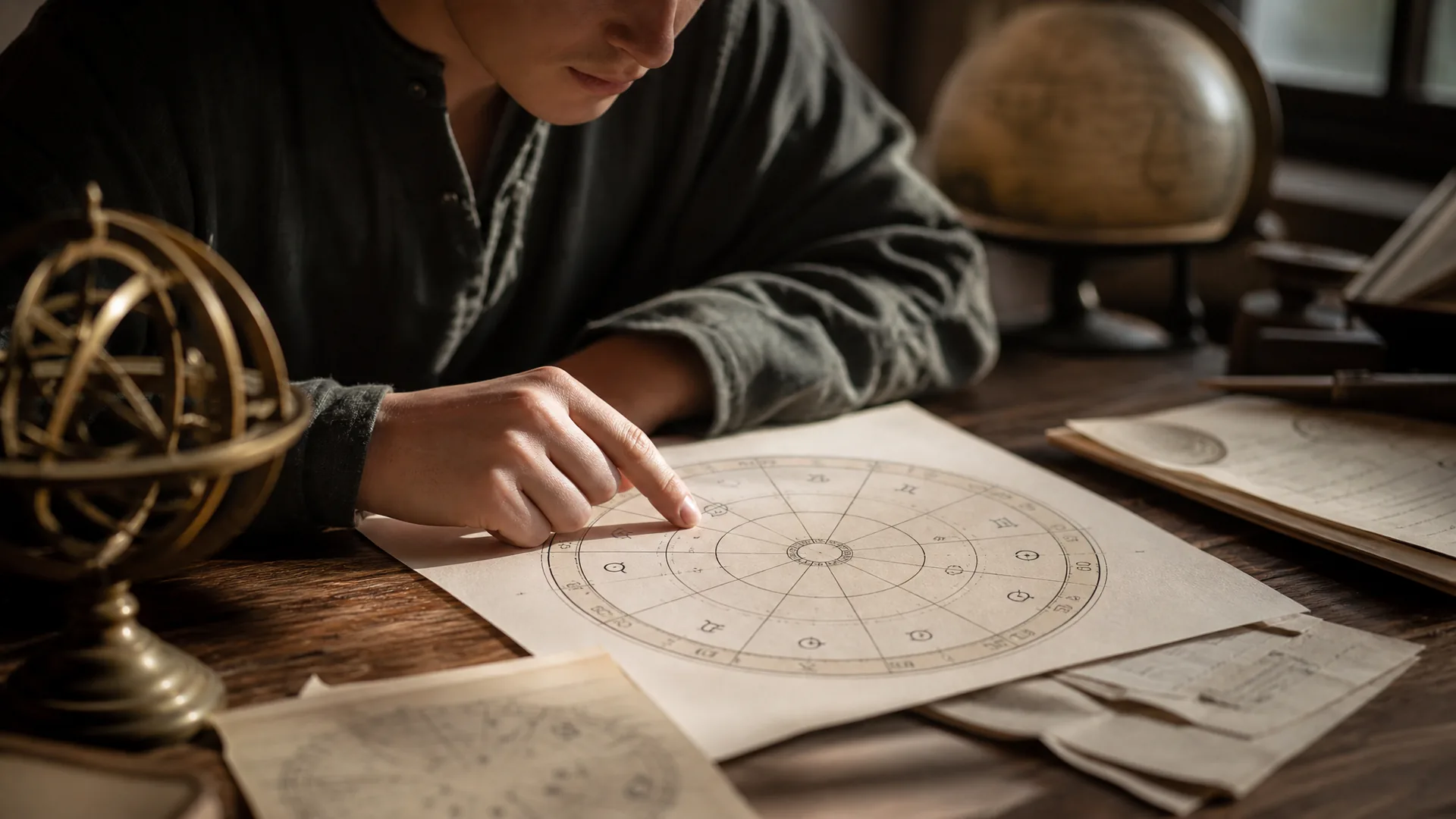
Most beginner guides to astrology drop you into a sea of glyphs, degree numbers, and Latin house names and expect you to swim. This guide does the opposite. Birth chart reading for beginners starts with one simple idea: your natal chart is a circular map of the sky at the exact moment you were born, and every symbol on it answers one of four questions. Learn those four questions and you can read any chart, including your own.
To generate a chart, you need three pieces of information: your birth date, your birth time, and your birth location. All three matter. Two people born on the same day but in different cities, or even different hours apart, can have noticeably different charts.
What Is a Birth Chart, and Why Does It Matter?
Birth chart explained: a snapshot of the sky at your birth
Picture the solar system as a clock face, frozen at the second you arrived. A birth chart, also called a natal chart, captures that freeze-frame and projects it onto a circular wheel divided into twelve segments.
Every planet had a position in that sky. The chart records where each one was, which zodiac sign it occupied, and which segment of the wheel it fell into. That combination produces something no horoscope column can replicate: a map that belongs to you alone.
A sun-sign horoscope groups everyone born in a 30-day window together and hands them the same forecast. Your natal chart is the opposite. Two people can share the same Sun sign, say, both Aries, yet have completely different charts if their Rising signs, Moon placements, and planetary distributions differ. One Aries might be emotionally private with a Scorpio Moon; another might be outwardly bold with a Sagittarius Rising. The full chart sees both; a newspaper column sees neither.
Your Astral Life casts charts to the arcsecond of precision using your birth time, date, and place, the same three inputs that separate a personalised natal chart from a generic reading.
How to Read a Natal Chart: The Four-Layer Framework
Most beginners stall because they try to absorb everything at once. Instead, read your chart in four ordered layers. Each layer adds meaning to the one before it.
Layer 1, Planets: the 'what'
Planets are the actors. Each one represents a specific drive or function in your life, desire, communication, ambition, emotion. When you see a planet in your chart, ask: what part of me is this describing?
Layer 2, Signs: the 'how'
Signs are the costume each actor wears. They describe the style, tone, and flavour with which a planet expresses itself. Mars in Capricorn acts very differently from Mars in Aries, even though both are the same planet.
Layer 3, Houses: the 'where'
Houses are the stage. Each of the twelve houses governs a specific life arena, career, home, relationships, money, and so on. A planet's house placement tells you which area of life it most directly influences.
Layer 4, Aspects: the 'relationship'
Aspects are the angles planets form to one another. A tight angle between two planets means they interact, sometimes cooperatively, sometimes with friction. Beginners don't need to master aspects right away, but knowing they exist helps explain why a chart feels like more than the sum of its parts.
Worked example, Venus in Scorpio in the 7th house:
- Planet (what): Venus governs love, beauty, and what you value.
- Sign (how): Scorpio filters Venus through intensity, depth, and a hunger for emotional truth.
- House (where): The 7th house is the arena of committed partnerships.
- Put it together: this person brings deep, all-or-nothing energy to their closest relationships. They don't do surface-level. They crave genuine intimacy and may take time to trust, but when they do, they are fiercely loyal. One placement, three layers, a coherent story.
Planets, Signs, and Houses Explained (Quick-Reference Guide)
The ten planets and what they represent
| Planet | Core theme |
|---|---|
| Sun | Identity, vitality, core self |
| Moon | Emotions, instincts, what makes you feel safe |
| Mercury | Communication, thinking, learning |
| Venus | Love, beauty, values, pleasure |
| Mars | Drive, action, desire, anger |
| Jupiter | Growth, expansion, luck, wisdom |
| Saturn | Structure, discipline, limits, mastery |
| Uranus | Innovation, disruption, freedom |
| Neptune | Dreams, intuition, dissolution, illusion |
| Pluto | Transformation, power, depth, endings |
Modern astrology includes the Sun and Moon in this list alongside the eight planets for practical reading purposes.
The twelve signs as flavours and drives
| Sign | Element | Core flavour |
|---|---|---|
| Aries | Fire | Bold, initiating, competitive |
| Taurus | Earth | Steady, sensory, persistent |
| Gemini | Air | Curious, adaptable, communicative |
| Cancer | Water | Nurturing, protective, intuitive |
| Leo | Fire | Creative, expressive, generous |
| Virgo | Earth | Analytical, precise, service-oriented |
| Libra | Air | Harmonious, relational, fair-minded |
| Scorpio | Water | Intense, investigative, transformative |
| Sagittarius | Fire | Expansive, philosophical, freedom-seeking |
| Capricorn | Earth | Ambitious, disciplined, strategic |
| Aquarius | Air | Independent, humanitarian, innovative |
| Pisces | Water | Empathic, imaginative, boundary-dissolving |
The twelve houses as life arenas
| House | Life arena |
|---|---|
| 1st | Self, appearance, first impressions |
| 2nd | Money, possessions, self-worth |
| 3rd | Communication, siblings, local travel |
| 4th | Home, family, roots, the past |
| 5th | Creativity, romance, play, children |
| 6th | Health, daily routines, service |
| 7th | Partnerships, marriage, open enemies |
| 8th | Shared resources, transformation, death and rebirth |
| 9th | Philosophy, higher education, long-distance travel |
| 10th | Career, public reputation, authority |
| 11th | Friends, community, hopes and visions |
| 12th | Hidden matters, solitude, the unconscious |
What Does My Birth Chart Mean? Reading Your Big Three First
Before diving into all ten planets, start with the Big Three: your Sun sign, your Moon sign, and your Rising sign (also called the Ascendant).
Sun sign, where the Sun was at your birth. This is your core identity, your conscious sense of self, the story you're here to live out. It's the placement most people already know from horoscope columns.
Moon sign, where the Moon was. This governs your emotional nature: what makes you feel safe, how you react instinctively under pressure, and what you need to feel nurtured. Many people find their Moon sign describes their inner life more accurately than their Sun sign does.
Rising sign, the zodiac sign climbing above the eastern horizon at the moment of your birth. It shapes your outward manner, your appearance, and the first impression you make on others. Two people with the same Sun and Moon signs but different Rising signs will come across very differently in the world.
Together the Big Three give you a working portrait: who you are inside (Sun), how you feel (Moon), and how others meet you (Rising). Think of it as a sketch before you add detail, complete enough to be useful, simple enough not to overwhelm.
The Big Three are a starting framework, not the full picture. Once they feel familiar, every other placement deepens and nuances what they reveal.
Astrologers often describe the natal chart as a map, not a mandate, it shows tendencies and timing windows rather than fixed outcomes. That framing makes the whole exercise feel empowering rather than fatalistic, especially for newcomers.
Birth Chart Symbols Guide: Decoding the Glyphs
Look at a natal chart for the first time and it can resemble an engineer's blueprint, concentric circles, intersecting lines, and small symbols scattered at odd angles. Here's what you're actually seeing.
The wheel is divided into twelve segments (the houses). The cusp, the starting line, of each house is marked with a degree number, usually followed by the glyph of the sign that begins that house.
Planet glyphs are shorthand symbols for each planet. A few are immediately recognisable: ☀ for the Sun, ☽ for the Moon, ♀ for Venus, ♂ for Mars. Others take a little memorisation, but most chart tools label them with text on hover or in a key alongside the wheel.
Sign glyphs appear at the house cusps and next to each planet. ♈ is Aries, ♉ is Taurus, and so on through ♓ for Pisces. You'll find a full glyph key in any chart legend.
Degree numbers tell you exactly how far through a sign each planet sits, from 0° (just entered) to 29° (about to leave). The number matters for precise interpretation but isn't essential for your first read.
Aspect lines are the coloured or dashed lines drawn across the centre of the wheel, connecting planets that form significant angles. Blue or green lines typically represent harmonious aspects (trines, sextiles); red lines usually signal tension (squares, oppositions). They're the last layer, not the first, don't let them slow you down before you've found your Big Three.
Getting Your First Free Natal Chart (and What to Do Next)
The fastest way to apply everything above is to hold your own chart in front of you. You can generate your natal chart instantly, and reading at Your Astral Life. Enter your birth date, time, and location and the chart appears within seconds, no subscription, no credit card.
Once you have it, work through the four layers in order:
- Find your Sun, Moon, and Rising, your Big Three, and read those placements first.
- Locate each planet and note which sign it's in.
- Check which house each planet occupies.
- When aspects feel approachable, look at the lines connecting your planets and explore which ones are in conversation.
When the natal chart feels familiar, natural next steps include transit readings, which show how current planetary movements interact with your birth placements, and solar return charts, which map the sky at the exact moment the Sun returns to its natal degree each year, giving a portrait of the year ahead.
The free birth chart & reading on Your Astral Life supports all of these, but there's no pressure to rush there. The natal chart itself rewards slow, curious reading. Start with your Big Three, return when you're ready, and let the map reveal itself layer by layer.