How Accurate Are Birth Chart Readings?
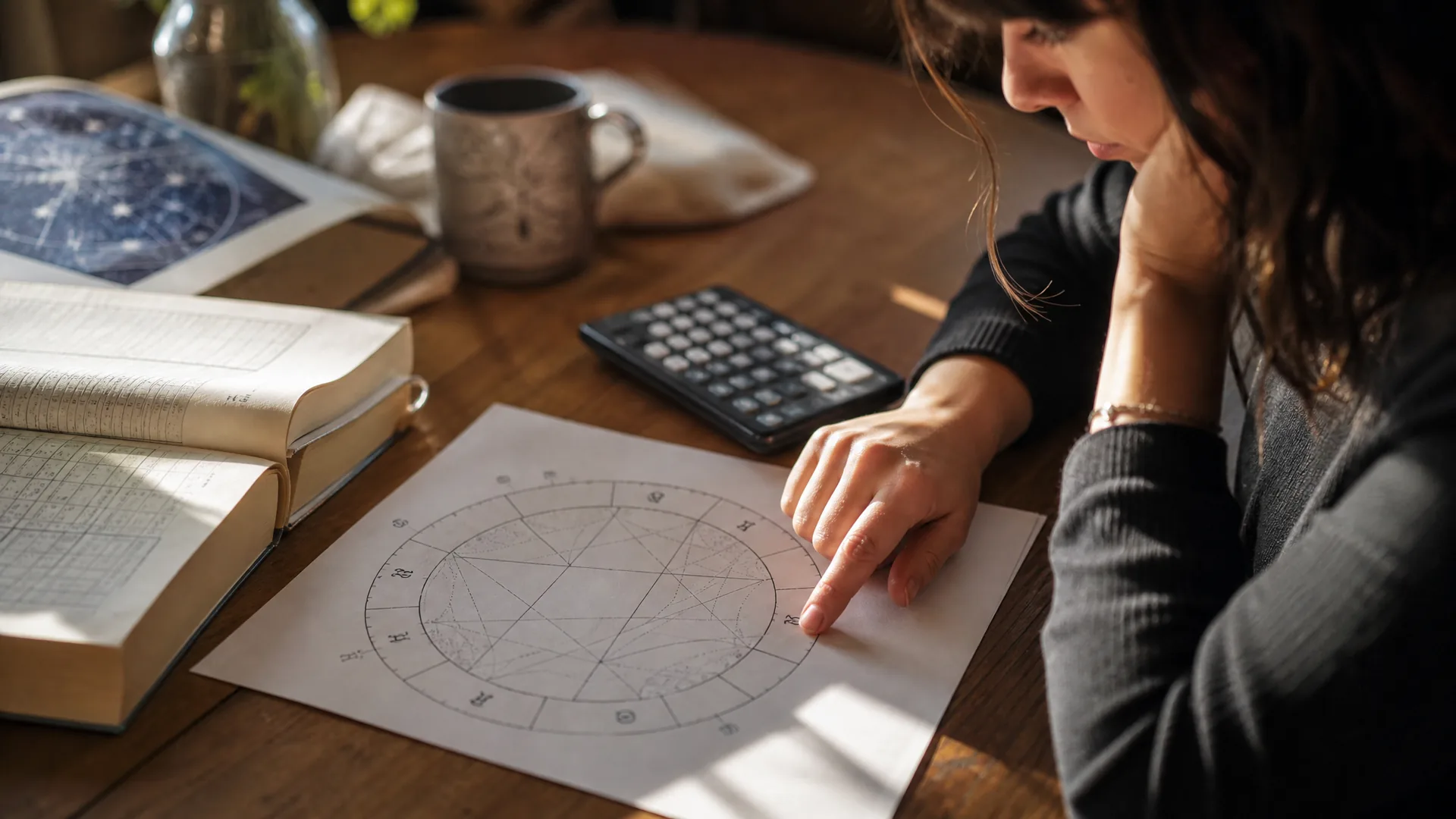
You want to know if your chart is real, or just a comforting story arranged in a pretty wheel. It's a fair question. Most answers online come from one of two camps: the debunker who dismisses the whole practice, or the enthusiast who insists every word is destiny. Neither is honest about what accuracy actually means here. So let's talk about how accurate birth chart readings really are, without flinching and without cheerleading.
What "Accuracy" Actually Means in Astrology
There are two separate questions hiding inside the word "accurate," and conflating them is where most of the confusion starts.
The first is mathematical: was your chart calculated correctly for the exact place and moment you were born? This is a matter of astronomy, geography, and arithmetic. There's a right answer, and it can be verified.
The second is interpretive: does the reading of that chart feel true to who you are? This is a matter of psychology, symbol, and self-recognition. It can't be checked against a table of numbers.
Precision of Calculation vs. Truth of Interpretation
A chart can be perfectly precise and still be interpreted badly. A chart calculated from a rounded, careless birth time can still produce interpretations that feel eerily accurate, just by chance or by the reader's own openness to pattern-matching. That's why serious astrology insists on getting the calculation right first. You can't judge the truth of an interpretation fairly if the chart underneath it was never accurate to begin with. This piece focuses mostly on that first sense, because it's the one you can actually verify, and it's the foundation everything else stands on.
Birth Chart Accuracy Starts With Birth Time Precision
Ask any astrologer what they need from you, and birth time will be near the top of the list, right alongside date and location. That's not a formality. It's the single most consequential piece of data in the whole chart.
Why Arcsecond Precision Matters
The planets and the horizon are always moving against each other, and astrology tracks that movement down to the arcsecond, a unit of measure so fine it's normally reserved for surveying and astronomy, not personality profiles. That rigor exists because the sky doesn't hold still. The Moon, the Ascendant, and the house cusps are all shifting continuously across the day. A chart cast to the arcsecond is simply one that hasn't rounded any of that movement away.
How a Few Minutes Can Change Your Whole Chart
The Ascendant, the point of the zodiac rising on the eastern horizon at your birth, moves through the entire zodiac roughly once every 24 hours. That means it can shift into a new zodiac sign roughly every two hours on average. A birth time off by just 15 to 20 minutes can be enough to nudge your rising sign or move a house cusp across a boundary.
Two people born on the same day in the same city, forty minutes apart, can end up with entirely different rising signs and house placements. That's not a minor footnote. It changes the interpretive framework of the entire chart, because the houses organize everything else, career, relationships, home, identity, around that one time-sensitive axis.
The planets' positions by sign move far more slowly, over days or weeks rather than minutes. If you only know your birth date, your Sun, Moon, and most planetary signs will usually still be right. It's specifically the Ascendant and the house cusps that demand precision.
Natal Chart vs. Sun-Sign Horoscope: A Precision Comparison
This is where the difference between a fun horoscope and a real reading becomes obvious.
A sun-sign horoscope is written for everyone born under the same sign, an average across roughly one-twelfth of the population. It has to speak broadly enough to apply to millions of different lives, so by design it can only ever be a loose sketch.
A full natal chart is built from your exact birth time, date, and place. It maps the position of every planet, the rising sign, and all twelve houses as they stood at that specific moment, for you alone. No one else, not even someone born the same day in the same hospital an hour earlier, will have an identical chart.
If you've never seen the difference for yourself, you can generate your own precise birth chart for free and compare it to whatever sun-sign column you've read this week. For readers newer to the subject, working through birth chart reading for beginners is a natural way to start learning what all those placements actually mean.
How Precise Is Astrology When Your Birth Time Is Unknown or Approximate
Not everyone has a birth certificate with the time recorded, and not everyone's parents remembered to write it down. If that's you, you're not out of options, but you should know what you're working with.
Estimating a Birth Time
Some astrologers offer rectification, a process of working backward from major life events to narrow down a probable birth window. It's laborious and imperfect, but it can get you closer than a guess. Failing that, hospital records, family recollection, or even a rough range like "sometime in the morning" beat nothing, since they at least narrow the pool of possible Ascendants and house arrangements.
What Changes If You're Off by an Hour
An hour of uncertainty is enough to put your Ascendant in a neighboring sign and shuffle your house cusps meaningfully. What it does not touch is your Sun sign, your Moon sign in most cases, and the sign placements of the outer planets, since those move slowly enough that an hour rarely matters. Until you have a firmer birth time, it's reasonable to treat those slower-moving placements as trustworthy, and to hold the Ascendant and house-based interpretations more loosely.
How an Accurate Natal Chart Calculator Works
A trustworthy calculator isn't just plugging your birthday into a lookup table. It's doing real astronomical work behind the scenes.
- Geolocation: converting your birth city into precise latitude and longitude, since the horizon and house angles depend on exactly where on Earth you were standing.
- Time zone and daylight saving correction: adjusting your local birth time to Universal Time, accounting for historical time zone rules and daylight saving changes in effect on your specific birth date.
- Ephemeris lookups to the arcsecond: querying precise astronomical tables for the position of every planet at that converted moment, rather than interpolating loosely between rounded hourly positions.
This is what separates a genuinely accurate natal chart calculator from an app that rounds you to the nearest hour or, worse, defaults everyone to noon when a time is missing. Your Astral Life casts every chart to the arcsecond, using your exact birth time, date, and location rather than rounding it away. Because it requires no account to generate a first chart, you can test how sensitive your own placements are to small time changes before you decide whether to go further. No credit card required either.
Putting Chart Accuracy Into Practice
Once you understand why exact timing matters, the practical path is simple: get your birth certificate or ask family members who were present, enter it as precisely as you can, and treat any placement built on an uncertain time with appropriate skepticism until you can confirm it.
When to Go Deeper Than the Free Chart
A precise natal chart is the foundation, but it's also the starting point for everything else astrology offers. Transits, the ongoing movement of current planets against your natal chart, depend on that same exact foundation, and you can see how planetary transits are calculated to understand why. Synastry, the comparison of two people's charts for compatibility, is even more sensitive to timing errors, since it's comparing two sets of precise angles against each other; compatibility readings that go beyond sun signs and synastry reports built on exact chart data both rely on that same arcsecond-level care. Solar returns, birthday-based forecasts, follow the same rule.
Accuracy compounds. The more precisely your foundational chart is cast, the more reliable every reading built on top of it becomes. If you've been reading sun-sign horoscopes and wondering whether there's something more exact underneath them, the only real way to find out is to look at your own sky, cast correctly, and see what it says.