Vedic Vs Western Astrology Birth Chart: Two Skies, One You
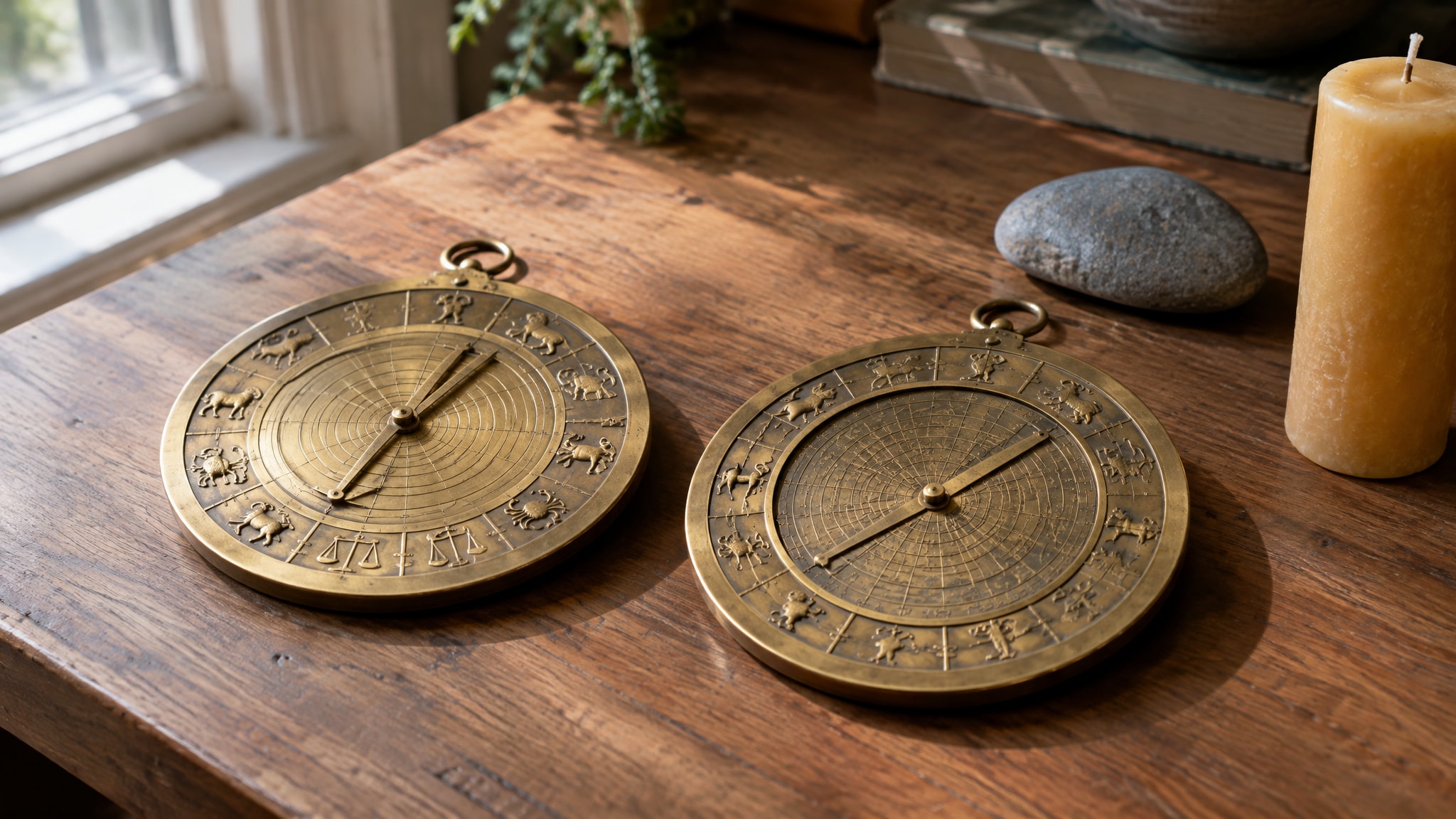
You were born under one sky. Yet ask two astrologers to read it, one trained in the Western tradition and one in the Vedic, and they may name your Sun sign differently, open with a different planet and tell the story in a different order.
That can feel like a contradiction. It is closer to a choice of lens, and the right first lens depends on the question you carry today.
This guide sets the two birth charts side by side, shows what each answers best and helps you decide which to order first.
Sidereal vs Tropical Zodiac: Where Each One Begins
"Two skies" is a figure of speech. Both traditions read the same planets, moving through the same heavens, from the same birth moment. They differ first in where they start counting.
The zodiac is a belt of twelve 30-degree signs. Each system pins the start of that belt, 0° Aries, to a different anchor. The gap between the two anchors is called the ayanamsa.
Tropical Zodiac: Anchored to the Seasons
Western astrology uses the tropical zodiac. Its starting point is the March equinox, when day and night are roughly equal in length. Aries begins there, every year, by definition.
The tropical zodiac follows the Sun's relationship to Earth's seasons, not the constellations behind it. Over centuries, Earth's axis wobbles slowly, so the stars drift against the equinox. The tropical signs stay with the seasons and let the stars drift.
For you, this means Western signs describe a cycle of light and growth. Many readers find that fitting for questions about temperament, motive and the way you relate to others.
Sidereal Zodiac: Anchored to the Fixed Stars
Vedic astrology, known as Jyotish, uses the sidereal zodiac. It measures the signs against the fixed stars, so the belt stays aligned with the sky's own background.
Because the two zodiacs started together roughly 1,700 years ago and have slowly separated, the offset is now about 24 degrees. Vedic schools do not all apply the same ayanamsa, and Lahiri is one widely used choice. A few degrees of difference between schools rarely changes a sign, but it can shift a planet sitting near a boundary.
The Sun moves about one degree a day. A 24-degree offset therefore moves it back by roughly three and a half weeks. Picture someone who has always known herself as a tropical Libra. In the sidereal zodiac, her Sun may well sit in Virgo, the sign before.
This is not an error in either system. It is the same moment described from a different starting line, and the difference between the two zodiacs is simply a matter of reference point.
Vedic and Western Birth Charts Side by Side
Open each chart and the difference is visible before you read a word. The Western chart is a circular wheel, with the signs around the rim and the houses divided inside it. A Vedic chart is usually drawn as a square. North Indian charts use a diamond layout, South Indian charts a fixed grid of twelve boxes.
The houses work differently too. Vedic charts most often use whole sign houses: the sign that rises becomes the first house in full, and each following sign becomes the next house. Western astrologers choose among several systems, such as Placidus, Koch and whole sign, in which house cusps fall at unequal points depending on the latitude of your birthplace.
Emphasis shifts as well. A Western reading most often leans on the Sun and the rising sign, with the Moon close behind. A Vedic reading puts the Moon at the centre. Your Moon sign, and the nakshatra the Moon occupied at birth, set the tone. A nakshatra is one of 27 lunar mansions, each spanning 13°20′ of the zodiac.
Both charts depend on the rising sign. If you want to see why the ascendant anchors the whole chart, it comes down to this: the rising sign sets the house layout, and the house layout shapes where each planet speaks.
So the same person gets two portraits. One is drawn in the colours of the Sun and the rising sign, the other in the colours of the Moon and its lunar mansion.
Different Questions Each Tradition Answers Best
Neither chart is a better picture of you. Each is built to answer a particular kind of question, and you will get more from a reading when you match the two.
Western Astrology: Inner Patterns and Relationships
Modern Western astrology grew up alongside psychology. It is most often used for self-understanding: why you react the way you do, what drives your ambition, how you love and where you hold back.
Its strengths are the inner landscape and the dynamics between people. The aspects between planets read like tensions and harmonies within a single character. Synastry, the comparison of two charts, does the same for relationships. If you want to see which lens fits relationship questions, that guide takes the comparison further.
This approach does not hand you a timetable. It describes tendencies and themes, and what you do with them stays yours.
Vedic Astrology: Karma and Dasha Timing
Jyotish is traditionally framed around karma and the timing of life periods. Here, karma is best understood as recurring pattern and context: the themes you carry in, and the conditions in which they tend to surface. It is not a sentence passed in advance.
The tool for timing is the dasha system. The most widely used, Vimshottari, divides life into planetary periods across a 120-year cycle, and your starting point is set by the Moon's nakshatra at birth. Each period, with its sub-periods, colours a stretch of years with the themes of one planet.
If you are asking when a chapter might open or close, such as a move, a career turn or a season of rest, this is where Jyotish is at its most distinctive. A dasha reading lights the weather of a period. It does not tell you what you will do in it.
Which Astrology System Is More Accurate?
Neither tradition is more accurate by default. The question mixes two separate things, and it helps to pull them apart.
Both traditions have long histories, so age settles nothing. Scholars still debate the exact origins of each, including how much each borrowed from older Mesopotamian and Hellenistic sources. A tradition being older does not make it more useful to you, and a newer style of reading is not automatically shallower.
Calculation Precision Versus Interpretive Fit
Precision is a calculation standard, and you can check it. It rests on three things: exact birth data, the ephemeris that places the planets and, for Vedic work, the ayanamsa that shifts them into the sidereal zodiac.
Your Astral Life computes chart positions in-house, using the NASA/JPL ephemerides, and offers both Western and Vedic charts on the one platform. Ask any provider which ayanamsa it applies. A clear answer is a fair test of transparency.
Fit is another matter, because it depends on the question you bring. A chart can be computed to the arc-second and still feel wrong if it answers a question you were not asking.
Neither system promises predictive certainty, and a good reading never should. For a fuller look at accuracy in each system, the dedicated comparison goes into the detail.
Reading Both Charts for Yourself
Yes, you can read both, and many people do. Because the charts answer different questions, they work best as complementary lenses, not rival verdicts.
Think of two maps of one city: one shows the streets, the other the transit lines. Neither is wrong, and you would not choose between them for life.
Holding Two Lenses at Once
The method is simple and unhurried. Read the chart that matches your current question first. Sit with it until it feels familiar.
Then open the second chart and look for two things. Note where it echoes the first: a theme that shows up in both, perhaps a restlessness, a gift for teaching or a pull toward solitude. Note where it diverges too, because the gaps are often the most interesting part. A Western Sun in one sign and a sidereal Sun in the previous one will not contradict each other. They will emphasise different sides of one character.
One caution: do not expect the two to agree line by line. They use different zodiacs, different houses and a different centre of gravity. Agreement on a theme means more than agreement on a label.
Choosing Between Vedic and Western Astrology
You do not need to settle this in the abstract. Choosing between Vedic and Western astrology comes down to the question you are carrying right now.
Start With the Western Chart for Inner Patterns
Begin here if your question is about the self. Perhaps you keep meeting the same conflict in love, or you want words for how you work, rest and decide.
Western astrology gives you a vocabulary for temperament and relationships. It suits a reader who wants insight to reflect on, not a schedule to follow.
Start With the Vedic Chart for Life Timing
Begin here if your question is about when. Perhaps you are weighing a change of city or career, or you want to understand why one stretch of years felt so different from the last.
The dasha cycles give Vedic astrology a built-in sense of timing, and the Moon-centred chart often resonates with readers who want a karmic, long-view reading. It is not a fit if you want a single clear answer to a yes-or-no decision. It frames periods, not verdicts.
Numerology is a third lens. It reads your birth date and name as numbers, and it can be a gentler entry point for some people. If you are still deciding between the two, numerology or astrology, which to try first has its own guide.
The easiest first step costs nothing. You can start with a free birth chart reading, see how the approach feels, and then choose a one-time report or a membership in the system that matches your question. Adding the second chart later is a perfectly normal path. For the figures, here is what a personalized reading costs.
Vedic Chart Reading Online: What to Prepare
A precise chart needs three facts, in either system: your birth date, your birth time and your birthplace. The date gives the Sun and the slower planets. The place fixes the horizon, and the time decides how the sky was turning above it.
Timing errors matter most for the rising sign and the houses. The ascendant changes sign roughly every two hours, so a birth time that is off by thirty minutes can move a planet into a different house, and an error of an hour or two can change the rising sign altogether. The Moon travels about 13 degrees a day, so a vague time can also blur your Moon's degree and nakshatra, which matters most in a Vedic reading.
Find your time on a birth certificate or hospital record if you can. Family memory is a reasonable second source. If you only know the time approximately, say so, and treat house-level details with care. Time-sensitive details are the first to loosen when the hour is uncertain.
Your chart is only as exact as the moment you give it. If you want a way to check any service before you order, here is how to judge a chart platform's precision.
When your details are ready, the next step is a quiet one. Enter them for the free personalized reading, and see which sky speaks to your question first.
Frequently asked questions
Is Western or Vedic astrology more accurate?
Neither is more accurate by default. Accuracy of calculation depends on exact birth data, a reliable ephemeris and, for Vedic charts, the ayanamsa applied. Whether a reading feels accurate depends on whether it answers the question you brought.
Which astrology birth chart is most accurate?
The most accurate chart is the one computed from your exact birth date, time and place with a transparent method. That holds in both systems. A Western chart and a Vedic chart will differ in zodiac and houses, but each can be precise when the data and calculation are sound.
Which is older, Vedic or Western astrology?
Both traditions have long histories, and scholars still debate the exact origins of each, including how much they borrowed from older sources. Age does not make one more useful than the other. Choose by the question you want answered.
Will my Sun sign change in a Vedic chart?
For most people, yes. The sidereal zodiac sits about 24 degrees behind the tropical one, so a Sun in the early part of a tropical sign usually falls in the previous sign in a Vedic chart. Both are valid in their own system.
Do I need my exact birth time for a chart?
A date and place give you the planets in their signs, but the rising sign and houses need the time. A small error can shift them, and in Vedic work it can also affect the Moon's degree. Check a birth certificate or hospital record if you can.